Eight Dominoes
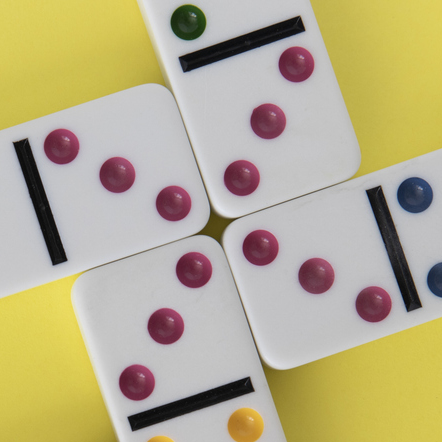
Using the 8 dominoes, can you make a square where each of the columns and rows adds up to 8?
These hands-on activities are ideal for students aged 11-14 to use in maths clubs and whole-school maths events.
Using the 8 dominoes, can you make a square where each of the columns and rows adds up to 8?
How many solutions can you find to this sum? Each of the different letters stands for a different number.
The letters in the following addition sum represent the digits 1 ... 9. If A=3 and D=2, what number is represented by "CAYLEY"?
Play the divisibility game to create numbers in which the first two digits make a number divisible by 2, the first three digits make a number divisible by 3...
How many moves does it take to swap over some red and blue frogs? Do you have a method?
In how many ways can you fit all three pieces together to make shapes with line symmetry?
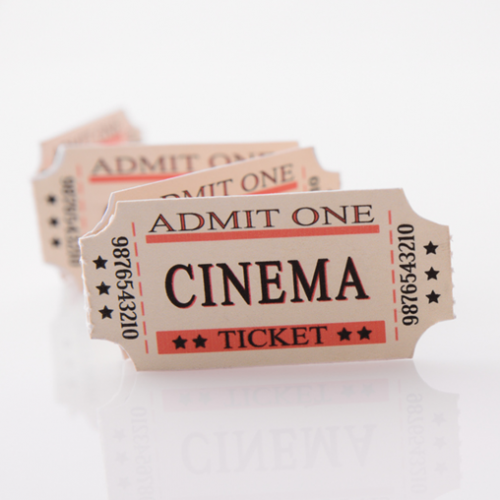
A cinema has 100 seats. How can ticket sales make £100 for these different combinations of ticket prices?
How many different symmetrical shapes can you make by shading triangles or squares?
My two digit number is special because adding the sum of its digits to the product of its digits gives me my original number. What could my number be?
Can you arrange these numbers into 7 subsets, each of three numbers, so that when the numbers in each are added together, they make seven consecutive numbers?
Find the frequency distribution for ordinary English, and use it to help you crack the code.
A jigsaw where pieces only go together if the fractions are equivalent.
Can you picture how to order the cards to reproduce Charlie's card trick for yourself?
Can you find rectangles where the value of the area is the same as the value of the perimeter?
Each clue in this Sudoku is the product of the two numbers in adjacent cells.
Can you arrange the numbers 1 to 17 in a row so that each adjacent pair adds up to a square number?
Move your counters through this snake of cards and see how far you can go. Are you surprised by where you end up?
Imagine we have four bags containing a large number of 1s, 4s, 7s and 10s. What numbers can we make?
Can you deduce which Olympic athletics events are represented by the graphs?
Alison, Bernard and Charlie have been exploring sequences of odd and even numbers, which raise some intriguing questions...
Charlie has made a Magic V. Can you use his example to make some more? And how about Magic Ls, Ns and Ws?
These Olympic quantities have been jumbled up! Can you put them back together again?