The Remainders Game
Play this game and see if you can figure out the computer's chosen number.


An investigation involving adding and subtracting sets of consecutive numbers. Lots to find out, lots to explore.
A game for two people, or play online. Given a target number, say 23, and a range of numbers to choose from, say 1-4, players take it in turns to add to the running total to hit their target.
What is the smallest number of answers you need to reveal in order to work out the missing headers?
The Number Jumbler can always work out your chosen symbol. Can you work out how?
Ten cards are put into five envelopes so that there are two cards in each envelope. The sum of the numbers inside it is written on each envelope. What numbers could be inside the envelopes?
Can you make doughnuts by matching these fractions, decimals and percentages?
How many solutions can you find to this sum? Each of the different letters stands for a different number.
15 = 7 + 8 and 10 = 1 + 2 + 3 + 4. Can you say which numbers can be expressed as the sum of two or more consecutive integers?
Can you find six numbers to go in the daisy from which you can make all the numbers from 1 to a number bigger than 25?
In how many ways can you fit all three pieces together to make shapes with line symmetry?
How many different symmetrical shapes can you make by shading triangles or squares?
Try entering different sets of numbers in the number pyramids. How does the total at the top change?
Can you arrange these numbers into 7 subsets, each of three numbers, so that when the numbers in each are added together, they make seven consecutive numbers?
Find the frequency distribution for ordinary English, and use it to help you crack the code.
If you are given the mean, median and mode of five positive whole numbers, can you find the numbers?
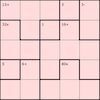
Each clue in this Sudoku is the product of the two numbers in adjacent cells.
Can you arrange the numbers 1 to 17 in a row so that each adjacent pair adds up to a square number?
Mathematicians are always looking for efficient methods for solving problems. How efficient can you be?
Can you find a way to identify times tables after they have been shifted up or down?
How can you change the area of a shape but keep its perimeter the same? How can you change the perimeter but keep the area the same?
Charlie has made a Magic V. Can you use his example to make some more? And how about Magic Ls, Ns and Ws?
I'm thinking of a rectangle with an area of 24. What could its perimeter be?
Can you find sets of numbers which satisfy each of our mean, median, mode and range conditions?
Can you deduce the perimeters of the shapes from the information given?