How Many?
This project challenges you to work out the number of cubes hidden under a cloth. What questions would you like to ask?
This is part of our collection of favourite rich tasks arranged by topic.
If you are a teacher, you can find the whole collection on our Primary Curriculum teacher page.
Alternatively, if you are a student, you'll find the same problems on our Primary Curriculum student page.
This project challenges you to work out the number of cubes hidden under a cloth. What questions would you like to ask?
Make one big triangle so the numbers that touch on the small triangles add to 10.
Can you find two butterflies to go on each flower so that the numbers on each pair of butterflies adds to the number on their flower?
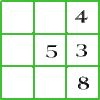
What do you notice about these squares of numbers? What is the same? What is different?
Use these head, body and leg pieces to make Robot Monsters which are different heights.
Here are some rods that are different colours. How could I make a yellow rod using white and red rods?
Can you hang weights in the right place to make the the number balance balanced?
Try grouping the dominoes in the ways described. Are there any left over each time? Can you explain why?
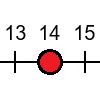
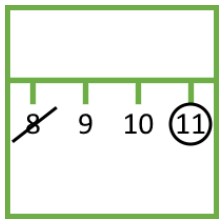
Leah and Tom each have a number line. Can you work out where their counters will land?
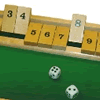
Can you use the numbers on the dice to reach your end of the number line before your partner beats you?
Can you each work out the number on your card? What do you notice? How could you sort the cards?
This activity is best done with a whole class or in a large group. Can you match the cards? What happens when you add pairs of the numbers together?
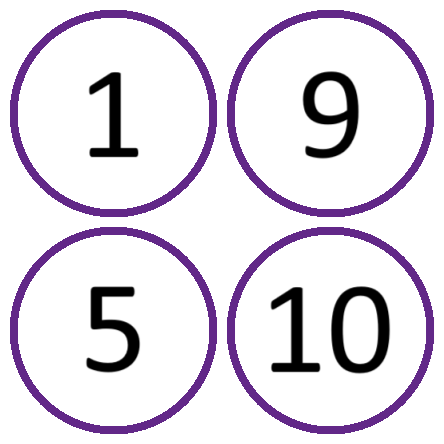
If you have ten counters numbered 1 to 10, how many can you put into pairs that add to 10? Which ones do you have to leave out? Why?
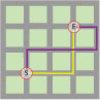
Two children made up a game as they walked along the garden paths. Can you find out their scores? Can you find some paths of your own?
This box does something to the numbers that go into it. If you know the numbers that come out, what might be going on inside the box?
This investigates one particular property of number by looking closely at an example of adding two odd numbers together.
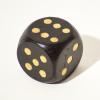
What two-digit numbers can you make with these two dice? What can't you make?
In this calculation, the box represents a missing digit. What could the digit be? What would the solution be in each case?
This challenge is about finding the difference between numbers which have the same tens digit.
Use five steps to count forwards or backwards in 1s or 10s to get to 50. What strategies did you use?
Throw the dice and decide whether to double or halve the number. Will you be the first to reach the target?
Are these statements relating to calculation and properties of shapes always true, sometimes true or never true?
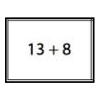
Order these four calculations from easiest to hardest. How did you decide?
Which two items of fruit could Kate and Sam choose? Can you order the prices from lowest to highest?
Can you spot the mistake in this video? How would you work out the answer to this calculation?
Jack's mum bought some candles to use on his birthday cakes and when his sister was born, she used them on her cakes too. Can you use the information to find out when Kate was born?
On a farm there were some hens and sheep. Altogether there were 8 heads and 22 feet. How many hens were there?
In Sam and Jill's garden there are two sorts of ladybirds with 7 spots or 4 spots. What numbers of total spots can you make?
There are three baskets, a brown one, a red one and a pink one, holding a total of 10 eggs. How many eggs are in each basket?
Choose four of the numbers from 1 to 9 to put in the squares so that the differences between joined squares are odd.
Ahmed is making rods using different numbers of cubes. Which rod is twice the length of his first rod?
Annie and Ben are playing a game with a calculator. What was Annie's secret number?
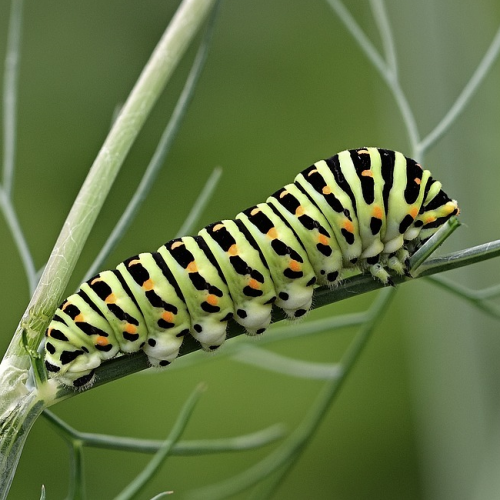
These caterpillars have 16 parts. What different shapes do they make if each part lies in the small squares of a 4 by 4 square?
Place the numbers 1 to 6 in the circles so that each number is the difference between the two numbers just below it.
Can you work out how many flowers there will be on the Amazing Splitting Plant after it has been growing for six weeks?
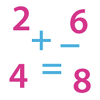
Using the cards 2, 4, 6, 8, +, - and =, what number statements can you make?
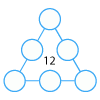
Arrange the numbers 1 to 6 in each set of circles below. The sum of each side of the triangle should equal the number in its centre.
At the beginning of May, Tom put his tomato plant outside. On the same day he sowed a bean in another pot. When will the two be the same height?
Use the information about Sally and her brother to find out how many children there are in the Brown family.
As you come down the ladders of the Tall Tower you collect useful spells. Which way should you go to collect the most spells?
Use your addition and subtraction skills, combined with some strategic thinking, to beat your partner at this game.
Sweets are given out to party-goers in a particular way. Investigate the total number of sweets received by people sitting in different positions.
What could the half time scores have been in these Olympic hockey matches?
What happens when you add three numbers together? Will your answer be odd or even? How do you know?