Dicey Operations
In these addition and subtraction games, you'll need to think strategically to get closest to the target.


An investigation involving adding and subtracting sets of consecutive numbers. Lots to find out, lots to explore.
A game for two people, or play online. Given a target number, say 23, and a range of numbers to choose from, say 1-4, players take it in turns to add to the running total to hit their target.
Think of a number and follow the machine's instructions... I know what your number is! Can you explain how I know?
Can you find a reliable strategy for choosing coordinates that will locate the treasure in the minimum number of guesses?
The Number Jumbler can always work out your chosen symbol. Can you work out how?
In these multiplication and division games, you'll need to think strategically to get closest to the target.

Can you make doughnuts by matching these fractions, decimals and percentages?
A game in which players take it in turns to choose a number. Can you block your opponent?
Play this game to learn about adding and subtracting positive and negative numbers
15 = 7 + 8 and 10 = 1 + 2 + 3 + 4. Can you say which numbers can be expressed as the sum of two or more consecutive integers?
How many different symmetrical shapes can you make by shading triangles or squares?
Find the frequency distribution for ordinary English, and use it to help you crack the code.
Can you arrange the numbers 1 to 17 in a row so that each adjacent pair adds up to a square number?
Mathematicians are always looking for efficient methods for solving problems. How efficient can you be?
Can you find a way to identify times tables after they have been shifted up or down?
Here is a chance to create some attractive images by rotating shapes through multiples of 90 degrees, or 30 degrees, or 72 degrees or...
Create some shapes by combining two or more rectangles. What can you say about the areas and perimeters of the shapes you can make?
Follow this recipe for sieving numbers and see what interesting patterns emerge.
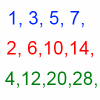
Alison, Bernard and Charlie have been exploring sequences of odd and even numbers, which raise some intriguing questions...
Charlie has made a Magic V. Can you use his example to make some more? And how about Magic Ls, Ns and Ws?
Imagine a very strange bank account where you are only allowed to do two things...
Can you find sets of numbers which satisfy each of our mean, median, mode and range conditions?
How many ways can you find to put in operation signs (+, −, ×, ÷) to make 100?
The large rectangle is divided into quadrilaterals and triangles. Can you untangle what fractional part is represented by each of the ten numbered shapes?