Strike It Out
Use your addition and subtraction skills, combined with some strategic thinking, to beat your partner at this game.
This activity is based on data in the book 'If the World Were a Village'. How will you represent your chosen data for maximum effect?
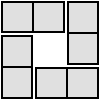
Use these four dominoes to make a square that has the same number of dots on each side.
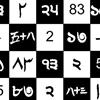
There are six numbers written in five different scripts. Can you sort out which is which?
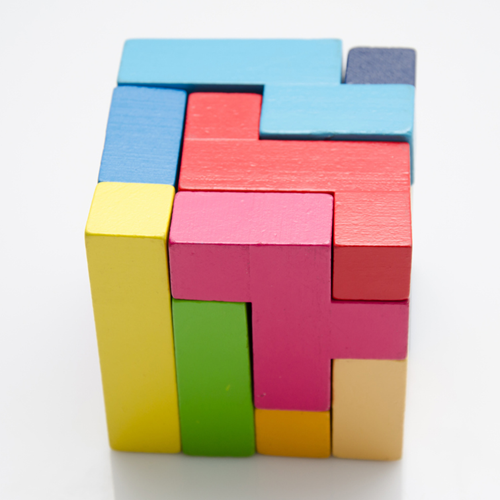
Here are the six faces of a cube - in no particular order. Here are three views of the cube. Can you deduce where the faces are in relation to each other and record them on the net of this cube?
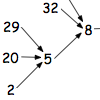
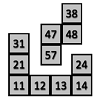
Place the numbers from 1 to 9 in the squares below so that the difference between joined squares is odd. How many different ways can you do this?
Have a look at this table of how children travel to school. How does it compare with children in your class?
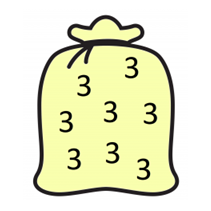
This big box multiplies anything that goes inside it by the same number. If you know the numbers that come out, what multiplication might be going on in the box?
Can you put the numbers 1-5 in the V shape so that both 'arms' have the same total?
This 100 square jigsaw is written in code. It starts with 1 and ends with 100. Can you build it up?
What happens when you add the digits of a number then multiply the result by 2 and you keep doing this? You could try for different numbers and different rules.
Take a look at these data collected by children in 1986 as part of the Domesday Project. What do they tell you? What do you think about the way they are presented?
This problem explores the range of events in a sports day and which ones are the most popular and attract the most entries.
In this game the winner is the first to make the total 37. Is this a fair game?
Use the 'double-3 down' dominoes to make a square so that each side has eight dots.
Mandeep's watch loses two minutes every hour. Adam's watch gains one minute every hour. Can you work out what time they arrived at the airport?
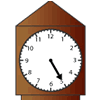
These clocks have only one hand, but can you work out what time they are showing from the information?
Have a look at the results for some events at past Olympic Games. Can you use these to predict the results at the next Olympics?
During the third hour after midnight the hands on a clock point in the same direction (so one hand is over the top of the other). At what time, to the nearest second, does this happen?
Choose the size of your pegboard and the shapes you can make. Can you work out the strategies needed to block your opponent?
An investigation involving adding and subtracting sets of consecutive numbers. Lots to find out, lots to explore.
A game for two people, or play online. Given a target number, say 23, and a range of numbers to choose from, say 1-4, players take it in turns to add to the running total to hit their target.
This cube has ink on each face which leaves marks on paper as it is rolled. Can you work out what is on each face and the route it has taken?