

Wonky Watches

 2 out of 3
Mandeep's watch loses two minutes every hour. Adam's watch gains one minute every hour. Can you work out what time they arrived at the airport?
Problem
Mandeep's watch loses two minutes every hour.
Adam's watch gains one minute every hour.
They both set their watches from the radio at 6:00 a.m. then start their journeys to the airport. When they arrive (at the same time) their watches are 10 minutes apart.
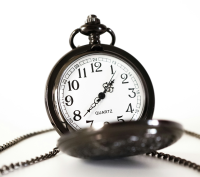
At what time (the real time) did they arrive at the airport?
Getting Started
What time will each watch say after an hour? Two hours ...?
How far apart will the times on the two watches be after an hour? Two hours ...?
Student Solutions
Jason from Priory Middle School, Dunstable says:
The time where the 2 watches are 10 mins apart is 9:20.
At 7 o'clock they're 3 mins apart
At 8 o'clock they're 6 mins apart
9 o'clock, 9 mins.
For 1 minute you divide 1 hour by 3, as 20 is 3 times as small as 60.
Then you add 9:00 and 0:20 to make 9:20, which is when they are 10 mins apart.
Stuart and Mark (Lower Juniors at Cummersdale, Cumbria) also say 9:20. They used this technique:
Every hour the difference between the two watches increases by 3 minutes 3x3=9
That gives us 3 hours and then divide 60 into 3 to make 20 minutes
3hours + 20mins = 3 20mins
6:00 a.m. + 3hrs 20 mins = 9:20 a.m.
George (Rosebank Primary School, Leeds) drew diagrams to show his thinking:
I knew that it would take them 3 hours and something because every hour they got three minutes apart. That meant that it will have minutes as well as hours. I knew that Mandeep's and Adam's watches went three minutes apart every hour. Now I needed to know how many minutes apart the boys' watches go in one minute. For this I drew a scale.

Then I marked how much they'd be apart.

This showed me that it must be between 15 and 30 minutes. When I divided it into even smaller parts I got the answer.

This got me to the answer, which is 3 hours and twenty minutes.
Daniel (Anglo-Chinese School - Primary, Singapore), Thomas (Tattingstone School) and Timothy (Munsang College, Hong Kong) gave very similar explanations. The one below is Timothy's:
Mandeep's watch loses 2 min every hour and Adam's watch gains 1 min every hour,
so they are 1 + 2 = 3 min apart after the 1st hour and 3 more mins after every hour.
When they arrive at the airport, their watches are 10 mins apart, so they travel:
10/3 hours = 60 x 10/3 = 200min = 3hours and 20mins
They start at 6:00am, so they arrive at 9:20am.
Tyler from Ysgol Dyffryn Dulas wrote:
Mandeep's watch has 58 mins per hour, I timesed that by 3 = 174
I did the same with 61, Adams' watch, 183
Now the difference was 9 mins
I timesed 58 by a third =19 and the same with 61=20
Now the difference was 1 minute
9+1=10 I had found the answer
174+19=193
183+20=203
Then I converted them to hours: 3:13, 3:23 from here I woked out as 7, the difference beetween 3:13 and 3:20 was 3, the difference beetween 3:20 and 3:23 was 7, which was roughly double 3.
3:20+6:00 was the answer to complete the soloution and that answer was 9:20 there for they arrived at 9:20.
Teachers' Resources
Using NRICH Tasks Richly describes ways in which teachers and learners can work with NRICH tasks in the classroom.
Why do this problem?
This problem consolidates children's understanding of the passage of time and encourages them to work systematically towards a solution. There are many ways of approaching this problem so it would be worth drawing attention to this.
Possible approach
This problem would make a good challenge activity for the end of a block of work on time. You could begin by posing a few quick questions to make sure the children understand what gaining and losing time means. For example, if I wind up my watch so it shows the correct time at 5pm, but it loses three minutes every hour, what time will it say when the real time is 7pm? 8pm ... etc?
You could present the problem itself orally to the group, perhaps writing up the key pieces of information on the board. Allow pairs or small groups to talk about how they might go about solving the problem without saying much more yourself at this stage. After just a few minutes, encourage learners to share some of their thoughts and then give them more time to work on the problem. Give each group a large sheet of paper so that they can record what they do and tell them that they will present their work to everyone at the end.
Once the pupils have reached a solution and have presented their results, their pieces of paper could be displayed on the wall.
Key questions
What time will each watch say after an hour? Two hours ...?
How far apart will the times on the two watches be after an hour? Two hours ...?
Possible extension
You could challenge some children to make up their own version of the problem according to certain criteria, for example, if the watches were 10 minutes apart on the hour, what could the amount that they gain/lose be?
Possible support
Breaking the problem down to an hour at a time might help some learners.