Dicey Array
Watch the video of this game being played. Can you work out the rules? Which dice totals are good to get, and why?
This is part of our collection of favourite rich tasks arranged by topic.
If you are a teacher, you can find the whole collection on our Primary Curriculum teacher page.
Alternatively, if you are a student, you'll find the same problems on our Primary Curriculum student page.
Watch the video of this game being played. Can you work out the rules? Which dice totals are good to get, and why?
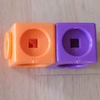
In how many different ways can you break up a stick of seven interlocking cubes? Now try with a stick of eight cubes and a stick of six cubes. What do you notice?
This problem is designed to help children to learn, and to use, the two and three times tables.
We can arrange dots in a similar way to the 5 on a dice and they usually sit quite well into a rectangular shape. How many altogether in this 3 by 5? What happens for other sizes?
Investigate the different shaped bracelets you could make from 18 different spherical beads. How do they compare if you use 24 beads?
How many different shaped boxes can you design for 36 sweets in one layer? Can you arrange the sweets so that no sweets of the same colour are next to each other in any direction?
Put operations signs between the numbers 3, 4, 5 and 6 to make the highest possible number and lowest possible number.
On the planet Vuv there are two sorts of creatures. The Zias have 3 legs and the Zepts have 7 legs. The great planetary explorer Nico counted 52 legs. How many Zias and how many Zepts were there?
48 is called an abundant number because it is less than the sum of its factors (without itself). Can you find some more abundant numbers?
Norrie sees two lights flash at the same time, then one of them flashes every 4th second, and the other flashes every 5th second. How many times do they flash together during a whole minute?
The value of the circle changes in each of the following problems. Can you discover its value in each problem?
The planet of Vuvv has seven moons. Can you work out how long it is between each super-eclipse?
Can you work out the arrangement of the digits in the square so that the given products are correct? The numbers 1 - 9 may be used once and once only.
Which is quicker, counting up to 30 in ones or counting up to 300 in tens? Why?
Can you replace the letters with numbers? Is there only one solution in each case?
Can you put the numbers 1 to 8 into the circles so that the four calculations are correct?
Find out what a Deca Tree is and then work out how many leaves there will be after the woodcutter has cut off a trunk, a branch, a twig and a leaf.
There is a clock-face where the numbers have become all mixed up. Can you find out where all the numbers have got to from these ten statements?
Think of a number, square it and subtract your starting number. Is the number you're left with odd or even? How do the images help to explain this?
One block is needed to make an up-and-down staircase, with one step up and one step down. How many blocks would be needed to build an up-and-down staircase with 5 steps up and 5 steps down?
Each child in Class 3 took four numbers out of the bag. Who had made the highest even number?
These sixteen children are standing in four lines of four, one behind the other. They are each holding a card with a number on it. Can you work out the missing numbers?
Do you agree with Badger's statements? Is Badger's reasoning 'watertight'? Why or why not?
Place the numbers from 1 to 9 in the squares below so that the difference between joined squares is odd. How many different ways can you do this?
Can you predict when you'll be clapping and when you'll be clicking if you start this rhythm? How about when a friend begins a new rhythm at the same time?
Can you complete this jigsaw of the multiplication square?
This big box multiplies anything that goes inside it by the same number. If you know the numbers that come out, what multiplication might be going on in the box?
These eleven shapes each stand for a different number. Can you use the number sentences to work out what they are?
In this game, you can add, subtract, multiply or divide the numbers on the dice. Which will you do so that you get to the end of the number line first?
Four of these clues are needed to find the chosen number on this grid and four are true but do nothing to help in finding the number. Can you sort out the clues and find the number?
Can you put the numbers 1-5 in the V shape so that both 'arms' have the same total?
Investigate the sum of the numbers on the top and bottom faces of a line of three dice. What do you notice?

In this activity, the computer chooses a times table and shifts it. Can you work out the table and the shift each time?

This group activity will encourage you to share calculation strategies and to think about which strategy might be the most efficient.
You are organising a school trip and you need to write a letter to parents to let them know about the day. Use the cards to gather all the information you need.
What happens when you add the digits of a number then multiply the result by 2 and you keep doing this? You could try for different numbers and different rules.
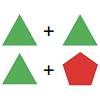
Tom and Ben visited Numberland. Use the maps to work out the number of points each of their routes scores.
After training hard, these two children have improved their results. Can you work out the length or height of their first jumps?
Look at different ways of dividing things. What do they mean? How might you show them in a picture, with things, with numbers and symbols?
In this game the winner is the first to make the total 37. Is this a fair game?
Can you complete this calculation by filling in the missing numbers? In how many different ways can you do it?
Can you work out some different ways to balance this equation?
Have a go at balancing this equation. Can you find different ways of doing it?
This challenge encourages you to explore dividing a three-digit number by a single-digit number.
Are these statements always true, sometimes true or never true?
How do you know whether you will reach these numbers when you count in steps of six from zero?
You'll need to know your number properties to win a game of Statement Snap...
Can you find any two-digit numbers that satisfy all of these statements?