Picture Your Method
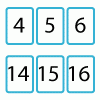
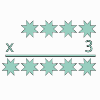
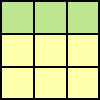
Can you match these calculation methods to their visual representations?
This is part of our collection of favourite rich tasks arranged by topic.
If you are a teacher, you can find the whole collection on our Primary Curriculum teacher page.
Alternatively, if you are a student, you'll find the same problems on our Primary Curriculum student page.
Can you match these calculation methods to their visual representations?
Can you put these four calculations into order of difficulty? How did you decide?
Here is an interesting property about two sets of digits. Can you work out what the digits might be?
What happens if you join every second point on this circle? How about every third point? Try with different steps and see if you can predict what will happen.
Cut differently-sized square corners from a square piece of paper to make boxes without lids. Do they all have the same volume?
Find at least one way to put in some operation signs to make these digits come to 100.
On my calculator I divided one whole number by another whole number and got the answer 3.125. If the numbers are both under 50, what are they?
Peter wanted to make two pies for a party. His mother had a recipe for him to use. However, she always made 80 pies at a time. Did Peter have enough ingredients to make two pumpkin pies?
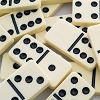
Amy has a box containing domino pieces but she does not think it is a complete set. Which of her domino pieces are missing?
Katie had a pack of 20 cards numbered from 1 to 20. She arranged the cards into 6 unequal piles where each pile added to the same total. What was the total and how could this be done?
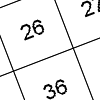
Can you fill in this table square? The numbers 2-12 were used to generate it with just one number used twice.
One quarter of these coins are heads but when I turn over two coins, one third are heads. How many coins are there?
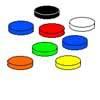
The discs for this game are kept in a flat square box with a square hole for each. Use the information to find out how many discs of each colour there are in the box.
Mrs Morgan, the class's teacher, pinned numbers onto the backs of three children. Use the information to find out what the three numbers were.
This multiplication uses each of the digits 0 - 9 once and once only. Using the information given, can you replace the stars in the calculation with figures?
Can you make square numbers by adding two prime numbers together?
Can you make a cycle of pairs that add to make a square number using all the numbers in the box below, once and once only?
A 750 ml bottle of concentrated orange squash is enough to make fifteen 250 ml glasses of diluted orange drink. How much water is needed to make 10 litres of this drink?
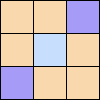
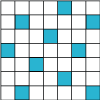
What do the numbers shaded in blue on this hundred square have in common? What do you notice about the pink numbers? How about the shaded numbers in the other squares?
Can you see how these factor-multiple chains work? Find the chain which contains the smallest possible numbers. How about the largest possible numbers?
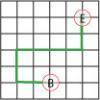
Find the product of the numbers on the routes from A to B. Which route has the smallest product? Which the largest?
This challenge is a game for two players. Choose two of the numbers to multiply or divide, then mark your answer on the number line. Can you get four in a row?
Use your logical thinking skills to deduce how much Dan's crisps and ice cream cost altogether.
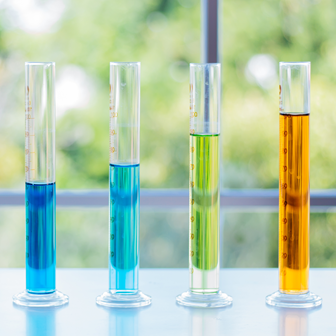
A group of children are using measuring cylinders but they lose the labels. Can you help relabel them?
Nearly all of us have made table patterns on hundred squares, that is 10 by 10 grids. This problem looks at the patterns on differently sized square grids.
Each light in this interactivity turns on according to a rule. What happens when you enter different numbers? Can you work out the rule for each light?
Factor track is not a race but a game of skill. The idea is to go round the track in as few moves as possible, keeping to the rules.
Investigate the different numbers of people and rats there could have been if you know how many legs there are altogether!
This challenge combines addition, multiplication, perseverance and even proof.
This task combines spatial awareness with addition and multiplication.
Nine squares with side lengths 1, 4, 7, 8, 9, 10, 14, 15, and 18 cm can be fitted together to form a rectangle. What are the dimensions of the rectangle?
Can you order the digits from 1-3 to make a number which is divisible by 3 so when the last digit is removed it becomes a 2-figure number divisible by 2, and so on?
Look at what happens when you take a number, square it and subtract your answer. What kind of number do you get? Can you prove it?
Play this game and see if you can figure out the computer's chosen number.
A game for two people, or play online. Given a target number, say 23, and a range of numbers to choose from, say 1-4, players take it in turns to add to the running total to hit their target.
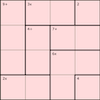
Can you use the clues to complete these 4 by 4 Mathematical Sudokus?
Five children are taking part in a climbing competition with three parts, where their score for each part will be multiplied together. Can you see how the leaderboard will change depending on what happens in the final climb of the competition?
In these multiplication and division games, you'll need to think strategically to get closest to the target.
Arrange the four number cards on the grid, according to the rules, to make a diagonal, vertical or horizontal line.
I'm thinking of a number. My number is both a multiple of 5 and a multiple of 6. What could my number be?
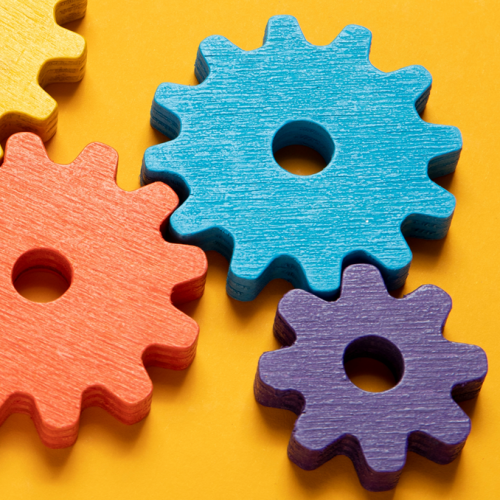
Which pairs of cogs let the coloured tooth touch every tooth on the other cog? Which pairs do not let this happen? Why?
Take three consecutive numbers and add them together. What do you notice?
Some of the numbers have fallen off Becky's number line. Can you figure out what they were?
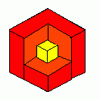
We start with one yellow cube and build around it to make a 3×3×3 cube with red cubes. Then we build around that red cube with blue cubes and so on. How many cubes of each colour have we used?
A game in which players take it in turns to choose a number. Can you block your opponent?