

Round and Round the Circle

 2 out of 3
What happens if you join every second point on this circle? How about every third point? Try with different steps and see if you can predict what will happen.
Problem
Round and Round the Circle printable sheet
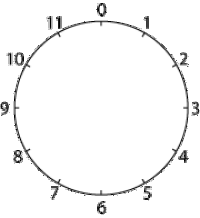
I started with a clock without hands or lines showing the minutes (except for those where there is a number). The $12$ was replaced by a $0$ and the numbers placed outside the face.
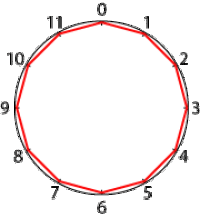
I drew straight lines to join up the numbers.
I started by counting in ones and I got a $12$-gon (that is a $12$-sided polygon - if you like long words you can call it a dodecagon).
Then I drew straight lines counting round in $2$s. And I got ...?
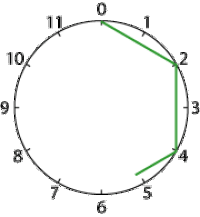
Perhaps you could try without putting the numbers round the circles.
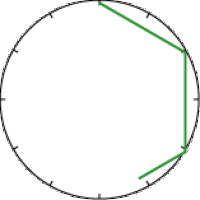
I tried $5$s (wow!) and $6$s (well!).
Each time I go on drawing lines until I get to the point where I first started.
Then I tried $7$s, $8$s, $9$s, $10$s, and $11$s.
Something interesting was happening.
Why don't you try it? What patterns do you notice emerging?
And what about counting round in $12$s?
Which shapes are the same? Can you think of a reason why?
Can you see a connection between the number in which you are counting around the circle and the number of sides in the shape you are making?
Getting Started
You could use this sheet of circles marked in $12$s and this one that has circles marked in $10$s, $9$s, $8$s and $7$s.
You might find this interactivity helpful for drawing your shapes.
Student Solutions
From Mounts Bay School we had solutions in from Jamie, Luke, Cory, Luke, Joseph, Ben, Kara, Merrion, Katie, Ben, Chris, Ellen, Emma, Liam and Heidi. Here are three of them;
Certain numbers are the same. I think that numbers which are half of another number have double the amount of trails around the circle. This happens because when you try the numbers $8$ and $4$ they are exactly the same.
In the middle of each shape there is a perfect square. We can tell it is a perfect square because the angles are all right angles. We all figured it out together by looking and trying to do a number $8$ when we noticed the squares. We did not think it was a coincidence!
$12$ is equal
$11$ is the same as $1$ except backwards
$10$ is the same as $2$ except backwards
$09$ is the same as $3$ except backwards
$08$ is the same as $4$ except backwards
$07$ is the same as $5$ except backwards
$06$ is just a recurring straight line
All others are in reverse.
The pattern is that as the numbers from $11$ go down, the numbers which they are the same go up.
At the very end of the month we had two comments in from Morgan, Sara, Billie and Lucy from Southam St. James Primary School:
If the number of points are prime, all numbers will work but if the number of points are not prime all numbers apart from factors of the number of points will work.
and
If there's an even number of points odd numbers of steps won't work. If there's an odd number of points even steps won't work. If there's a prime number all of them work.
Teachers' Resources
Using NRICH Tasks Richly describes ways in which teachers and learners can work with NRICH tasks in the classroom.
Why do this problem?
This problem brings out patterns in numbers, factors and multiples as well as properties of shapes. There are plenty of opportunities for visualising to predict what patterns will emerge. Learners will need to work systematically and to generalise, and the work done also often makes a very appealing 'finished product' for display purposes.
Possible approach
You could start with a clock with the numbers round the outside of the circle, but change the 12 into a 0 as in the question. If you are able to display the image on an interactive whiteboard, you will be able to draw round in ones and then start the twos (as in the question). Ask the group to predict what will happen, and then to check by continuing to draw on the board. Make sure that they understand that they go on round the circle until they reach 0 again.
Many children have a problem with counting round in 5s. To avoid this show them how it is done on the board. Start at 0 count round 5 and make a mark by the relevant place on the circle. Now join the 0 to this mark. Again, count round 5 and make a mark by the relevant place on the circle and join this to the place where the last line finished. Continue doing this until you reach 0 again. You should have visited every point round the circle by this time.
Children can then work on the challenge in pairs - encourage them to make predictions before testing them. Make sure that they realise that every number should be done on a new dial. A sheet of six numbered circles, which makes a good starting point, can be printed out. Alternatively, pupils might prefer to work on a sheet with twelve blank circles.
After a suitable length of time, draw learners together to share their findings. You may want to collate their results on the board as pairs demonstrate the drawing or show their sketches. Ask them to explain how the shapes relate to the number of divisions round the circles, looking out for those who use appropriate vocabulary such as 'factor' and 'multiple'. Which numbers produced the same shapes? Ask again about the relationship of these to the number of divisions round the circles. Press the group to generalise their findings as this can bring out interesting facts about factors, multiples and primes. You might find this interactivity helpful in the discussion.
(If you want to make mathematical stars for Christmas or Divali make sheets with circles divided into a prime number of divisions such as 5, 7, 11 and 13.)
Key questions
Have you made this shape before? Which number made it?
Can you see a connection between these two numbers and the number of divisions round the circle?
Can you predict what different shapes you will get with this circle?
What is the connection between these two numbers?
Which numbers make stars? Why?
Possible extension
After doing the 12s and 10s, learners could try to predict which shapes will be produced with other numbers on the circle before testing their predictions. They could work on this sheet of circles divided into 10s, 9s, 8s and 7s. You might be able to introduce the concept of 'co-prime'.
Possible support
Most difficulties with this problem (at the start at least) lie in the actual drawing rather than in the numbers. Encourage learners to pencil very lightly so the work can be rubbed out if necessary and to mark where they are going before starting to draw the line. Pupils often have trouble with counting round in 5s so it might help to go through the process, stage by stage: start at 0, count round 5 and make a mark by the relevant place on the circle. Now join the 0 to this mark. Again, count round 5 and make a mark by the relevant place on the circle and join this to the place where the last line finished. Continue doing this until 0 is reached again. Every point round the circle should have been visited by this time.