Diamond Collector
Collect as many diamonds as you can by drawing three straight lines.
In this problem we are faced with an apparently easy area problem, but it has gone horribly wrong! What happened?
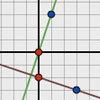
Position the lines so that they are perpendicular to each other. What can you say about the equations of perpendicular lines?
How many intersections do you expect from four straight lines ? Which three lines enclose a triangle with negative co-ordinates for every point ?
Can you decide whether two lines are perpendicular or not? Can you do this without drawing them?
I took the graph y=4x+7 and performed four transformations. Can you find the order in which I could have carried out the transformations?
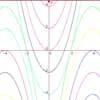
The illustration shows the graphs of fifteen functions. Two of them have equations $y=x^2$ and $y=-(x-4)^2$. Find the equations of all the other graphs.
Quadratic graphs are very familiar, but what patterns can you explore with cubics?
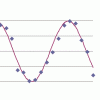
10 graphs of experimental data are given. Can you use a spreadsheet to find algebraic graphs which match them closely, and thus discover the formulae most likely to govern the underlying processes?
Can you work out which processes are represented by the graphs?