Networks/graph theory

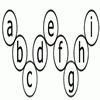
  • Magic W
    problem

    Magic W

    Age
    14 to 16
    Challenge level
    filled star filled star empty star

    Find all the ways of placing the numbers 1 to 9 on a W shape, with 3 numbers on each leg, so that each set of 3 numbers has the same total.

  • The Olympic Torch Tour
    problem

    The Olympic Torch Tour

    Age
    14 to 16
    Challenge level
    filled star filled star empty star

    Imagine you had to plan the tour for the Olympic Torch. Is there an efficient way of choosing the shortest possible route?

  • Fermat's Poser
    problem

    Fermat's Poser

    Age
    14 to 16
    Challenge level
    filled star filled star filled star

    Find the point whose sum of distances from the vertices (corners) of a given triangle is a minimum.

  • Network Trees
    problem

    Network Trees

    Age
    14 to 18
    Challenge level
    filled star empty star empty star

    Explore some of the different types of network, and prove a result about network trees.

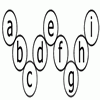
  • Magic W Wrap Up
    problem

    Magic W Wrap Up

    Age
    16 to 18
    Challenge level
    filled star empty star empty star

    Prove that you cannot form a Magic W with a total of 12 or less or with a with a total of 18 or more.

  • Simply Graphs
    problem

    Simply Graphs

    Age
    16 to 18
    Challenge level
    filled star empty star empty star

    Look for the common features in these graphs. Which graphs belong together?

  • Cube Net
    problem

    Cube Net

    Age
    16 to 18
    Challenge level
    filled star filled star empty star

    How many tours visit each vertex of a cube once and only once? How many return to the starting point?

  • Torus patterns
    problem

    Torus Patterns

    Age
    16 to 18
    Challenge level
    filled star filled star filled star
    How many different colours would be needed to colour these different patterns on a torus?
  • Ding Dong Bell
    article

    Ding Dong Bell

    The reader is invited to investigate changes (or permutations) in the ringing of church bells, illustrated by braid diagrams showing the order in which the bells are rung.
  • Dice, Routes and Pathways
    article

    Dice, Routes and Pathways

    This article for teachers discusses examples of problems in which there is no obvious method but in which children can be encouraged to think deeply about the context and extend their ability to think mathematically, especially geometrically.