

Connecting Averages

 1 out of 3
The number in the square is the mean of the four numbers surrounding it. Can you find the missing numbers?
Problem
This problem builds on Hunting for Averages.
Hunting for Averages printable sheet
Connecting Averages printable sheet
In these challenges, the number in each square is the average (mean) of the four numbers surrounding it.
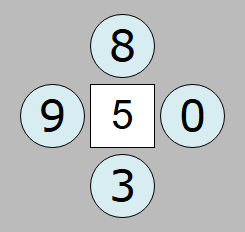
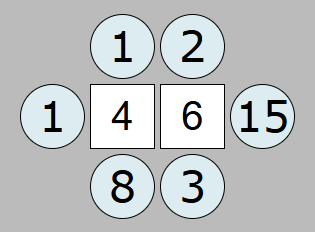
Can you explain why the numbers 5, 4 and 6 belong in the squares in the two examples above?
The challenge, in the interactivity below, is to find the missing number(s). All numbers are whole numbers.
You can click on the purple cog to change the grid size.
Can you create a similar problem for someone else to solve (with whole number solutions)?
Thank you to Silvia, who first worked on this problem with us.
Student Solutions
We received a lot of solutions to this problem, so thank you to everybody who shared their ideas with us. Some of the solutions were more suited to Hunting for Averages, so we've published those there instead.
Kimaya from Ganit Kreeda in Vicharvatika, India used a trial and improvement approach:
My method is to count how much there is on any side. So, add the least number needed to make the total a multiple of 4. Then write the average and try it for the other side. If it works try for the middle. If not then start over using the next possible multiple of 4. If the total of the middle and the average doesn’t work then start over using the next possible multiple of 4. If it works then the puzzle is solved.
Aathirai from Sishya OMR in Chennai, India had a similar approach, except they always chose to start from the side with the bigger numbers. Take a look at Aathirai's full solution to see how they solved these problems.
Why might it be helpful to start from the side with the bigger numbers?
Alex and San San from ESF Clearwater Bay School in Hong Kong had a similar approach:
For the third question, we actually worked from right to left because 243 was a large number and every missing number affected the next missing number.
Taisei, Tyler, Anika, Austin, Dozan and Sho from St. Mary's International School in Japan explained why they always filled in the middle numbers last:
You need to add the 3 numbers given, add a number which gives you a total that is a multiple of 4, divide it by 4 and place the mean in. Sometimes it does not work and you have to keep using multiples of 4 until it does.
When there are more than 2 boxes in the middle, you should begin on the left hand side and add the three numbers missing, so you only have one number to add to make a multiple of 4. Then, add the three numbers of the far right, and work your way in.
Vivaan from Ganit Kreeda also used trial and improvement to solve these problems, and used some algebra to help them keep track of the totals:
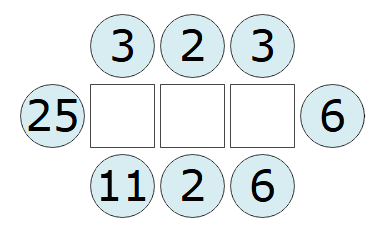
Let's call the 3 unknown values as A, B and C. Goal is to find these 3 values.
Find the 3 totals. Three sums from left to right are:
- 39+B
- 4+A+C
- 15+B
Since left hand sum is 39. A cannot be less than 10. Since mid-sum is 4, B cannot be less than 1 and since right hand sum is 15, C cannot be less than 4
(An interesting thing to think about at this point is what all of this information tells you, even without considering multiples of 4. As A is at least 10 and C is at least 4, B must actually be at least $(2 + 2 + 10 + 4) \div 4$, so it must be at least 5!)
Now, let me start from C. Now we know that the sum should be multiple of 4. We have total of 15, to make this a multiple of 4:
- Try B=1, then sum = 15+1 = 16, and value of C will be 16/4 = 4, then C=4. But B cannot be 1 as this has to be >1.
- So, we will try next number, B=5. Then C = (15+5)/4 = 5. This is a good possibility.
- Now, if B= 5, C=5, let’s find A.
A = (39+B)/4 = (39+5)/4 = 11.
So, A = 11
Verification: Validate the 3 values and cross check if the values are correct from either end.
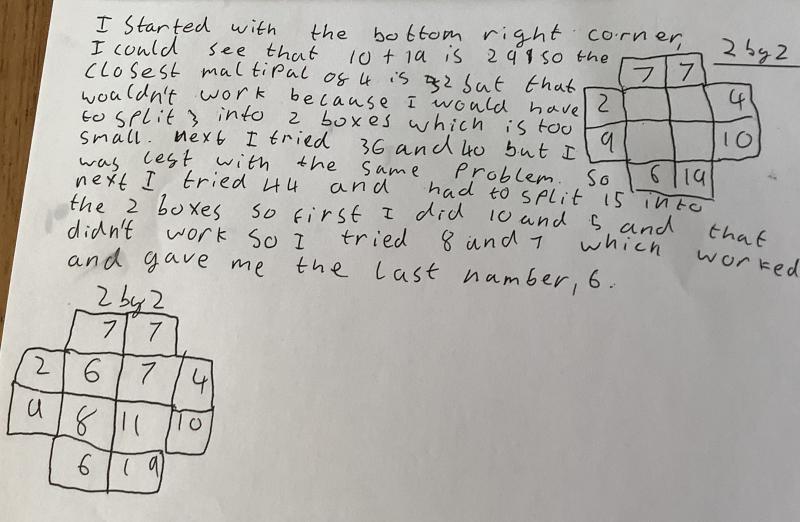
Ellie from Eden Primary in England also used multiples of four, and thought carefully about using number bonds to help her solve the 2 by 2 version of this problem using trial and improvement:
Rufus from Bristol Grammar School in the UK also had some interesting ideas about using number bonds to solve these problems:
To solve the connecting averages problems, you can assume the blanks from left to right as A, B, C. With these variables you can use a formula to find B to help solve for A and C. The formula used is A = (the total of the known values + B) divided by 4. We know the total of the three numbers + B is divisible by 4 because A must be an integer. Therefore, we know B will be in the formula 4n – (an amount taken away from 4 to get to the next number in the sequence). Using this knowledge, we can search along 4n using inferred estimating until we have solved for B which in turn lets us find A and C by averaging the 4 surrounding values.
This can also be applied to other problems with more than one missing value. For example, in a question with 2 missing values, you can do the same remembering there is an additional value and then split the numbers in the Nth term sequence into two numbers and see if the solution fits (e.g. 7 can be 1,6/ 2,5/ 3,4) You can then limit the possibilities of splits down by using tricks like the assumption that if the total is already above 12 when you divide by four then the split cannot include 1,2 or 3 as it must be higher (although the number can be 0). You can filter all of the splits by seeing how many numbers in the sequence 4n it is above and based off of the amount it is above you can discount all of the splits including that number or below in that box.
Hayden from Ilford County High in England explained how to use simultaneous equations to solve these problems:
Basically on the first question, you first name the squares, x , y , z and you can rearrange them into a system of three equations (basically a simultaneous equation). For example, you make z the subject and substitute everything into the other equations since z should be on its own. Then you do that again and finally get one of the squares. Using that you can find the mean of the other squares by adding the surrounding numbers including the letter and times the square you just got by 4 to make the total of the surrounding numbers. Then you do that for the rest and get all of the squares.
Luca from Conyers School in the UK created their own problem, and solved it in a similar way:
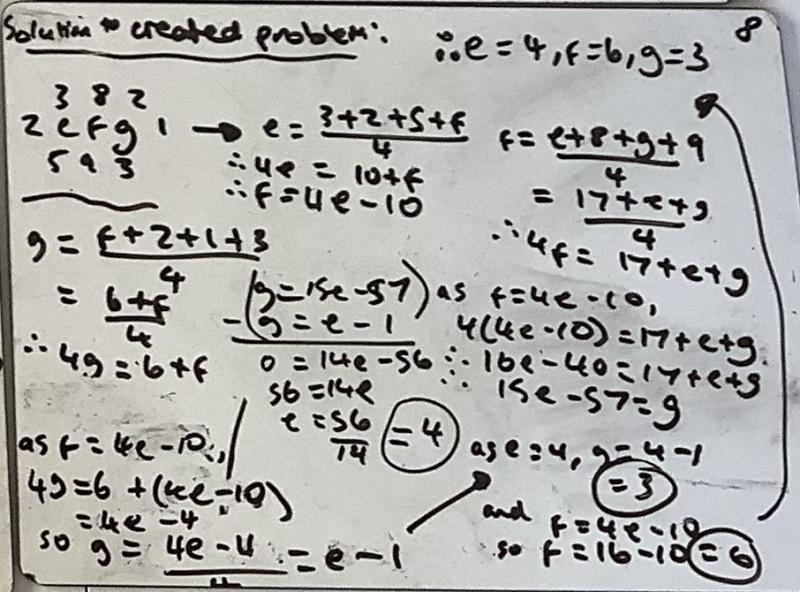
Arvee from Dr Challoner's High School in England created a problem to solve which used negative numbers:
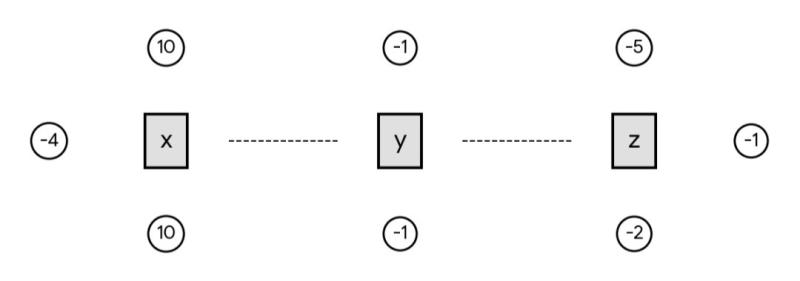
This network is a discrete Dirichlet problem where each square node is the precise arithmetic mean of its four cardinal neighbors. Because the variables are interdependent, we must solve them simultaneously using a system of linear equations.
The Algebraic proof:
Node x: x = (10 + 10 - 4 + y) / 4 --> 4x = 16 + y --> y = 4x - 16
Node z: z = (-5 - 2 - 1 + y) / 4 --> 4z = -8 + y --> y = 4z + 8
Node y: y = (-1 - 1 + x + z) / 4 --> 4y = -2 + x + z
4x - 16 = 4z + 8 --> 4x - 4z = 24 --> z = x - 6
4(4x - 16) = -2 + x + (x - 6)
16x - 64 = 2x - 8
14x = 56
x = 4
y = 4(4) - 16 = 0
z = 4 - 6 = -2
Check:
(10 + 10 - 4 + 0) / 4 = 4
(-1 - 1 + 4 - 2) / 4 = 0
(-5 - 2 - 1 + 0) / 4 = -2
Final Solution: x=4, y = 0, z = -2
Ayaansh from Ganit Kreeda used simultaneous equations to solve a 2 by 2 version of this problem, and noticed that a lot of terms could be cancelled out. Take a look at Ayaansh's full solution to see how this happens.
Ziqian from Harrow International School in Hong Kong only used one unknown to solve the 1 by 2 version of this problem:
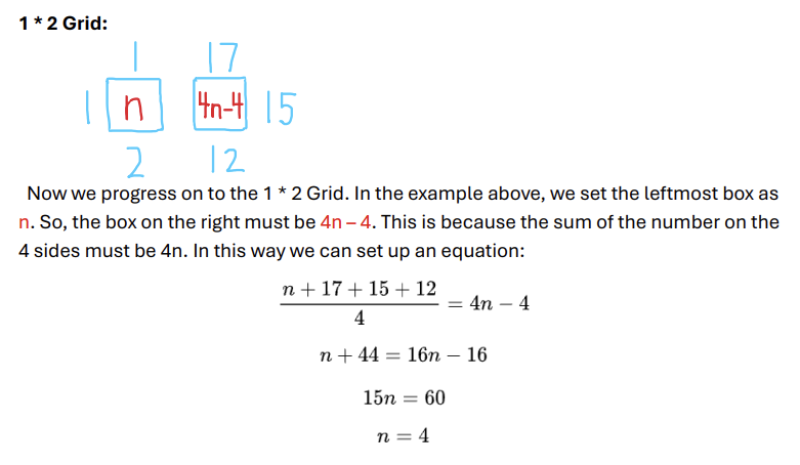
Take a look at Ziqian's full solution to see more ideas like this. Ziqian also uses one unknown for the 1 by 3 version, but then switches to using two unknowns for the 1 by 4 version. It is actually possible to still use only one unknown in this case - can you see how this might be done?
I wonder what the fewest possible number of unknowns are for every version of this problem?
We also received similar solutions from the following students: Aadhrith from Linton Heights in the UK; Ayah, Amelia and Aarav from Doha College in Qatar; Xian from Garden International School in Malaysia; Yasin from Newton British Acadamy Al Dafna in Qatar; Jerry from Hampton School in England; Kaumudi, Avic, Sanat, Vishnuvardhan, Prakul, Aarav, Harmann and Mrunmayee from Ganit Kreeda in Vicharvatika, India; Yumeng from Kings' School Al Barsha in the UAE; Viren KS; Vihaan from Singapore American School in Singapore; Zein from Castle Academy in England; Tasby from Mulberry School for Girls in England; Shreehari from Gurukul The Day School in India; Viduni from Kendrick School in the UK; and Curtis from Harrow School in the UK. Thank you all for sending in your solutions.
Teachers' Resources
Using NRICH Tasks Richly describes ways in which teachers and learners can work with NRICH tasks in the classroom.
Why do this problem?
This problem offers opportunities for students to apply what they know about finding the mean. As students move towards working systematically, they are challenged to adapt and extend their approaches to suit the more complex problems.
Key ideas
There are multiple ways of approaching this problem. Learners might take a numerical approach, developing a systematic form of trial and improvement, recognising that the four numbers surrounding each square must add to a multiple of 4.
Some might prefer to use algebra, writing letters to represent all or some of the unknowns and creating algebraic statements using the information they know.
Key questions
How could you calculate the mean of four numbers?
If the mean of four numbers is a whole number, what can you say about the total of these numbers?
What is the smallest value this mean could be? (Remember that the means are whole numbers.)
For students who are using algebraic approaches:
If $A$ is the mean of the four numbers surrounding it, what is the total of those four numbers?
Possible support
It is essential that students have a good understanding of the concept of mean average. This Primary webinar recording offers some guidance on how to introduce the concept.
If students take an algebraic approach, they may find it difficult to set up equations involving the unknowns. This Secondary webinar recording offers guidance on how these problems can be approached algebraically.
Possible extension
The Settings menu (purple cog) offers a whole range of levels, including the 3x3 grid, which is likely to challenge even the highest attainers in the class!
Students who are confident with using an algebraic approach may be tempted to put a different letter in each square of the grid. They might like to find a simpler algebraic approach, which uses as few unknowns as possible.
An alternative way to extend the problem is to ask students to create a similar problem for someone else to solve (with whole number solutions).
Algebraic Averages offers two levels of challenge:
Level 1 requires students to solve equations with one unknown
Level 2 requires students to solve simultaneous equations with two unknowns