

Hunting for Averages

 1 out of 3
Can you find the missing number(s)? The square is the average (mean) of the numbers surrounding it.
Problem
Hunting for Averages printable sheet
In these challenges, the number in each square is the average (mean) of the four numbers surrounding it.
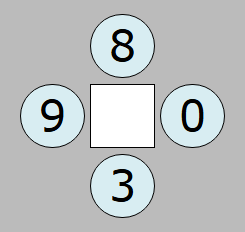
What number should go in this square? Have a think, then take a look at the answer.
Answer
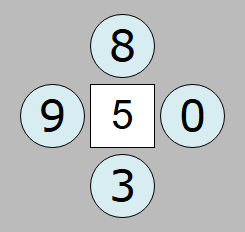
Can you see why the answer is 5?
Can you see why the numbers 4 and 6 belong in the two squares in the problem below?
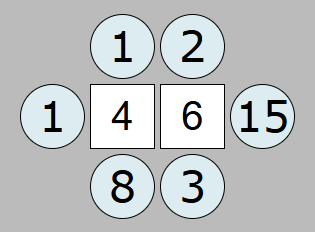
The challenge, in the interactivity below, is to find the missing number(s). All numbers are whole numbers.
You can click on the purple cog to change the grid size.
Can you create a similar problem for someone else to solve (with whole number solutions)?
Connecting Averages offers further challenges.
Student Solutions
We received a lot of solutions to this problem, so thank you to everybody who shared their ideas with us. Some of the solutions were more suited to Connecting Averages, so we've published them there instead.
1 by 1 layout
Demir from Pierrepont Gamston Primary School in England explained the general method for solving the problems with one empty square:
Add all the numbers surrounding the answer box
Make sure you have added correctly
Divide your answer by the amount of numbers surrounding the answer box
Adam from Copthorne Prep School in England explained how this method can be used to answer our first example question:
To solve a mean problem you have to add the sum of all the numbers for example the first one 9, 8, 3, 0 which the sum is 20 then you divide by the numbers shown which in this example is four so the answer is five.
Prakul from Ganit Kreeda, Vichar Vatika in India explained how to solve these problems when the missing number is in a circle, rather than in the middle square:
To find the missing number I can multiply the mean by four as multiplication and division are reverse operations and then subtract the sum of the other three numbers. That is the solution.
Vihaan from Singapore American School in Singapore gave a slightly different explanation of these methods for solving the problems where there's a single square:
I will give the answer for 2 types of puzzles: when you fill in the mean or when you fill in a number that is not the mean.
Fill in the mean. You take the average of the numbers given (add all up then divide by the amount of numbers given). The quotient is the mean.
Fill in a number that is not the mean. You multiply the mean (in the middle) by the number of non-mean numbers then subtract the given non-mean numbers to get the answer.
It looks like everybody agrees that these are the most efficient methods for solving the 1 by 1 version of this problem. I wonder if there are more different ways to solve the 1 by 2 version...
1 by 2 layout
Aathirai from Sishya OMR in India explained how to solve our example question using trial and improvement:
In 2, 15, 3 it can add up to 20. 20 is divisible by 4 but if we put 5 and 0 the other side 1, 1, 8 adds up to 10 and 0 is too small. So we try 24. 20+4=24 and 6×4=24 so the answer is 4 6.
Amane, Tyler, Shion, Omar, Kaito and Eva from St. Mary's International School in Japan also used multiples of four to help them solve these problems:
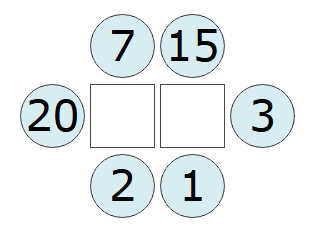
For the blank diagrams, we added the three numbers which were given, then Amane advised that we use multiples of 4 because the mean number must be whole so the total must be divisible by 4.
For the first problem with two blank squares, we added the three numbers; 20+7+2 which gave us 29. The next multiple of 4 greater than 29 is 32. So we tried placing 3 in the right-hand box. 32 divided by 4 is 8, so we placed 8 in the left hand box.
8+15+3+1 = 27. This is not divisible by 4 so we had to start again.
The next multiple after 32 is 36. So this time we placed 7 in the right hand box to make a total of 36, which divided by 4 is 9.
9+15+3+1 = 28. Divided by 4 this is 7 which is what we already had!
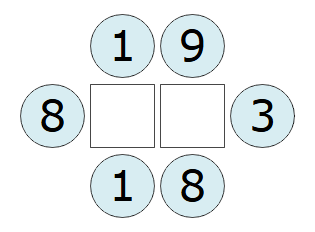
We used the same method for the next problem and found it did not work when using the multiple 12 for the left hand numbers, so tried 16 and got 4 and 6 as the centre numbers which worked!
Mahika from Navadisha Montessori School in India used a similar method, except she was very deliberate with her starting point:
Step 1: Start with the highest combination of numbers.
Why might it be helpful to begin by adding up the biggest numbers first?
Vivaan from Ganit Kreeda looked at all of the missing numbers at the same time, and used facts about multiples of four to narrow down what the missing numbers might be. Take a look at Vivaan's full solution to see more ideas about this.
Ayaansh from Ganit Kreeda used algebra to solve this problem:
Let's call the left box X and the right box Y.
My Equations:
For the left box X, the numbers around it are 7, 20, 2, and Y.
- $X = (7 + 20 + 2 + Y) \div 4$
- $4 \times X = 29 + Y$
For the right box Y, the numbers around it are 15, 3, 1, and X.
- $Y = (15 + 3 + 1 + X) \div 4$
- $4 \times Y = 19 + X$
- $X = (4 \times Y) - 19$
Finding the numbers:
Now I change the X in my first equation to be $(4 \times Y) - 19$.
- $4 \times ((4 \times Y) - 19) = 29 + Y$
- $(16 \times Y) - 76 = 29 + Y$
Move the Y to one side and numbers to the other side:
- $15 \times Y = 29 + 76$
- $15 \times Y = 105$
- $Y = 105 \div 15$
- $Y = 7$
Now that I know Y is 7, I can easily find X:
- $X = (4 \times 7) - 19$
- $X = 28 - 19$
- $X = 9$
My Final Answers:
- Left Box = 9
- Right Box = 7
Lamees from Doha College in Qatar had a very similar method, but explained in more detail how to get from one equation to the next. Take a look at Lamees' full solution to see how this is done.
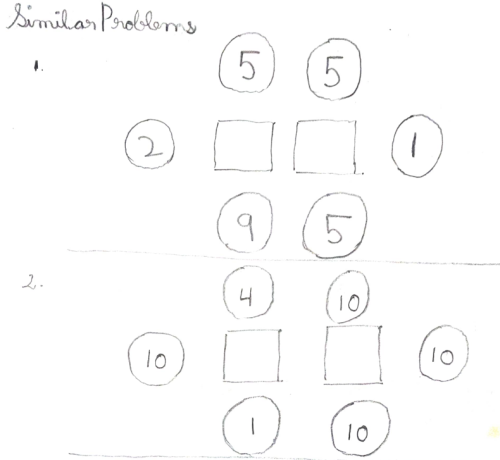
Atharvv from Pupil Tree School in India made up some problems for others to solve:
Finally, Mollie from Kambala in Australia noticed something interesting about the 1 by 2 version of this challenge:
First, I add all the exterior numbers. Then, after some other tries on the website, I figured out that the exterior number total must be 3 times the interior number total.
Aniruddha from Gurukul The Day School in India noticed the same thing:
First, let's assume that we are solving the 1 × 2 version. Let the boxes be A and B. Now, we can use a rule that A + B = (The sum of all the 6 numbers surrounding A and B) divided by 3. For example, if the numbers surrounding A and B have a sum of 48, then A + B = 16.
I wonder why this happens? If we can show that this will always be the case, it could be a helpful piece of information to help us solve these problems!
We also received similar solutions from: Jason C, Jason L, Justin, Martin, Adyuth, Xander, Nathan, Raphael and Leya from ESF Clearwater Bay School in Hong Kong; Syeda from Hollywood Primary Nedlands WA in Australia; Aarush from Pierrepont Gamston Primary School in the UK; Danish, Nura, Yaman, Julien, Rodri and Umar from Newton British Acadamy Al Dafna in Qatar; Isla and Chloe from Kambala in Australia; Emaan from Eastcourt Independent School in the UK; Ophir, Rose, Alon, Noam, Manon, Raphael, Bibi, Bel, Theo, Sasha, Ellie, Gidi, Mika, Lola, Eloise and Rosie from Eden Primary School in England; Shivashree, Advaya, Harvy, Siddharth, Shravani and Aathirai from Ganit Kreeda, Vichar Vatika in India; and Dhakshitha, Pranav, Dvithi, Thwisha, Meghna and Lohithashri from Navadhisha Montessori School in India. Thank you all for sending in your solutions.
Teachers' Resources
Using NRICH Tasks Richly describes ways in which teachers and learners can work with NRICH tasks in the classroom.
Why do this problem?
This webinar recording offers guidance on how to introduce the concept of mean average, and then goes on to discuss this task and how it might be used in the classroom.
This problem offers opportunities for learners to explore what is meant by the mean of four numbers. As learners move from the challenge with one unknown to the more complex challenge with two unknowns, they will have the opportunity to develop and improve their strategies, working systematically and using known facts about the four times table to find the solutions.
Key ideas
Learners might take an exploratory approach initially, possibly developing a systematic form of trial and improvement as they become more familiar with the problem.
Key questions
How do you calculate the mean of four numbers?
If the mean of four numbers is a whole number, what can you say about the total of these numbers?
If I know three of the numbers, how can I use their total to work out possible values for the fourth number?
If a number is the mean of the four numbers surrounding it, what can you say about the total of those four numbers?
Possible support
Spending some time on the grid with only one unknown will help learners become more confident with the properties of the mean before they move onto the 1x2 grid. Once they've noticed that the numbers surrounding a square must sum to a multiple of four, you could encourage learners to write down the multiples of four.
Possible extension
Learners could move on to creating a similar problem with whole number solutions.
Learners who become confident with both levels in the interactivity may like to have a go at Connecting Averages, which includes larger grids for them to think about. The second page of the printable sheet includes a taster of the challenges provided by the larger grids.