A Biggy
Find the smallest positive integer N such that N/2 is a perfect cube, N/3 is a perfect fifth power and N/5 is a perfect seventh power.
If a two digit number has its digits reversed and the smaller of the two numbers is subtracted from the larger, prove the difference can never be prime.
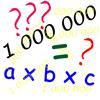
In how many ways can the number 1 000 000 be expressed as the product of three positive integers?
Take any pair of numbers, say 9 and 14. Take the larger number, fourteen, and count up in 14s. Then divide each of those values by the 9, and look at the remainders.
Weekly Problem 6 - 2010
Can you find three primes such that their product is exactly five times their sum? Do you think you have found all possibilities?
This group tasks allows you to search for arithmetic progressions in the prime numbers. How many of the challenges will you discover for yourself?
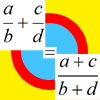
When if ever do you get the right answer if you add two fractions by adding the numerators and adding the denominators?