Let's Investigate Triangles
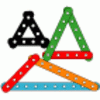
Vincent and Tara are making triangles with the class construction set. They have a pile of strips of different lengths. How many different triangles can they make?
This is part of our collection of favourite rich tasks arranged by topic.
If you are a teacher, you can find the whole collection on our Primary Curriculum teacher page.
Alternatively, if you are a student, you'll find the same problems on our Primary Curriculum student page.
Vincent and Tara are making triangles with the class construction set. They have a pile of strips of different lengths. How many different triangles can they make?
In this town, houses are built with one room for each person. There are some families of seven people living in the town. In how many different ways can they build their houses?
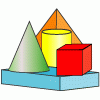
We have a box of cubes, triangular prisms, cones, cuboids, cylinders and tetrahedrons. Which of the buildings would fall down if we tried to make them?
Can you sort these triangles into three different families and explain how you did it?
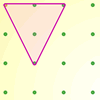
How many different triangles can you draw which each have one dot in the middle?
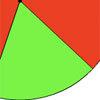
Use your mouse to move the red and green parts of this disc. Can you make images which show the turnings described?
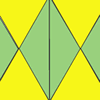
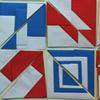
Try continuing these patterns made from triangles. Can you create your own repeating pattern?
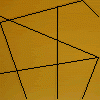
This challenge invites you to create your own picture using just straight lines. Can you identify shapes with the same number of sides and decorate them in the same way?
Sara and Will were sorting some pictures of shapes on cards. "I'll collect the circles," said Sara. "I'll take the red ones," answered Will. Can you see any cards they would both want?
Shapes are added to other shapes. Can you see what is happening? What is the rule?
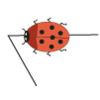
This ladybird is taking a walk round a triangle. Can you see how much she has turned when she gets back to where she started?
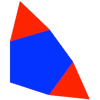
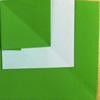
Can you work out what shape is made when this piece of paper is folded up using the crease pattern shown?
Have a go at making a few of these shapes from paper in different sizes. What patterns can you create?
Are these statements relating to calculation and properties of shapes always true, sometimes true or never true?
Here is a selection of different shapes. Can you work out which ones are triangles, and why?
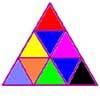
Explore ways of colouring this set of triangles. Can you make symmetrical patterns?
In this activity, shapes can be arranged by changing either the colour or the shape each time. Can you find a way to do it?
How many balls of modelling clay and how many straws does it take to make these skeleton shapes?
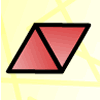
How many different ways can you find to join three equilateral triangles together? Can you convince us that you have found them all?
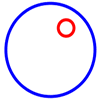
The red ring is inside the blue ring in this picture. Can you rearrange the rings in different ways? Perhaps you can overlap them or put one outside another?
Can you design your own version of the Olympic rings, using interlocking squares instead of circles?
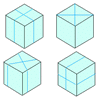
Eight children each had a cube made from modelling clay. They cut them into four pieces which were all exactly the same shape and size. Whose pieces are the same? Can you decide who made each set?
If you split the square into these two pieces, it is possible to fit the pieces together again to make a new shape. How many new shapes can you make?
Complete the squares - but be warned some are trickier than they look!
Can you each work out what shape you have part of on your card? What will the rest of it look like?
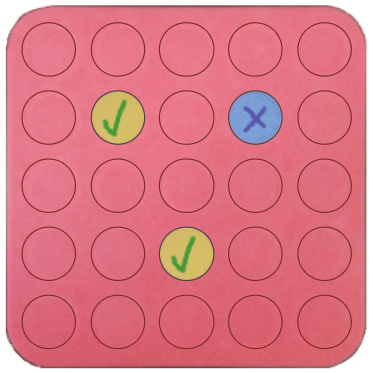
The computer has made a rectangle and will tell you the number of spots it uses in total. Can you find out where the rectangle is?
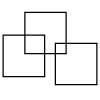
What is the greatest number of squares you can make by overlapping three squares?