

Triangle Animals

 2 out of 3
How many different ways can you find to join three equilateral triangles together? Can you convince us that you have found them all?
Problem
I can join two equilateral triangles together along their edges like this:
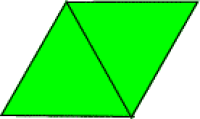
How many different ways are there to join three equilateral triangles together? (You must match an edge to an edge.)
How do you know you have got them all? You may find it useful to print out and cut up triangles from this sheet.
Have you got a system for checking that you have them all?
For a further challenge, you might like to look at Tri-Five.
Getting Started
What is the same?
What is different?
How do you know that you have them all?
You might like to print off this sheet of equilateral triangles and cut them out.
Student Solutions
Grace and Brittany from Stradbroke Primary both made the problem simpler to start with (this is often a good way of starting a problem, so good thinking!). Grace wrote:
$1$ triangle makes $1$ shape
$2$ triangles makes $1$ shape
$3$ triangles makes $1$ shape
$4$ triangles makes $3$ shapes
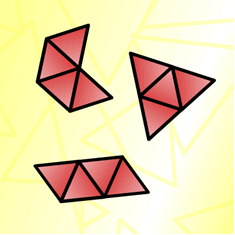
Jonathan from Brick Street Public School explained how he found the three different ways for 4 triangles, starting with the shape made from three triangles:
Here is a picture of the three shapes that Jonathan sent:
Teachers' Resources
Using NRICH Tasks Richly describes ways in which teachers and learners can work with NRICH tasks in the classroom.
Why do this problem?
There are two main reasons for using this problem in the classroom. The first is to encourage children to develop a systematic approach to solving problems. The second is to enable them to understand that rotating a shape does not change the shape itself, it just puts it in a different place (or orientation). Both these ideas can be touched upon as you introduce the problem.
Possible approach
To begin with, explore just two triangles. This might be best done by having large cut out triangles on the floor, or using some on an interactive whiteboard.
Give learners time to explore in pairs using triangular blocks, or triangles cut from paper/card (this sheet may be useful). Make sure you allow time for them to 'play' with the ideas before asking about the number of different solutions.
As they begin to consider how many possible solutions there are for two triangles, and how they know, listen out for pairs who are coming up with a system of some sort to keep track of their thinking. If necessary, suggest to the group that one of the triangles could be kept still while you look at the different positions of the second triangle. This will encourage them to move the second triangle around the first in a particular direction i.e. having a system so that no possibilities are left out. Then, by looking at each of the different shapes and rotating them, children can be asked what they notice. (They are all the same.)
In this way, the class can conclude that in fact there is only one way to put two triangles together. This initial exploration and discussion will equip them for tackling the main parts of the problem in their pairs.
Key questions
Have you decided what is the same and what is different?
How do you know that you have them all?
Possible extension
Children could have a go at Tri-Five. They could also see what happens if they use two or three isoceles triangles. Are their results different? Why? Again the focus should be on developing the use of accruate descriptive language and beginning to introduce the correct mathematical vocabulary of vertices, sides and angles.
Possible support
Having lots of cut-out triangles for children to stick down will help them access this challenge. You could use this sheet of equilateral triangles for printing and cutting (and possibly laminating too).