Round the Three Dice
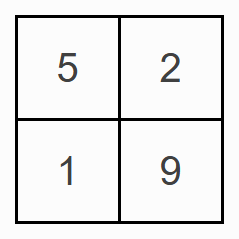
What happens when you round these three-digit numbers to the nearest 100?
This is part of our collection of favourite rich tasks arranged by topic.
If you are a teacher, you can find the whole collection on our Primary Curriculum teacher page.
Alternatively, if you are a student, you'll find the same problems on our Primary Curriculum student page.
What happens when you round these three-digit numbers to the nearest 100?
Which is quicker, counting up to 30 in ones or counting up to 300 in tens? Why?
Can you replace the letters with numbers? Is there only one solution in each case?
Do you agree with Badger's statements? Is Badger's reasoning 'watertight'? Why or why not?
Can you complete this calculation by filling in the missing numbers? In how many different ways can you do it?
Can you work out some different ways to balance this equation?
What happens when you round these numbers to the nearest whole number?
Have a go at balancing this equation. Can you find different ways of doing it?
Use your knowledge of place value to try to win this game. How will you maximise your score?
Find out what a Deca Tree is and then work out how many leaves there will be after the woodcutter has cut off a trunk, a branch, a twig and a leaf.
Each child in Class 3 took four numbers out of the bag. Who had made the highest even number?
You have two sets of the digits 0-9. Can you arrange these in the five boxes to make four-digit numbers as close to the target numbers as possible?
There are nasty versions of this dice game but we'll start with the nice ones...
Use two dice to generate two numbers with one decimal place. What happens when you round these numbers to the nearest whole number?
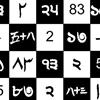
There are six numbers written in five different scripts. Can you sort out which is which?
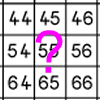
Four of these clues are needed to find the chosen number on this grid and four are true but do nothing to help in finding the number. Can you sort out the clues and find the number?
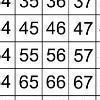
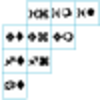
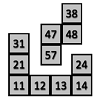
This 100 square jigsaw is written in code. It starts with 1 and ends with 100. Can you build it up?
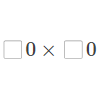
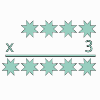
This multiplication uses each of the digits 0 - 9 once and once only. Using the information given, can you replace the stars in the calculation with figures?
Choose four different digits from 1-9 and put one in each box so that the resulting four two-digit numbers add to a total of 100.
In these addition and subtraction games, you'll need to think strategically to get closest to the target.
In these multiplication and division games, you'll need to think strategically to get closest to the target.
Try out these calculations. Are you surprised by the results?
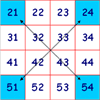
In this 100 square, look at the green square which contains the numbers 2, 3, 12 and 13. What is the sum of the numbers that are diagonally opposite each other? What do you notice?
How many solutions can you find to this sum? Each of the different letters stands for a different number.