

Less Is More

 1 out of 3
Use your knowledge of place value to try to win this game. How will you maximise your score?
Problem
The video below introduces this challenge:
You can have a go using this interactivity:
If you are working away from a computer, you could treat this as a game for two people, or play in two teams of two.
You will need a 1-6 or 0-9 dice. Our dice interactivity can be used to simulate throwing different dice.
Each team should draw some cells that look like the picture below. (The cells on the left don't need to be a different colour, but we will refer to those cells later.) Alternatively, you could print off this sheet of cells.
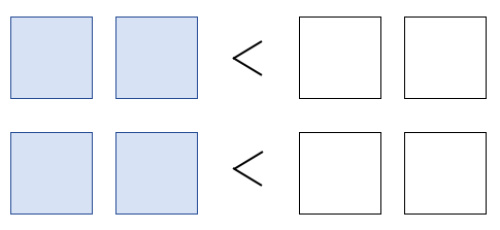
Version 1
You will need to throw the dice eight times in total. After each throw of the dice, each team decides which of their cells to place that number in.
When all the cells are full, each team will have created four two-digit numbers.
Teams then check if their number sentences are correct:
- If both number sentences are correct, the team scores the sum of the two two-digit numbers written in the blue boxes.
- If only the first number sentence is correct, the team scores the two-digit number in the top blue boxes.
- If only the second number sentence is correct, the team scores the two-digit number in the bottom blue boxes.
The winner is the team with the higher score. See Getting started for some examples of scoring.
Have a go at playing the game and keep a running total of your scores.
- Who is the winner after ten rounds?
- Who is the first to reach 500 points?
In between rounds, teams might like to try to find the highest possible score they could have achieved, if they had known the eight numbers in advance. Their new scores can be added to their running totals.
Will this affect your strategy in the next round?
Version 2
Have a go at playing the game in a similar way to Version 1, but this time, note down all eight dice rolls before deciding where to place them.
Keep a running total of your scores.
Who is the winner after ten rounds?
Who is the first to reach 500 points?
Final challenge:
Now, imagine that the numbers 1, 2, 3, 4, 5, 6, 7 and 8 have been thrown.
Where would you place them in order to get the highest possible score?
Can you provide a convincing argument that you have arranged the numbers in the best possible way?
You may like to check whether you have indeed got the maximum score by typing the numbers 1 to 8 (without commas and with no spaces between them) into the 'Values' box in the Settings of the interactivity above, and then testing your solution.
An interesting follow-up to this game is More Less is More, which again challenges you to create correct statements, but this time after carrying out some simple calculations.
This activity featured in an NRICH student webinar.
Getting Started
Here are some examples to help you understand the scoring system:

Score = 57 (both number sentences are correct)

Score = 33 (only the bottom number sentence is correct)
With the numbers 1-8, it is possible to score more than 117!
Student Solutions
Well done to everybody who managed to find the highest maximum score in this game. We received lots of interesting solutions which described how to go about arranging the numbers to maximise the score.
Ghaya from Nord Anglia School in Abu Dhabi, UAE gradually increased their score using trial and improvement:
First attempt:
45<62
43<53
I put 62 on the right because 6 is the highest possible number. I scored 88 but it isn't the highest possible score.
Second attempt:
53<62
43<45
I switched 45 and 53 because 53 would give me a higher possible score but I still didn't get the highest score. My score was 96.
Third attempt:
53<62
44<53
This time I switched the 4 from 45 and the 3 from 43 then this gave me the highest possible score which was 97.
Ze Zhi from St. Mary's International in Tokyo, Japan explained that the key digits to focus on are the tens digits of the numbers on the left of the inequality signs:
First, to solve this question we can look at the left side of this question. Instead of trying
randomly we can see if we can make the tens column as big as we can without getting the
question wrong. The answer comes from adding the top and bottom number on the left of this
question. You can see here that the total is 98 which is the highest number you can possibly
score without getting the question wrong.
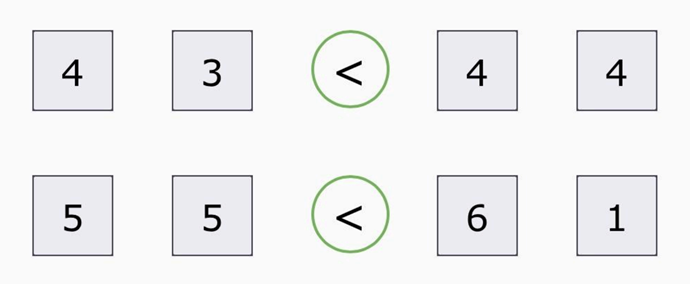
As the score comes from adding the two numbers on the left, making these numbers as large as possible does make sense. Emma from St Elizabeth Catholic Primary School in England also looked at the tens digits:
You need to work out the tens first so that it is a bigger number. Tip: Be systematic!
I wonder how being systematic can help us find the maximum score?
The Golden Eagles and Snowy Owls from Anston Greenlands Primary School explained what to do once the tens digits were in place:
If the tens digit is not the same in an inequality, make the ones digit as small as possible in the bigger number and make the ones digit as large as possible in the smaller number.
I wonder what we should do when the tens digits are the same? Luke from England described the full strategy and began to consider this:
Find the 4 highest digits and put them in the tens columns - the highest goes in the top right number, second highest top left, next highest bottom right, then bottom left.
You then put the four smallest numbers in the ones columns - lowest goes on the right and as high as possible on the left as long as they are correct for the equality signs.
It's interesting that putting the lowest ones digits on the right and the highest on the left won't always work. Meera from the GYM Foundation in India also noticed this, and had some ideas for how to solve this problem in the case where there are repeating digits. Take a look at Meera's full solution to see her ideas.
Rishi from Padma Seshadri Bala Bhavan in India also thought hard about how the order of the ones digits has to change when there are repeated tens digits. Rishi has worked through several different examples in this video, and he's found a case where the game is impossible to win!
Lots of other children agreed with Rishi that 127 was the largest possible solution for the final challenge of placing the numbers 1, 2, 3, 4, 5, 6, 7 and 8. Angie and Nini from SJS in Hong Kong explained why putting the highest digits in the tens columns is the most effective method here:
Usually people would put 87 on the right, but the logic here is that you should put 81 on the right, because you need to save up 7 for the left to get high scores. On the right are 1 & 2 because we need the small numbers on right so that we don't end up getting a lower score. The reason why we don't put higher numbers on the right side right box is because: 87 and 65, if you even try to make a higher number it would be 43+21=64, which as you can see, is very low compared to this: 74<81 & 53<62 which equals to 127; very different.
Dylan from SJS described how to tackle this problem systematically:
Write down a list of numbers from 1 to 8. Put the largest number in the tens place on the right, and put the second largest in the tens place on the left. Cross those numbers out. Then, put the smallest number into the units place on the right and the second smallest number in the units place on the left. Cross those numbers out from the list. Repeat with the remaining numbers for the 2nd equation.
Noah from St Augustine's Catholic Primary School in the UK filled in the numbers in two steps:
If you roll 1 ,2, 3, 4, 5, 6 ,7 and 8, here's how to get quite a high score: (B = blank). 7B < 8B and 5B < 6B. Then, do 74 < 81 and 53 < 62. This gets us a score of 127.
Matthew and Chris from SJS explained why 127 is the highest possible score, and they found several different ways of making 127:
I believe the highest score is 127, and I believe there are four ways to achieve this.
Solution 1: 74<81 53<62 74+53=127
Solution 2: 73<81 54<62 73+54=127
Solution 3: 74<82 53<61 74+53=127
Solution 4: 73<82 54<61 73+54=127
I think 127 is the correct answer for the final challenge because if you want the numbers to be the biggest, then you have to make sure the tens are 1 bigger on the right than the left and having the smallest numbers ( 1 and 2 ) on the right side units place while having the second and third smallest on the left units. Why? Because since the tens provide the most amount and they matter the most, you must have 8 as one of the tens on the right, and trying to use the most of it, put 7 on the same sentence on the the left's tens place. Next just put 6 underneath 8 in the second sentence's right's tens place and the tens place is finished. After we finish the tens place, we focused on the remaining digits: 1, 2, 3, 4. Since you want the left to be the biggest, just squish 3 and 4 in the units place on the left and 1,2 on the right.
We also received similar solutions from: Akhil from Cannon Lane Primary School in the UK; Dhriya from Nord Anglia School in Abu Dhabi, UAE; Iwinosa and Osarumen from Hope Primary School in the UK; Lloyd, Lenni and Isaac from Penarlag in the UK; Emma and Kylynn from Shatin Junior School in Hong Kong; Aarav, Marvin and Noa from St. Mary's International School in Tokyo, Japan; Shivaprasad from The GYM Foundation in India; Manvik from Ganit Kreeda in Vicharvatika, India; the children from William Konkin Elementary School in Canada; and Noah from St Augustine's Catholic Primary School in Frimley, UK. Thank you all for sharing your ideas with us.
Teachers' Resources
Using NRICH Tasks Richly describes ways in which teachers and learners can work with NRICH tasks in the classroom.
Why play this game?
This game is thought-provoking and very engaging, and helps learners become more familiar with the mathematical symbols for 'greater than' and 'less than'. Along with Dicey Operations, it encourages discussion of place value, alongside valuable strategic mathematical thinking.
Setting up the game with students working collaboratively offers the chance for them to focus on key ways of thinking and working as mathematicians.
Possible approach
Before the interactivity was added, this problem featured in an NRICH Primary and Secondary webinar.
You can introduce the game by playing the video, or recreating the video contents for yourself using the interactivity.
Invite students to have a go at the game in pairs, ideally using the interactivity on a computer or tablet. Set them the challenge to try to find the highest possible scores in fewer than three attempts.
Once they have had chance to play several rounds, bring everyone together to discuss their thinking. How are they deciding where to place the numbers? How are they trying to maximise their score?
Having shared strategies, students might enjoy playing in teams of two against each other. Who can reach 500 points first? Or who can make the highest score after five rounds?
Key questions
How are you trying to make sure each number sentence is true, while still getting a high score?
How are you deciding which cells to fill in first?
Possible extension
More Less is More also challenges learners to create inequality statements, but this time after carrying out some simple calculations. The first challenge (called 'sum-sum') is a natural follow-up to this task.
Possible support
Learners could try a single-digit version of the game initially, rolling the dice four times.
Learners could be provided with number cards that they can move around the grid to consider different options.