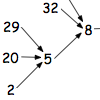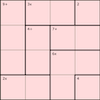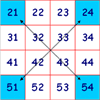
Strike It Out
Use your addition and subtraction skills, combined with some strategic thinking, to beat your partner at this game.
This is part of our collection of favourite rich tasks arranged by topic.
If you are a teacher, you can find the whole collection on our Primary Curriculum teacher page.
Alternatively, if you are a student, you'll find the same problems on our Primary Curriculum student page.
Use your addition and subtraction skills, combined with some strategic thinking, to beat your partner at this game.
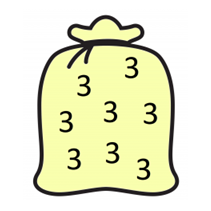
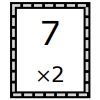
This problem is designed to help children to learn, and to use, the two and three times tables.
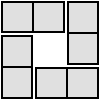
Use these four dominoes to make a square that has the same number of dots on each side.
We can arrange dots in a similar way to the 5 on a dice and they usually sit quite well into a rectangular shape. How many altogether in this 3 by 5? What happens for other sizes?
Lolla bought a balloon at the circus. She gave the clown six coins to pay for it. What could Lolla have paid for the balloon?
Put operations signs between the numbers 3, 4, 5 and 6 to make the highest possible number and lowest possible number.
On the planet Vuv there are two sorts of creatures. The Zias have 3 legs and the Zepts have 7 legs. The great planetary explorer Nico counted 52 legs. How many Zias and how many Zepts were there?
48 is called an abundant number because it is less than the sum of its factors (without itself). Can you find some more abundant numbers?
The value of the circle changes in each of the following problems. Can you discover its value in each problem?
Can you put the numbers 1 to 8 into the circles so that the four calculations are correct?
Find out what a Deca Tree is and then work out how many leaves there will be after the woodcutter has cut off a trunk, a branch, a twig and a leaf.
There is a clock-face where the numbers have become all mixed up. Can you find out where all the numbers have got to from these ten statements?
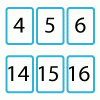
These sixteen children are standing in four lines of four, one behind the other. They are each holding a card with a number on it. Can you work out the missing numbers?
Place the numbers from 1 to 9 in the squares below so that the difference between joined squares is odd. How many different ways can you do this?
Add or subtract the two numbers on the spinners and try to complete a row of three. Are there some numbers that are good to aim for?
In this game, you can add, subtract, multiply or divide the numbers on the dice. Which will you do so that you get to the end of the number line first?
What numbers would you put on this number line as it goes under the sea level?
Can you put the numbers 1-5 in the V shape so that both 'arms' have the same total?
There are nasty versions of this dice game but we'll start with the nice ones...
This group activity will encourage you to share calculation strategies and to think about which strategy might be the most efficient.
You are organising a school trip and you need to write a letter to parents to let them know about the day. Use the cards to gather all the information you need.
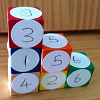
What happens when you add the digits of a number then multiply the result by 2 and you keep doing this? You could try for different numbers and different rules.

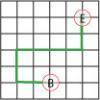
Tom and Ben visited Numberland. Use the maps to work out the number of points each of their routes scores.
In this game the winner is the first to make the total 37. Is this a fair game?
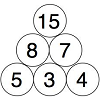
Can you find all the ways to get 15 at the top of this triangle of numbers? Many opportunities to work in different ways.
Roll two red dice and a green dice. Add the two numbers on the red dice and take away the number on the green. What are all the different possible answers?
Can you go through this maze so that the numbers you pass add to exactly 100?
Use the 'double-3 down' dominoes to make a square so that each side has eight dots.
Find at least one way to put in some operation signs to make these digits come to 100.
Amy has a box containing domino pieces but she does not think it is a complete set. Which of her domino pieces are missing?
Katie had a pack of 20 cards numbered from 1 to 20. She arranged the cards into 6 unequal piles where each pile added to the same total. What was the total and how could this be done?
Mrs Morgan, the class's teacher, pinned numbers onto the backs of three children. Use the information to find out what the three numbers were.
Choose four different digits from 1-9 and put one in each box so that the resulting four two-digit numbers add to a total of 100.
Can you make square numbers by adding two prime numbers together?
Tim had nine cards each with a different number from 1 to 9 on it. How could he have put them into three piles so that the total in each pile was 15?
Use your logical thinking skills to deduce how much Dan's crisps and ice cream cost altogether.
A group of children are using measuring cylinders but they lose the labels. Can you help relabel them?
Investigate the different numbers of people and rats there could have been if you know how many legs there are altogether!
This challenge combines addition, multiplication, perseverance and even proof.
This task combines spatial awareness with addition and multiplication.
How could you arrange at least two dice in a stack so that the total of the visible spots is 18?
In these addition and subtraction games, you'll need to think strategically to get closest to the target.
An investigation involving adding and subtracting sets of consecutive numbers. Lots to find out, lots to explore.
A game for two people, or play online. Given a target number, say 23, and a range of numbers to choose from, say 1-4, players take it in turns to add to the running total to hit their target.
Try out these calculations. Are you surprised by the results?
Can you use the clues to complete these 4 by 4 Mathematical Sudokus?
Ten cards are put into five envelopes so that there are two cards in each envelope. The sum of the numbers inside it is written on each envelope. What numbers could be inside the envelopes?