Your Number Is...
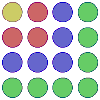
Think of a number and follow the machine's instructions... I know what your number is! Can you explain how I know?
The Number Jumbler can always work out your chosen symbol. Can you work out how?
I'm thinking of a number. My number is both a multiple of 5 and a multiple of 6. What could my number be?
Some of the numbers have fallen off Becky's number line. Can you figure out what they were?
Play this game to learn about adding and subtracting positive and negative numbers
15 = 7 + 8 and 10 = 1 + 2 + 3 + 4. Can you say which numbers can be expressed as the sum of two or more consecutive integers?
In how many ways can you fit all three pieces together to make shapes with line symmetry?
How many different symmetrical shapes can you make by shading triangles or squares?
Square numbers can be represented as the sum of consecutive odd numbers. What is the sum of 1 + 3 + ..... + 149 + 151 + 153?
Try entering different sets of numbers in the number pyramids. How does the total at the top change?
Can you arrange these numbers into 7 subsets, each of three numbers, so that when the numbers in each are added together, they make seven consecutive numbers?
Create some shapes by combining two or more rectangles. What can you say about the areas and perimeters of the shapes you can make?
Follow this recipe for sieving numbers and see what interesting patterns emerge.
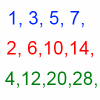
Alison, Bernard and Charlie have been exploring sequences of odd and even numbers, which raise some intriguing questions...
Can you deduce the perimeters of the shapes from the information given?
A colourful cube is made from little red and yellow cubes. But can you work out how many of each?
The large rectangle is divided into quadrilaterals and triangles. Can you untangle what fractional part is represented by each of the ten numbered shapes?
When number pyramids have a sequence on the bottom layer, some interesting patterns emerge...
Explore the area of families of parallelograms and triangles. Can you find rules to work out the areas?
If you move the tiles around, can you make squares with different coloured edges?
A 2 by 3 rectangle contains 8 squares and a 3 by 4 rectangle contains 20 squares. What sizes of rectangle contain exactly 100 squares? Can you find them all?
If you have a large supply of 3kg and 8kg weights, how many of each would you need for the average (mean) of the weights to be 6kg?