Hex
Explain how the thirteen pieces making up the regular hexagon shown in the diagram can be re-assembled to form three smaller regular hexagons congruent to each other.
It's easy to work out the areas of most squares that we meet, but what if they were tilted?
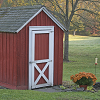
Can you minimise the amount of wood needed to build the roof of my garden shed?
Can you make sense of these three proofs of Pythagoras' Theorem?
A dot starts at the point (1,0) and turns anticlockwise. Can you estimate the height of the dot after it has turned through 45 degrees? Can you calculate its height?
Sets of integers like 3, 4, 5 are called Pythagorean Triples, because they could be the lengths of the sides of a right-angled triangle. Can you find any more?
Four identical right angled triangles are drawn on the sides of a square. Two face out, two face in. Why do the four vertices marked with dots lie on one line?
A square of area 40 square cms is inscribed in a semicircle. Find the area of the square that could be inscribed in a circle of the same radius.
The area of a square inscribed in a circle with a unit radius is 2. What is the area of these other regular polygons inscribed in a circle with a unit radius?