Immersion
Various solids are lowered into a beaker of water. How does the water level rise in each case?
The illustration shows the graphs of fifteen functions. Two of them have equations $y=x^2$ and $y=-(x-4)^2$. Find the equations of all the other graphs.
Quadratic graphs are very familiar, but what patterns can you explore with cubics?
10 graphs of experimental data are given. Can you use a spreadsheet to find algebraic graphs which match them closely, and thus discover the formulae most likely to govern the underlying processes?
Can you work out which processes are represented by the graphs?
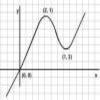
This problem challenges you to find cubic equations which satisfy different conditions.
Sketch the members of the family of graphs given by $y = a^3/(x^2+a^2)$ for $a=1, 2$ and $3$.
Can you work out the equations of the trig graphs I used to make my pattern?
By sketching a graph of a continuous increasing function, can you prove a useful result about integrals?