Seeing Squares
Players take it in turns to choose a dot on the grid. The winner is the first to have four dots that can be joined to form a square.


Players take it in turns to choose a dot on the grid. The winner is the first to have four dots that can be joined to form a parallelogram.
Take a look at these data collected by children in 1986 as part of the Domesday Project. What do they tell you? What do you think about the way they are presented?
Have a look at this table of how children travel to school. How does it compare with children in your class?
Can you see how these factor-multiple chains work? What can you find out about them?
What happens when you add two odd numbers together?
This box does something to the numbers that go into it. What might be happening inside the box?
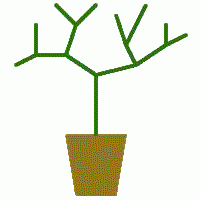
Can you work out how many flowers there will be on this plant after six weeks?
What happens when you add a three digit number to its reverse?
Here is a machine with four coloured lights. Can you develop a strategy to work out the rules controlling each light?