

Forwards Add Backwards

 1 out of 3
What happens when you add a three digit number to its reverse?
Problem
Forwards Add Backwards printable worksheet

The number $747$ can be made by adding a $3$-digit number with its reversal: $621 + 126 = 747$, for example.
Can you find the other two ways of making a total of 747 in this way?
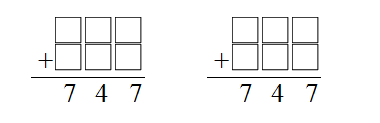
747 is not the only total between 700 and 800 that can be made from a number plus its reversal.
Can you find some other totals between 700 and 800 that can be made from a number plus its reversal?
Can you find all the totals between 700 and 800 that can be made from a number plus its reversal? (There are more than five...)
Can you explain how you know you have found all the possible totals?
How many totals between 300 and 400 can be made from a number plus its reversal? And between 800 and 900...?
Can you work out how to make a total of 1251 by adding a 3-digit number to its reversal?
Can you find all the totals between 1200 and 1300 that can be made from a number plus its reversal? (There are more than five...)
And what about totals between 1900 and 2000...?
Possible extension
I wonder what happens if we subtract rather than add...
Are there any numbers between 200 and 300 that can be made by subtracting a three digit number from its reversal? (There are fewer than five...)
Are there any numbers between 1200 and 1300 that can be made by subtracting a four digit number from its reversal? (There are fewer than five, but more than one...)
Have you found all the possibilities? Can you explain how you know?
With thanks to Don Steward, whose ideas formed the basis of this problem.
Getting Started
There are $10$ totals between $700$ and $800$ which can be made from a number plus its reversal.
Five of these totals are palindromic and the other five aren't.
Teachers' Resources
Using NRICH Tasks Richly describes ways in which teachers and learners can work with NRICH tasks in the classroom.
Why do this problem?
This problem offers students an engaging way to apply their understanding of place value. We hope that students will build on their initial results and use the generalisations that emerge to justify their conclusions.
Possible approach
This printable worksheet may be useful: Forwards add Backwards.
You could pose each of the questions in the form "I wonder..." to capture how productive it can be for mathematicians to be curious and keep asking questions.
The sequence of questions in the problem builds up ideas iteratively and offer slightly different challenges at each stage.
The real value of this problem is that it offers students various contexts in which to explore what's the same and what's different about the various solutions (see Key Questions below) and challenge students to use this to build convincing arguments.
It is important to allow enough time and opportunities for students to develop, refine and share their arguments with each other.
Key questions
Which numbers from 0 to 9 can you use in the tens column?
Which pairs of numbers could you use in the hundreds column (and ones column)?
What is the same in each calculation?
Possible support
You may like to invite students to write their totals on the board as they go along so that these can prompt other students to consider further alternatives.
Possible extension
In the problem, the possible extension invites students to consider subtraction rather than addition. Developing convincing arguments that they ahve found all poissble solutions is slightly more difficult in this case, so teachers might like to encourage students to turn to algebra.
Interestingly, if for the first challenge we start with $abc$, then $(100a+10b+c)-(100c+10b+a)=99a-99c$, so the differences need to be a multiple of $99$.
For the second challenge, starting with $abcd$, differences need to be of the form $999(a-d)+90(b-c)$. This means they could either be $999$ plus a multiple of $90$, or $1998$ minus a multiple of $90$.
Once students have worked on this extension, they might like to try working on Legs Eleven.
Submit a solution
What we like to see
We have written an article on what we are looking for when we decide which solutions to publish.
You can share your work with us by typing into the form above or uploading a file.
What can I upload?
- Word documents
- PDF files
- Excel spreadsheets
- Images, including screenshots or photos of written work
If your work is on another app
You can also send us a link to your work on:
- Youtube/Vimeo
- Google Docs
- Sharepoint/Office 365
- Anywhere sensible on the internet!
Please make sure you have set the permissions so that we can access your work.
How we use your information
By uploading your solution here you are giving us permission to publish your work, either as a whole or edited extracts, on the NRICH website and in associated educational materials for students and teachers, at our discretion.
For our full terms of use regarding submitted solutions and user contributions please see https://nrich.maths.org/terms.
Your information (first name, school name etc) is optional. If supplied, it may be used for attribution purposes only if your work is published on the website. Data that you supply on this form (e.g. age if supplied, location if supplied) may also be anonymised and used for evaluation and reporting.
For more information about the University's policies and procedures on handling personal information, and your rights under data protection legislation, please see https://www.information-compliance.admin.cam.ac.uk/data-protection/general-data.