

Data Shapes

 1 out of 3
Sara and Will were sorting some pictures of shapes on cards. "I'll collect the circles," said Sara. "I'll take the red ones," answered Will. Can you see any cards they would both want?
Problem
Sara and Will were sorting some pictures of shapes on cards.
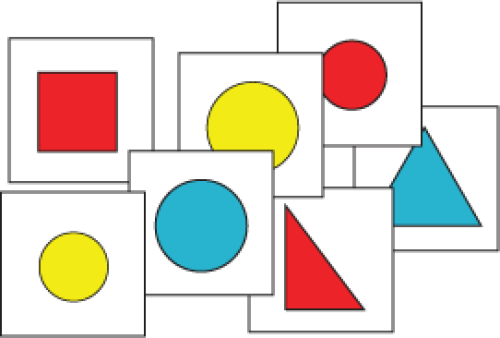
"I'll collect the circles," said Sara, "there are lots of those."
"I'll take the red ones," answered Will, "I like red."
Can you see any cards they would both want?
Here is a picture of all the cards they had.
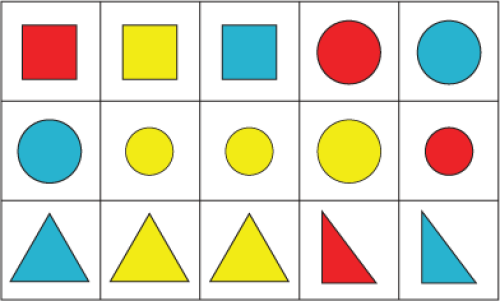
Image text description
For accessibility: A variety of shapes of different colours. A red square, a yellow square, a blue square, a large red circle, 2 large blue circles, 2 small yellow circles, a large yellow circle, a small red circle, a blue equilateral triangle, 2 yellow equilateral triangles, a red right-angled triangle, and a blue equilateral triangle.
How many cards could they have had each?
How many ways can you find to sort the cards?
Can you see any cards that are the same as other cards?
You might like to download the sheet of cards or investigate the different ways of sorting the cards using the interactivity below.
Getting Started
You could get a feel for this problem by sorting the shapes into three piles according to colour and then sorting them into the three shapes.
You could choose two cards and think about what is the same/different about them. This may help you find others which are the same/different too.
Student Solutions
We had good responses for this question.
Here is a selection.
The first is from Justin at Chatham Middle School, USA:
Sarah could have had a total of $7$ cards. Will could have had a total of $4$ cards.
There are a plethora of ways to sort the polygons on the cards.
Some ways to sort the cards would be:
Shape: Circle, Triangle, Square
Color: Red, Blue, Yellow
Number of Sides: Zero, Three, Four
Number of Angles: Zero, Three, Four
Total Degrees of All Angles: $180$, $360$
These ways are ways that some of the shapes are alike, and therefore can be characterized as such.
Daniel from Kings School in New Zealand wrote:
Sarah wants to collect the circles and Will wants to collect the red shapes so therefore the cards that they would both want would be the red circles.
Not including the red circles, Sarah would get $5$ cards with circles on them; and Will would get two cards with red shapes on them.
It is also possible to sort the shapes into groups of squares/quadrilaterals and triangles. You can further break it down into right angle triangles and equilateral triangles.
Also you can group them into polygons, constructible polygons, regular polygons, scalene triangles, big circles small circles.
There are also six cards exactly the same as another. The yellow equilateral triangles;
The two small, yellow circles;
And lastly, the blue circles.
Lastly, Matthew at Moonee Ponds Central School, Australia sent in the following:
How many cards could they have had each? The most equal amount of cards they could have had each is $4$ cards with one large blue circle card left out.
How many ways can you find to sort the cards? There are $4$ ways to sort the cards among Will and Sara.
Can you see any cards that are the same as other cards? There are three pairs of cards, one pair of small yellow circle cards, one pair of large yellow triangle cards and one pair of large blue circle cards.
Can you see any cards they would both want? There are $2$ cards they both want, one large red circle card and one small red circle card.
Thank you all very much. These were excellent suggestions for solutions. It's good to see that more and more of you are expressing your ideas so clearly in words. Well done and we look forward to hearing from you again soon.
Teachers' Resources
Using NRICH Tasks Richly describes ways in which teachers and learners can work with NRICH tasks in the classroom.
Why do this problem?
This problem uses simple shapes in three colours for sorting data in more than one way. Teachers and children may well think of other useful purposes for the cards.
If the shapes are printed onto thin card and laminated they should last a long time.
Possible approach
You could start by showing all the cards to the children and asking what they can tell you about them. This will be a good opportunity to listen to their use of mathematical vocabulary and introduce new terms where appropriate.
This problem is intended for children working in pairs, so that they are able to talk through their ideas with a partner. You could continue by giving each pair copies of these cards so that they can sort them in their own ways.
After they have had an opportunity to try sorting and to discuss with their partners how it could be done, it might be a good time to use, or introduce, a simple Venn diagram. This one shows how the question asked in the first part of the problem could be answered:

At the end of the lesson you could try different ways of sorting suggested by the children, using a Venn diagram if you think it appropriate.
Key questions
What can you see?
Can you think of another way you could sort the cards?
What is the same/different about these?
Tell me about what you are collecting.
Why do you think those two go together?
Where could you put this/these?
Possible extension
Learners could try one of the harder sorting problems, for example, Butterfly Cards.
Possible support
Some children may need a suggestion from you as to how to sort the cards to get them started.