

Jumping

 1 out of 3
After training hard, these two children have improved their results. Can you work out the length or height of their first jumps?
Problem
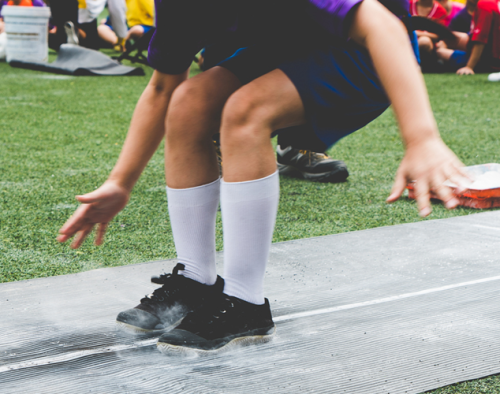
Mia is hoping to enter the long jump at her school sports day.
One day I saw her manage quite a good jump.
However, after practising several days a week she finds that he can jump half as far again as she did before.
This last jump was 3.75 metres long.
So how long was the first jump that I saw?
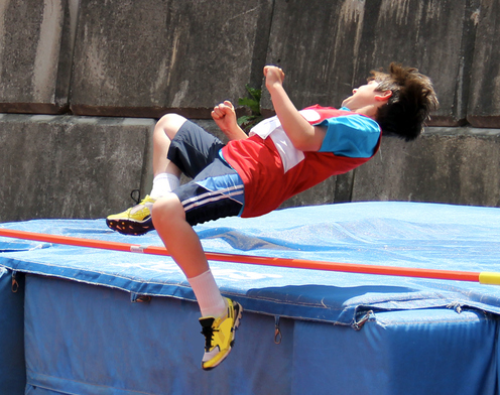
Now Ben has been practising for the high jump.
I saw that he managed a fairly good jump, but after training hard, he managed to jump half as high again as he did before.
This last jump was 1.20 metres.
So how high was the first jump that I saw?
How did you work these out?
Can you find any other ways of finding a solution?
Which way do you prefer? Why?
Getting Started
Use anything that you like to help you - pictures, number lines, a whiteboard for jottings ...
Is your answer sensible? Does it seem about the right size?
Student Solutions
We had a large number of solutions sent in and most of them were correct.
Baston, Midgley, Longcroft and Montgomerie Schools sent in many solutions. Here are some explanations that showed some good thinking.
The Maths Challenge Club from St Aidan's Primary sent in the following:
Isobel used a trial and error method:
$200 \times 1.5 = 300$ no- too small
$300 \times 1.5 = 450$ no- too big
$250 \times 1.5 = 375$ yes!
So the first jump was $250$cm
She used a trial and error method for the second question too:
$10+10+10= 30$ no- too small
$20+20+20=60$ no- too small
$30+30+30=90$ no, still too small
$40+40+40=120$ yes!
So the first jump was $40+40=80$cm
Jamila got the same answer, but used a different method:
$3.75 \div 2 = 1.875$
$1.875 \div 3 = 0.625$
$1.875 + 0.625 = 2.500$ or $2.5$m
$(a\div2) + (a\div6)$
She used the same method for the second question:
$(a\div3) \times 2$ where $a=120$cm = $80$cm
Holly and Chris from Myland School in England sent in this thorough explanation;
We worked out that Mia's first jump was $250$cm and Ben's first jump was $80$cm. We used division, multiplication, and addition to solve the problem.
First we halved the last jump number. Ben's last jump was $120$cm, half of that is $60$cm. We halved the number then added on the half. That would mean that Ben's last jump was $90$cm, which wasn't right.
We used a trial and improvement method. We chose round even numbers because it was much easier to find half. If the last jump worked out as $75$cm less than what we needed then we added $75$cm to the first jump number and tried again. Example - If the 1st jump was $200$cm the last jump would be $300$cm so we tried - If the 1st jump $275$cm then the last jump would be $412.5$cm That didn't work but it did get us closer to the answer. As $275$cm was too high, we tried $260$cm, then $250$cm.
We tried our own standing long jumps. Our best scores were:
Holly $110$cm Jordan $143$cm
If we improved our scores by half again that would be:
Holly $165$cm Jordan $214.5$cm
If we improved our scores by a quarter again that would be:
Holly $137.5$cm Jordan $178.75$cm
We folded the tape measure to help us work out a half and a quarter of different lengths.
Finally, Daniel from King's School New Zealand said:
Mia's last jump was $3.75$ metres long.
$3.75 = f + \frac{f}{2}$
$f$ = Mia's 1st jump
You need to find the value of $f$.
So $3.75 \div 3 = 1.25$
$1.5f \div 3 = \frac{f}{2}$
$\frac{f}{2} \times 2 = f$
$1.25 \times 2 = 2.5$
$f = 2.5$
Mia's first jump was $2.5$ metres
Ben's last jump was $1.20$ metres high.
$1.20 = f + \frac{f}{2}$
$f$ = Ben's first jump
You need to find the value of $f$.
So $1.20 \div 3 = 0.40$
$\frac{1.5f}{3} = \frac{f}{2}$
$\frac{f}{2} \times 2 = f$
$0.40 \times 2 = 0.80$
$f = 0.80$
Ben's first jump was $0.80$ metres high.
Well done all of you, and thanks for those contributions sent in.
Teachers' Resources
Using NRICH Tasks Richly describes ways in which teachers and learners can work with NRICH tasks in the classroom.
Why do this problem?
This problem uses the context of sports training to offer opportunities for learners to explore division and/or multiplication. Pupils will be required to consider the relationships between multiplication, division and fractions, which will help reveal their level of understanding.
Possible approach
Depending on pupils' previous experiences and skills, it might be helpful to pose a few questions involving finding 'half as much again' before going on to the problems as posed. You could encourage pupils to record their own long jump results during a PE lesson, then list some of these on the board when you return to class. Pick out one length and ask the group how far that child would have jumped if s/he had jumped half as far again. Invite pairs to work on finding a solution and then the ensuing discussion will allow you to assess how well they have understood the idea. You can pose a few similar questions to give them more practice, should they need it.
You can then introduce them to the questions as stated in the problem which require children to 'work backwards'. Again, encourage them to talk to a partner or work in a small group and give them free choice of equipment/tools that they feel would help their calculations.
Allow plenty of time for them to come together to discuss their methods. You may like to have picked out some pairs/groups and warned them in advance that you'd like them to explain what they've done to everyone else. Try to sit back during this discussion so that class comments on the explanations rather than you. This may well prove a good assessment opportunity from your perspective.
You may like to conclude by asking the children which method they would use if they were now given a similar problem. There are likely to be a range of responses, so encourage each pupil to give reasons for their choice.
Key questions
Tell me about the two jumps.
How did you get to your answer?
Possible extension
Ask children to create questions (to which they know the answers) that are similar, but also extend the simple phrase to one involving more difficult fractions. e.g. "only reached two thirds of what they did the first time" or "a third as much again".
Possible support
Some pupils may find it helpful to use some material to count with, for example a paper number line that can be cut up can be useful.