

Twice as Big?

 1 out of 3
Investigate how the four L-shapes fit together to make an enlarged L-shape. You could explore this idea with other shapes too.
Problem
If we double each side of a small square we get a new enlarged square:
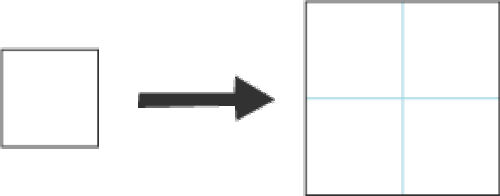
The new enlarged square is the size of four of the smaller squares.
This also happens when we enlarge other shapes. Some, like the squares, can be filled with the same smaller shape.
Look at these:
Can you work out how the four shapes fit to make the enlarged shape each time?
You might need to rotate or reflect the smaller shapes to fit them in. (This means that if you make them from squared paper you will need to turn them round or turn them over.) In this interactivity the rotation and the reflection of the shapes has been done for you.
If you enjoyed working on this problem, you might like to investigate some more shapes. Have a look at Two Squared or print out the sheet of shapes which contains some other examples as well as the shapes above.
Getting Started
Try putting one shape in at a time, being careful not to leave any gaps which you won't be able to fill.
If you're not using the interactivity, you might like to use this sheet and cut out the smaller shapes.
Student Solutions
We received several solutions to this problem - thank you to all of you who wrote in, including Ivy, Kelsie and William from Mason Middle School; Issy from Culford Prep and Jessica and Philip from CWBS. Here is the image that Jessica and Philip sent:
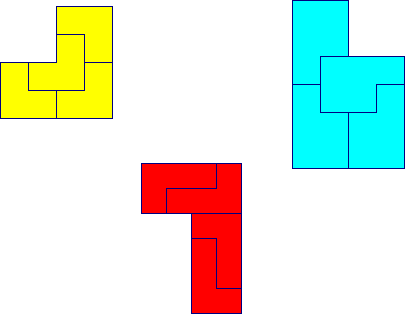
We also had suggestions about how to go about tackling the problem, for example by starting at the top and fitting shapes in, then gradually working down. Very good advice!
Teachers' Resources
Using NRICH Tasks Richly describes ways in which teachers and learners can work with NRICH tasks in the classroom.
Why do this problem?
This problem encourages children to use visualisation and will help to improve their spatial awareness.
Although, as it stands, the problem focuses on fitting the shapes into their enlarged version, it makes a good stepping stone to discussing what "bigger" means. Ask the class to investigate the difference in perimeter and area of the small and large version of the shapes. What do they notice?
Possible approach
You may like to talk to the group about some good ways to approach the problem - ask for their ideas and model some behaviours. You could place two shapes into the larger one leaving a small space which could not be filled to draw their attention to something to avoid!
If you are not using the interactivity, you may like to print off this sheet and cut out the shapes for the children. (The sheet also contains some shapes based on triangles as well as squares.) You may find that if they are working from "concrete" examples, the class will need reminding that they can flip and rotate the shapes.
Key questions
Can you think of a good way to start on this?
Why don't you try putting one shape in at a time?
Are you being careful not to leave any gaps which you won't be able to fill?
Have you remembered you can flip and rotate the shapes?
Possible extension
Learners could do the examples on the second page of this sheet or try Two Squared.
Possible support
Suggest using the interactivity working on one shape at a time from the top.