

Three by One

 1 out of 3
There are many different methods to solve this geometrical problem - how many can you find?
Problem
$ABCD$ is a rectangle where $BC$ = $3AB$. $P$ and $Q$ are points on $BC$ such that $BP$ = $PQ$ = $QC$.
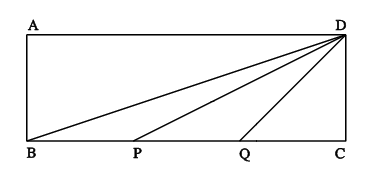
Show that: angle $DBC$ + angle $DPC$ = angle $DQC$
Generalise this result.
N.B. This problem can be tackled in at least 8 different ways using different mathematics learnt in the last two years in school and earlier. The methods are essentially the same when viewed from a more advanced perspective.
Getting Started
Here is a hint to help on you on the way :
Let $\alpha + \beta = \gamma$ and $\tan(\alpha + \beta) = \frac{\tan\alpha + \tan\beta}{1 - \tan\alpha\tan\beta}$
where $\alpha = \tan^{-1}{1\over3}$, $\beta = \tan^{-1}{1\over2}$, $\gamma = \tan^{-1}1$.
Student Solutions
The solutions produced here by school students show eight different methods. Reflection on these methods will help other students to see something of the 'bigger picture' in a way they will not experience from ploughing through the syllabus and working from textbooks (although that is also absolutely necessary).
Eight distinct proofs were given to this problem by two students, Alex and Neil (Madras College) using respectively sines, cosines, tangents, vectors, matrices, coordinate geometry, complex numbers and pure geometry.
Method 1: Tan Angle Sum Formula
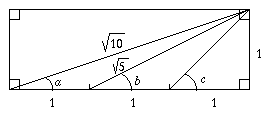
From the diagram, $a =\tan^{-1}(1/3), b =\tan^{-1}(1/2)$, and $c = \tan^{-1}(1)$.
We have to prove $a+b=c$, which is the same as proving that $\tan^{-1}(1/3)+\tan^{-1}(1/2)=\tan^{-1}(1)$.
Note that
$$
\begin{eqnarray}
\tan\left(\tan^{-1}\left(\frac{1}{3}\right)+\tan^{-1}\left(\frac{1}{2}\right)\right)
&=&\frac{\tan\left(\tan^{-1}\left(\frac{1}{3}\right)\right)+\tan\left(\tan^{-1}\left(\frac{1}{2}\right)\right)}
{1-\tan\left(\tan^{-1}\left(\frac{1}{3}\right)\right)\tan\left(\tan^{-1}\left(\frac{1}{2}\right)\right)}\cr &=&\frac{\frac{1}{3}+\frac{1}{2}}{1-\frac{1}{3}\cdot\frac{1}{2}}\cr &=&1
\end{eqnarray}
$$
Method 2: Sin Angle Sum Formula
Proof
Using Pythagoras we can calculate the lengths of the diagonal lines:
$$
\sin a = \frac{1}{\sqrt{10}}\quad \cos a = \frac{3}{\sqrt{10}}\quad \sin c = \frac{1}{\sqrt{2}}\quad \sin b = \frac{1}{\sqrt{5}}\quad \cos b = \frac{2}{\sqrt{5}}
$$
Using the identity $\sin(a+b) = \sin a \cos b + \sin b \cos a$ we see that
$$
\begin{eqnarray}
\sin(a+b) &=& \frac{1}{\sqrt{10}}\cdot\frac{2}{\sqrt{5}}+\frac{1}{\sqrt{5}}\cdot \frac{3}{\sqrt{10}}\cr
&=& \frac{2+3}{\sqrt{10\cdot 5}}\cr
&=& \frac{5}{\sqrt{50}}\cr
&=&\frac{1}{\sqrt{2}}\cr
&=& \sin c
\end{eqnarray}
$$
Hence the result is proved.
Method 3: Cosine Rule
This method required us to extend the diagram as follows:
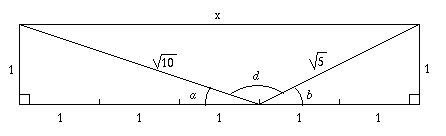
From the altered diagram it can be seen that $x=3+2=5$.
Next, $d$ can be found using the cosine rule $c^2= a^2+b^2-2ab \cos C$.
Substitution of these values gives
$$
\cos d = \frac{-1}{\sqrt{2}}
$$
Thus $d=135^\circ$. Therefore $a+b = 180^\circ - d = 45^\circ = c$
Hence the result is proved.
Method 4: Vector
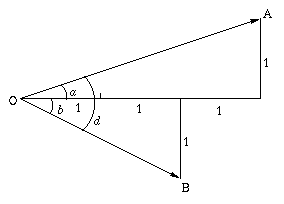
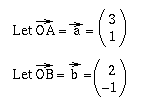
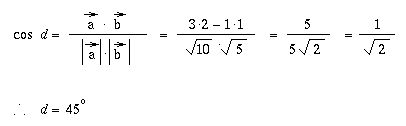
Hence the result is proved.
Method 5: Matrices
Let $\bf{d} = (x, y)$ be any point in the $x-y$ plane. Let $\bf{d}_1$ be the point obtained by rotating $a^\circ$ about the origin.

Let $\bf{d}_2$ be the point obtained by rotating $\bf{d}_1$ by $b^\circ$ around the origin.
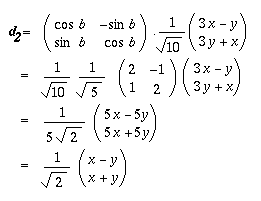
Finally, let $\bf{d}_2$ be the point obtained by rotating $\bf{d}$ by $c^\circ$ around the origin.

Hence a rotation by $a+b$ is the same as a rotation by $c$ degrees. Hence, $a+b=c$, as none of the angles is greater than $90^\circ$.
Method 6: Pure Geometry
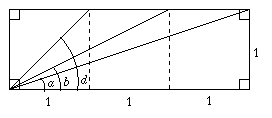
By looking at the leftmost unit square this diagram can be drawn
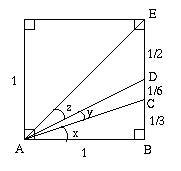
$a+b=c \Leftrightarrow x+x+y = x+y+z \Leftrightarrow x=z$
Hence it must be proven than $x=z$:
Split triangle ADE into two right angled triangles ADF and EDF
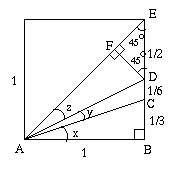
From this it can be seen that
$$
EF = DF = \frac{\sqrt{2}}{4}
$$
and
$$
AF = AE-FE = \sqrt{2} -\frac{\sqrt{2}}{4} = \frac{3\sqrt{2}}{4}
$$
Thus
$$
AF:AB = \frac{3\sqrt{2}}{4}:1
$$
and
$$
DF:BC = \frac{\sqrt{2}}{4}:\frac{1}{3} = \frac{3\sqrt{2}}{4}:1
$$
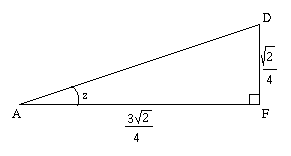
Hence ADF and ABC are similar triangles and, therefore, $x=z$. Thus, $a+b=c$.
Method 7: Coordinate Geometry
The coordinate geometry proof is based on the following diagram; the gradients are easy to read off the original image.
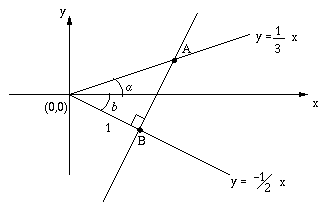
Let $B$ be the point $( x_B ,y_B )$ on the line $y = -\frac{1}{2} x$ at a distance of $1$ from the origin. Since $\sqrt{x^2_B+y^2_B} = 1$ and $y_B = -\frac{1}{2}x_B$ we have
$$
\begin{eqnarray}
\sqrt{x^2_B+\frac{1}{4}x^2_B} &=& \sqrt{\frac{5}{4}x^2_B} = 1\cr
\Rightarrow x_B = \frac{2}{\sqrt{5}}\cr
\Leftrightarrow y_B = \frac{-1}{\sqrt{5}}
\end{eqnarray}
$$
Thus,
$$
B=\left(\frac{2}{\sqrt{5}}, \frac{-1}{\sqrt{5}}\right)
$$
We can now determine the equation of the line through $B$ perpendicular to the line $y = -\frac{1}{2} x$ to be
$$
y = 2x-\sqrt{5}.
$$
This line intersects $y=\frac{1}{3} x$ at $A$ which we can calculate to be
$$
A= \left(\frac{3}{\sqrt{5}}, \frac{1}{\sqrt{5}}\right)
$$
Now that we konw points $A$ and $B$ we can calculate the distance between them as
$$
|AB| = \sqrt{\left(\frac{3}{\sqrt{5}}-\frac{2}{\sqrt{5}}\right)^2 +\left(\frac{1}{\sqrt{5}}+\frac{1}{\sqrt{5}}\right)^2}= \sqrt{\frac{1}{5}+\frac{4}{5}}=1
$$
Referring back to the diagram shows that $a+b=45^\circ$ and the result is proved.
Method 8: Complex Numbers
This method uses aspects of other proofs presented (and therefore could be shortened) but we include it because it gives a nice example of how complex numbers, matrices and all other methods fit nicely together.
Let $r=\sqrt{x^2+y^2}$.
Now, the complex number corresponding to the point with coordinates $(x, y)$ in the argand diagram can be written as
$$
z= x+iy = r\exp\left(i\tan^{-1} \left(\frac{y}{x}\right)\right)
$$
Let $z'$ be the complex number obtained by rotating $z$ by $2(a+b)$ degrees. Then we can use the identities $\sin(a+b) = \sin a \cos b +\cos a\sin b$ and $\cos(a+b) = \cos a \cos b-\sin a \sin b$ to see that:
$$
\begin{eqnarray}
z' &=& r\exp\left(i\tan^{-1}\left(\frac{y}{x}\right)+2i(a+b)\right)\cr
&=& r\left[\cos\left(\tan^{-1}\left(\frac{y}{x}\right)+2(a+b)\right)+i\sin\left(\tan^{-1}\left(\frac{y}{x}\right)+2(a+b)\right)\right]\cr
&=&r\left[\cos\left(\tan^{-1}\left(\frac{y}{x}\right)\right)\cos\left(2(a+b)\right)-\sin\left(\tan^{-1}\left(\frac{y}{x}\right)\right)\sin\left(2(a+b)\right)\right]\cr
&& +ir\left[ \sin\left(\tan^{-1}\left(\frac{y}{x}\right)\right)\cos\left(2(a+b)\right)+\cos\left(\tan^{-1}\left(\frac{y}{x}\right)\right)\sin\left(2(a+b)\right) \right]
\end{eqnarray}
$$
We can simplify the arctangents by considering the following diagram:
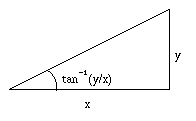
From this we can see that $\cos\left(\tan^{-1}\left(\frac{y}{x}\right) \right)= \frac{x}{r}$ and $\sin\left(\tan^{-1}\left(\frac{y}{x}\right) \right)= \frac{y}{r}$
This simplifies the expression for $z'$ to
$$
z' = x\cos\left(2(a+b)\right)-y\sin\left(2(a+b)\right)+i\left(y\cos\left(2(a+b)\right)+x\sin\left(2(a+b)\right)\right)
$$
Alex and Neil then used some double angle formulae and the fact that $\sin(a+b)=\cos(a+b)=\frac{1}{\sqrt{2}}$ to determine that
$$
z' = -y+ix
$$
Since this is a complex number rotated through $90^\circ$ we can conclude that $a+b = 45^\circ$
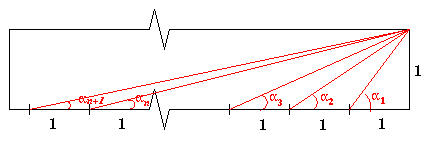
Alex and Neil went on to generalise this problem to rectangles with dimensions $n$ by 1.
| 1 | 2 | 3 | 4 | 5 | 6 | 7 | 8 | 9 | 10 | 11 | 12 | |
| ( p , q ) pairs | (2,3) | (3,7) | (4,13) | (5,21) | (6,31) | (7,43) | (8,57) | (9,73) | (10,91) | (11,111) | (12,133) | (13,157) |
| (3,2) | (5,8) | (7,18) | (9,32) | (13,21) | (11,50) | (13,72) | ||||||
| (12,17) |
Conjecture 1:
Proof:
Sigi suggests that certain solutions are dependent in that they use different notations for the same underlying contexts. Sigi suggests the following interesting task: Which of the different methods are genuinely mathematically independent of each other? Certainly something to think about.
Teachers' Resources
Using NRICH Tasks Richly describes ways in which teachers and learners can work with NRICH tasks in the classroom.
Why do this problem?
In this one problem you meet many important aspects of mathematics. It illustrates how much mathematics is inter-related. It shows the value of not being content to find one solution, but of asking yourself "could I solve this another way?" or "have I found the best method?" It is very satisfying to feel you have somehow got to the very essence of a mathematical idea by looking at it in the right way, though of course there can me many "right ways" to look at it.
Also this problem provides a good example of how you can generalise from a result that is really a simple case of a much more general result. Are you content just to solve a problem or do you ask yourself "what if ...." and try to find more general results?
Possible approach
You could challenge your class to find as many different methods of solving this problem as possible. You could tell them that one pair of school students found 8 different methods. At some stage of this work, and depending on your students' mathematical experience, you might mention that these two students used respectively sines, cosines, tangents, vectors, matrices, coordinate geometry, complex numbers and pure geometry.
Perhaps your students could work in pairs. They could come to the board and present their solutions to the rest of the class and/or make posters for the classroom wall. You could see collectively how many different methods your class can find.
Key questions
What lengths in the diagram can we find?
What do we know about sines, cosines, tangents, vectors, matrices, coordinate geometry, complex numbers and pure geometry that we can use to prove this result?
How might we generalise this result?
Possible extension
The linked article Why Stop at Three by One? beautifully generalises this result.