Dicey Array
Watch the video of this game being played. Can you work out the rules? Which dice totals are good to get, and why?
In this problem, we're investigating the number of steps we would climb up or down to get out of or into the swimming pool. How could you number the steps below the water?
Investigate the different shaped bracelets you could make from 18 different spherical beads. How do they compare if you use 24 beads?
48 is called an abundant number because it is less than the sum of its factors (without itself). Can you find some more abundant numbers?
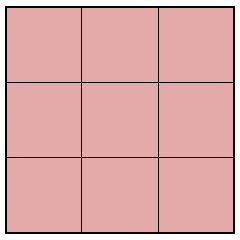
Can you work out the arrangement of the digits in the square so that the given products are correct? The numbers 1 - 9 may be used once and once only.
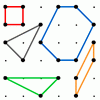
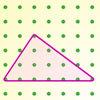
How would you move the bands on the pegboard to alter these shapes?
Which is quicker, counting up to 30 in ones or counting up to 300 in tens? Why?
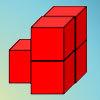
How can you arrange the 5 cubes so that you need the smallest number of Brush Loads of paint to cover them? Try with other numbers of cubes as well.
What numbers would you put on this number line as it goes under the sea level?
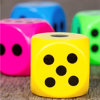
Investigate the sum of the numbers on the top and bottom faces of a line of three dice. What do you notice?
This challenge encourages you to explore dividing a three-digit number by a single-digit number.
Watch this animation. What do you see? Can you explain why this happens?
Use your knowledge of place value to try to win this game. How will you maximise your score?
Katie had a pack of 20 cards numbered from 1 to 20. She arranged the cards into 6 unequal piles where each pile added to the same total. What was the total and how could this be done?
Mrs Morgan, the class's teacher, pinned numbers onto the backs of three children. Use the information to find out what the three numbers were.
What do you think is going to happen in this video clip? Are you surprised?
Nine squares with side lengths 1, 4, 7, 8, 9, 10, 14, 15, and 18 cm can be fitted together to form a rectangle. What are the dimensions of the rectangle?
This problem challenges you to work out what fraction of the whole area of these pictures is taken up by various shapes.
Can you order the digits from 1-3 to make a number which is divisible by 3 so when the last digit is removed it becomes a 2-figure number divisible by 2, and so on?
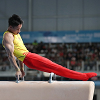
This task looks at the different turns involved in different Olympic sports as a way of exploring the mathematics of turns and angles.
What is the largest 'ribbon square' you can make? And the smallest? How many different squares can you make altogether?
Try out these calculations. Are you surprised by the results?
A game in which players take it in turns to choose a number. Can you block your opponent?