History of Mathematics books
This list is part of our Recommended Books selection of books, for young people who are interested in mathematics.
-
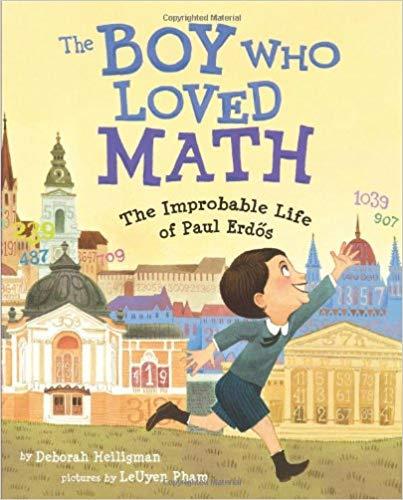
bookAges7+Most people think of mathematicians as solitary, working away in isolation. And, it's true, many of them do. But Paul Erdős never followed the usual path. At the age of four, he could ask you when you were born and then calculate the number of seconds you had been alive in his head. But he didn't learn to butter his own bread until he turned twenty. Instead, he traveled around the world, from one mathematician to the next, collaborating on an astonishing number of publications. With a simple, lyrical text and richly layered illustrations, this is a beautiful introduction to the world of math and a fascinating look at the unique character traits that made "Uncle Paul" a great man. -
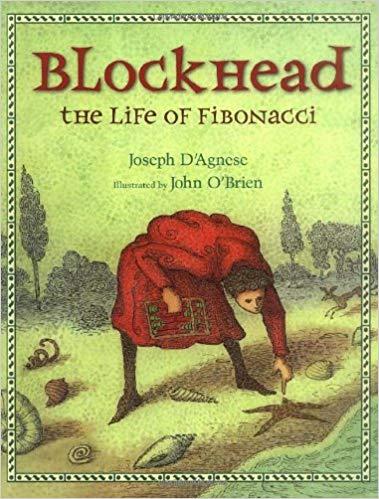
bookAges7+Blockhead: The Life of Fibonacci
As a young boy in medieval Italy, Leonardo Fibonacci thought about numbers day and night. He was such a daydreamer that people called him a blockhead. When Leonardo grew up and traveled the world, he was inspired by the numbers used in different countries. Then he realized that many things in nature, from the number of petals on a flower to the spiral of a nautilus shell, seem to follow a certain pattern. The boy who was once teased for being a blockhead had discovered what came to be known as the Fibonacci Sequence! -
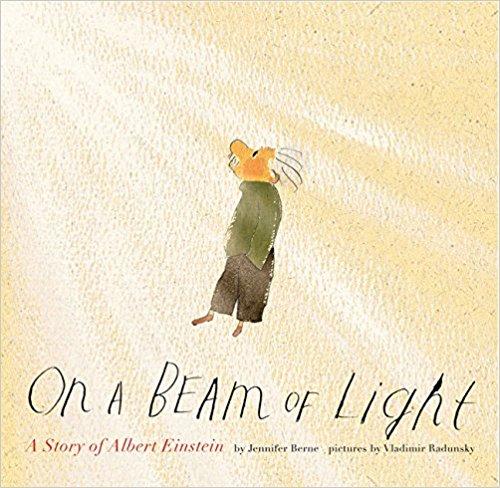
bookAges7+On a Beam of Light: A Story of Albert Einstein
Travel along with Einstein on a journey full of curiosity, laughter, and scientific discovery. Parents and children alike will appreciate this moving story of the powerful difference imagination can make in any life. -
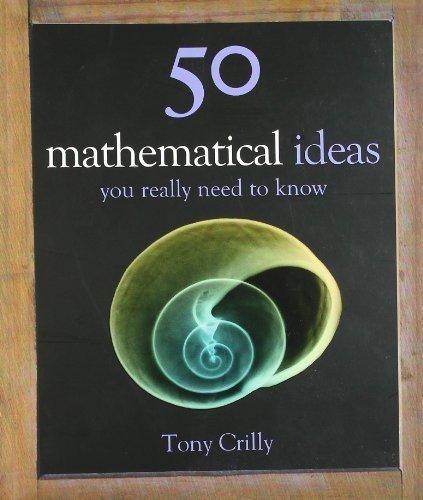
bookAges11+50 Mathematical Ideas You Really Need to Know
In this book, Professor Tony Crilly explains in 50 clear and concise essays the mathematical concepts - ancient and modern, theoretical and practical, everyday and esoteric - that allow us to understand and shape the world around us. Packed with diagrams, examples and anecdotes, this book is the perfect overview of this often daunting but always essential subject. For once, mathematics couldn't be simpler. -
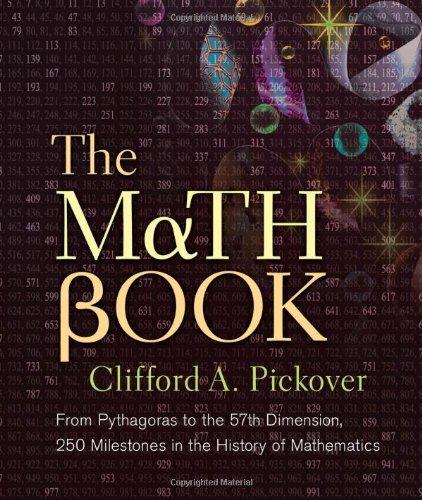
bookAges12+The Math Book
Mathematic's infinite mysteries and beauty unfold in this book. Beginning millions of years ago with ancient ant odometers and moving through time to our modern-day quest for new dimensions, prolific polymath Clifford Pickover covers 250 milestones in mathematical history. Among the numerous concepts readers will encounter as they dip into this inviting anthology: cicada-generated prime numbers, magic squares, the discovery of pi and calculus, and the butterfly effect. Each topic is presented in a lavishly illustrated spread, including formulas, fascinating facts about scientists' lives and real-world applications of the theorems. -
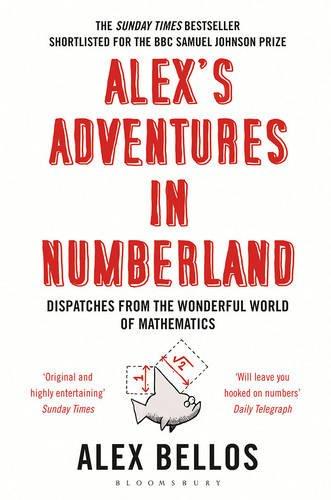
bookAges13+Alex's Adventures in Numberland
The world of maths can seem mind-boggling, irrelevant and, sometimes, boring. This groundbreaking book reclaims maths from the geeks. Mathematical ideas underpin just about everything in our lives: from the surprising geometry of the 50p piece to how probability can help you win in any casino. In search of weird and wonderful mathematical phenomena, Alex Bellos travels across the globe and meets the world's fastest mental calculators in Germany and a startlingly numerate chimpanzee in Japan. Packed with fascinating, eye-opening anecdotes, Alex's Adventures in Numberland is an exhilarating cocktail of history, reportage and mathematical proofs that will leave you awestruck. -
bookAges14+The Monty Hall Problem: Beyond Closed Doors
This short book explores the Monty Hall dilemma, a well known mathematical puzzle. The original problem, the controversy surrounding it and its solution are discussed. Further, the boundaries of the problem are expanded to consider prior knowledge and host intention. This book should be of interest to those who enjoy problem solving. -
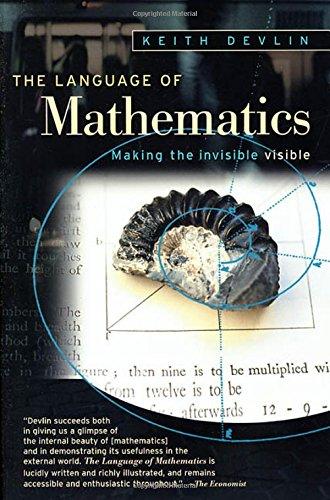
bookAges14+The Language of Mathematics
In The Language of Mathematics, award-winning author Keith Devlin reveals the vital role mathematics plays in our eternal quest to understand who we are and the world we live in. More than just the study of numbers, mathematics provides us with the eyes to recognize and describe the hidden patterns of life. Devlin shows us what keeps a jumbo jet in the air, explains how we can see and hear a football game on TV, allows us to predict the weather, the behavior of the stock market, and the outcome of elections. Far from a dry and esoteric subject, mathematics is a rich and living part of our culture. An exploration of an often woefully misunderstood subject, this book celebrates the simplicity, the precision, the purity, and the elegance of mathematics. -
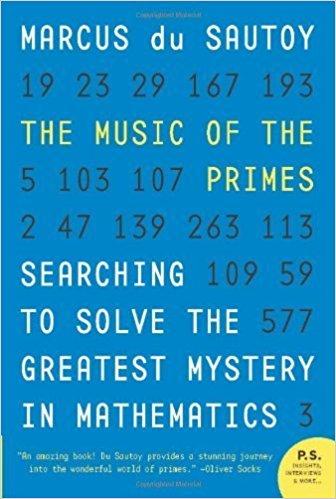
bookAges14+The Music of the Primes
How can one predict when the next prime number will occur? Is there a formula which could generate primes? These apparently simple questions have confounded mathematicians ever since the Ancient Greeks. In 1859, the brilliant German mathematician Bernhard Riemann put forward a hypothesis which finally seemed to reveal a magical harmony at work in the numerical landscape. The promise that these eternal, unchanging numbers would finally reveal their secret thrilled mathematicians around the world. Yet Riemann never publicly provided a proof for his hypothesis and his housekeeper burned most of his personal papers on his death. Whoever cracks Riemann's hypothesis will go down in history, for it has implications far beyond mathematics. In business, it plays a central role in security and e-commerce. In science, it brings together vastly different areas, with critical ramifications in Quantum Mechanics, Chaos Theory and the future of computing. Pioneers in each of these fields are racing to crack the code and a prize of $1 million has been offered to the winner. As yet, it remains unsolved. -
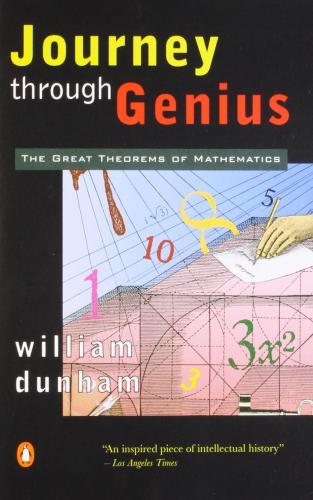
bookAges14+Journey Through Genius: The Great Theorems of Mathematics
In this book Dunham treats mathematical theorems as creative works of art. He places each theorem within its historical context and explores the very human and often turbulent life of the creator. He studies such great mathematicians as Archimedes, Gerolamo Cardano and Georg Cantor. He also provides step-by-step proofs for the theorems, each easily accessible to readers with no more than a knowledge of high school mathematics. -
bookAges14+The Mathematical Universe: Alphabetical Journey Through the Great Proofs, Problems & Personalities
In this book, Dunham takes us through a tantalizing selection of the great proofs, notorious disputes, and intriguing unsolved mysteries of the mathematical universe. Subjects range from the golden age of Greek geometry to the furthest frontier of infinite series. Dunham explores more than five thousand years of mathematical history, digging into the earliest records in Egypt, Babylon, India, and China, and turning up surprising tales and tidbits from modern times. All along the way, Dunham portrays the great masters of mathematics at their work. In colorful anecdotes, the brilliant - often eccentric - luminaries chart the course of mathematical progress. This book is accessible to any reader with a basic knowledge of algebra and geometry. You will come away from this exhilarating book with a keen sense of the power and splendor of the magical mathematical world. -
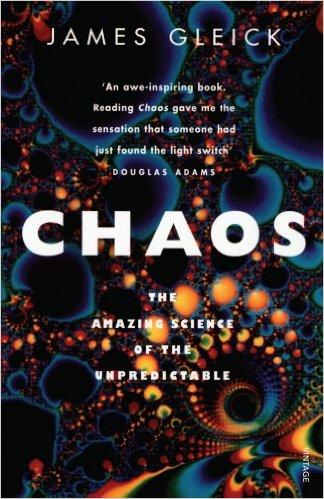
bookAges14+Chaos
Chaos is what happens when the behaviour of a system gets too complicated to predict; the most familiar example is the weather, which apparently cannot be forecast accurately more than five days ahead. This book tells the story so far in the study of this new field of Physics. -
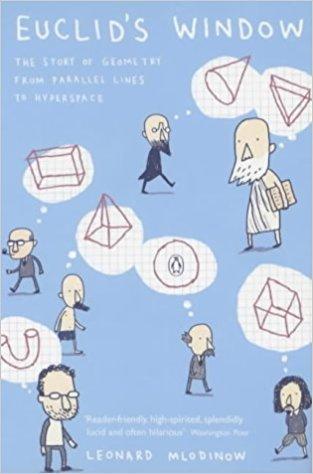
bookAges14+Euclid's Window: The Story of Geometry From Parallel Lines to Hyperspace
Anyone who thought geometry was boring or dry should prepare to be amazed. Despite its worthy cover this book is exactly what its title says - a story - and the plot of this story involves life, death and revolutions of understanding and belief. It stars the some of the most famous names in history, from Euclid who laid the logical foundations, to Albert Einstein, who united space and time in a single non-Euclidean geometry. It offers an alternative history of mathematics, revealing how simple questions anyone might ask about space - in the living room or in some other galaxy - have been the hidden engines of the highest achievements in science and technology. -
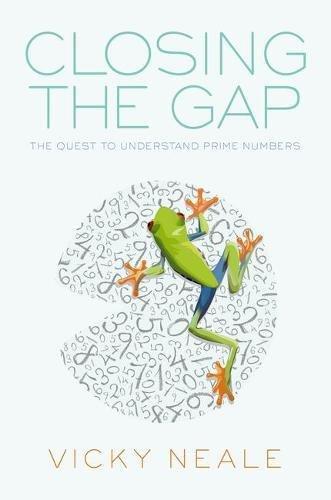
bookAges14+Closing the Gap: The Quest to Understand Prime Numbers
Prime numbers have intrigued, inspired and infuriated mathematicians for millennia. Every school student studies prime numbers and can appreciate their beauty, and yet mathematicians' difficulty with answering some seemingly simple questions about them reveals the depth and subtlety of prime numbers. In this book, Vicky Neale charts the recent progress towards proving the famous Twin Primes Conjecture, and the very different ways in which the breakthroughs have been made: a solo mathematician working in isolation and obscurity, and a large collaboration that is more public than any previous collaborative effort in mathematics. Interleaved with this story are highlights from a significantly older tale, going back two thousand years and more, of mathematicians' efforts to comprehend the beauty and unlock the mysteries of the prime numbers. -
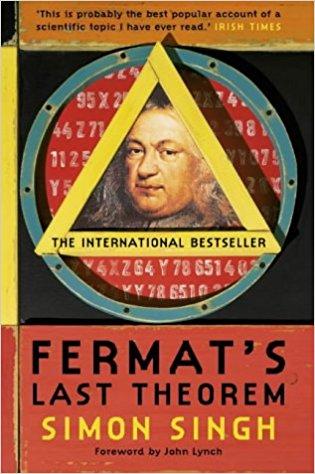
bookAges14+Fermat's Last Theorem
The story of the solving of a puzzle that has confounded mathematicians since the 17th century. In 1963, a schoolboy browsing in his local library stumbled across the world's greatest mathematical problem: Fermat's Last Theorem, a puzzle that every child can understand but which has baffled mathematicians for over 300 years. Aged just ten, Andrew Wiles dreamed that he would crack it. Wiles's lifelong obsession with a seemingly simple challenge set by a long-dead Frenchman is an emotional tale of sacrifice and extraordinary determination. In the end, Wiles was forced to work in secrecy and isolation for seven years, harnessing all the power of modern maths to achieve his childhood dream. Many before him had tried and failed, including a 18-century philanderer who was killed in a duel. An 18-century Frenchwoman made a major breakthrough in solving the riddle, but she had to attend maths lectures at the Ecole Polytechnique disguised as a man since women were forbidden entry to the school. -
bookAges14+The Code Book
The Code Book is a history of man's urge to uncover the secrets of codes, from Egyptian puzzles to modern day computer encryptions. As in Fermat's Last Theorem, Simon Singh brings life to an astonishing story of puzzles, codes, languages and riddles that reveals man's continual pursuit to disguise and uncover, and to work out the secret languages of others. Codes have influenced events throughout history, both in the stories of those who make them and those who break them. The betrayal of Mary Queen of Scots and the cracking of the enigma code that helped the Allies in World War II are major episodes in a continuing history of cryptography. In addition to stories of intrigue and warfare, Simon Singh also investigates other codes, the unravelling of genes and the rediscovery of ancient languages and most tantalisingly, the Beale ciphers, an unbroken code that could hold the key to a 20 million dollar treasure. -
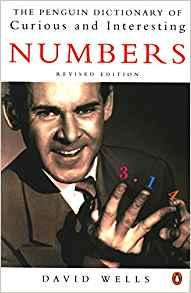
bookAges14+The Penguin Dictionary of Curious and Interesting Numbers
Look up 1729 to see why it is 'among the most famous of all numbers'. Look up 0.7404 () to discover that this is the density of closely packed identical spheres in what is believed by many mathematicians (though it was at that time an unproven hypothesis) and is known by all physicists and greengrocers to be the optimal packing. Look up Graham's number (the last one in the book), which is inconceivably big: even written as a tower of powers () it would take up far more ink than could be made from all the atoms in the universe. It is an upper bound for a quantity in Ramsey theory whose actual value is believed to be about 6. A book to be dipped into at leisure. -
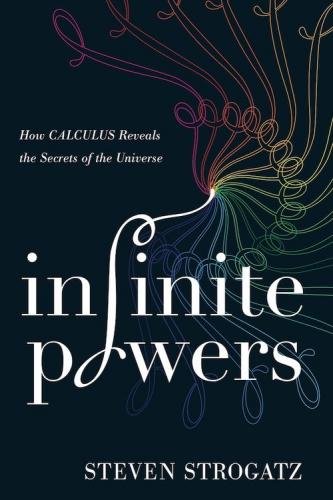
bookAges14+Infinite Powers
Calculus has a fierce reputation as complicated, abstract and difficult, but Steven Strogatz tells the true story of its beauty and simplicity. Starting with the Ancient Greeks, calculus has tantalised and fascinated humanity for millennia. Its applications grew from teaching us how to determine the area of a circle with only sand and a stick to safely launching rockets into space. Without it, we wouldn't have mobile phones, TV, GPS, or ultrasound. This book explains the history of our relationship with calculus, and its relationship with infinity.
-
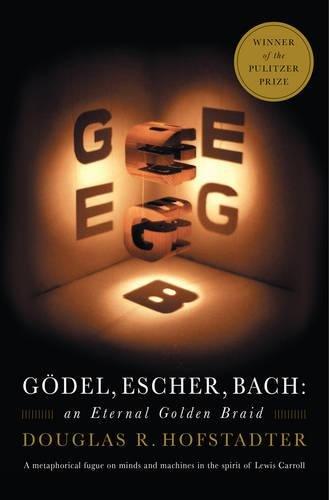
bookAges16+Gödel, Escher, Bach: An Eternal Golden Braid
Douglas Hofstadter's book is concerned directly with the nature of maps or links between formal systems. However, according to Hofstadter, the formal system that underlies all mental activity transcends the system that supports it. If life can grow out of the formal chemical substrate of the cell, if consciousness can emerge out of a formal system of firing neurons, then so too will computers attain human intelligence. Gödel, Escher, Bach is a wonderful exploration of fascinating ideas at the heart of cognitive science: meaning, reduction, recursion, and much more. -
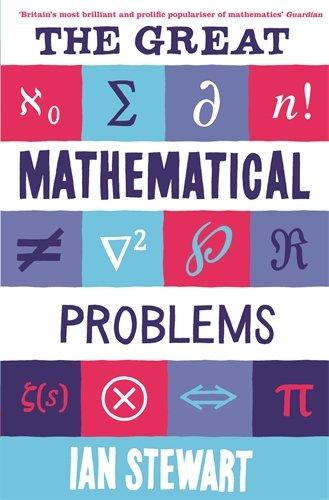
bookAges17+The Great Mathematical Problems
There are some mathematical problems whose significance goes beyond the ordinary - like Fermat's Last Theorem or Goldbach's Conjecture - they are the enigmas which define mathematics. This book explains why these problems exist, why they matter, what drives mathematicians to incredible lengths to solve them and where they stand in the context of mathematics and science as a whole. It contains solved problems - like the Poincaré Conjecture, cracked by the eccentric genius Grigori Perelman, who refused academic honours and a million-dollar prize for his work, and problems which, like the Riemann Hypothesis, remain baffling after centuries. Stewart is the guide to this mysterious and exciting world, showing how modern mathematicians constantly rise to the challenges set by their predecessors, as the great mathematical problems of the past succumb to the new techniques and ideas of the present.