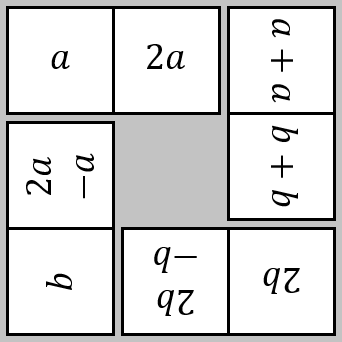
Pair Products
Choose four consecutive whole numbers. Multiply the first and last numbers together. Multiply the middle pair together. What do you notice?

This is part of ourĀ Secondary Curriculum collection of favourite rich tasks arranged by topic.
Choose four consecutive whole numbers. Multiply the first and last numbers together. Multiply the middle pair together. What do you notice?
Can you find the hidden factors which multiply together to produce each quadratic expression?
Can you find out what is special about the dimensions of rectangles you can make with squares, sticks and units?
Can you explain the surprising results Jo found when she calculated the difference between square numbers?
Many numbers can be expressed as the difference of two perfect squares. What do you notice about the numbers you CANNOT make?
Take any prime number greater than 3 , square it and subtract one. Working on the building blocks will help you to explain what is special about your results.
The sums of the squares of three related numbers is also a perfect square - can you explain why?
Pick a square within a multiplication square and add the numbers on each diagonal. What do you notice?
If you know the perimeter of a right angled triangle, what can you say about the area?
What is special about the difference between squares of numbers adjacent to multiples of three?
There are unexpected discoveries to be made about square numbers...
Can you explain what is going on in these puzzling number tricks?
A 2-digit number is squared. When this 2-digit number is reversed and squared, the difference between the squares is also a square. What is the 2-digit number?
Can you see how to build a harmonic triangle? Can you work out the next two rows?
Show that if you add 1 to the product of four consecutive numbers the answer is ALWAYS a perfect square.