

Sometimes We Lose Things
 3 out of 3
What would happen if we lost all the nines in our number system?
Problem
We use ten digits in our number system: 0, 1, 2, 3, 4, 5, 6, 7, 8 and 9. But what would happen if we lost all the 9s?
In this problem, we're going to imagine that we don't have the digit 9 anymore. (That means this is a 'base nine' number system, rather than our usual 'base ten' system.) So we would count: 1, 2, 3, 4, 5, 6, 7, 8, 10. But we would say 10 as 'nine', because this doesn't stand for 'one ten and zero ones' anymore - it stands for 'one nine and zero ones'.
Have a play around with this idea. What would happen if we kept counting up? How could we say the numbers 11, 12, 13, ...?
What would the number 100 stand for now?
Once you've had a think about this, we have some further challenges for you below. (If you'd like some help thinking about numbers in this new way, have a look at the Getting Started page.)
Using this new number system, have a go at:
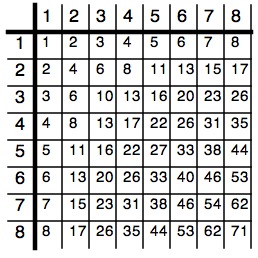
- Filling out a multiplication table, up to 8 times 8
- Adding some large numbers together - how do you have to change the addition method you usually use?
- Taking away some more digits - perhaps we aren't allowed to use the number 8, either!
- Investigating anything else you can think of. You might find it helpful to start by thinking, "I wonder what would happen if..."
Getting Started
This new number system can be very confusing. It might be helpful to think about place value. We usually have:
| Hundreds | Tens | Ones |
But now we have:
| ??? | Nines | Ones |
What could the column to the left of the nines represent? Can you use what you know about hundreds and tens to work it out?
Now that we know we have a 'nines' column and a 'ones' column, we can think about numbers like this:
| write | say | |
|---|---|---|
| 1 | one | |
| 2 | two | |
| 3 | three | |
| 4 | four | |
| 5 | five | |
| 6 | six | |
| 7 | seven | |
| 8 | eight | |
| 10 | nine | |
| 11 | nine | one |
| 12 | nine | two |
| 13 | nine | three |
| 14 | nine | four |
| 15 | nine | five |
| 16 | nine | six |
| 17 | nine | seven |
| 18 | nine | eight |
| 20 | two nines | |
| 21 | two nines | one |
| 22 | two nines | two |
Teachers' Resources
Using NRICH Tasks Richly describes ways in which teachers and learners can work with NRICH tasks in the classroom.
Why do this problem?
This investigation can be seen as one to introduce multibase work. Many articles have been written about the use of working in different bases. Some of you will remember using Dienes Multibase Blocks for the same purpose. It can certainly be of use to help pupils really get a better grip of the rules of number and what is happening when we are working in our own base ten.
This problem is also useful investigation in its own right, and from the multiplication table many patterns can be found. It is good to encourage pupils to look for the reasons why these patterns and relationships occur.
Possible approach
You might like to introduce this problem as being about aliens who have nine 'fingers' instead of ten. You can then go through some simple counting and adding on as if you are this nine-fingered alien.
Having done this out loud, you could introduce the way of writing the numbers to the group before suggesting they continue themselves.
You might like to create a large multiplication square on the board, and assign different times tables to different groups to calculate, in order to compile a full 8 by 8 multiplication square.
Key questions
How would you say that number?
What does the digit '1' represent in the number 18?
Possible extension
Once the multiplication grid has been compiled, learners could explore the similarity between multiplying by 8 in this system and multiplying by 9 in the base 10 system.
Possible support
Some children will find it useful to have something that can show the number nine physically - a toy alien or a drawing of an alien with nine fingers, for example. Sticks of nine multilink cubes will also be a helpful representation.