

Doplication

 1 out of 3
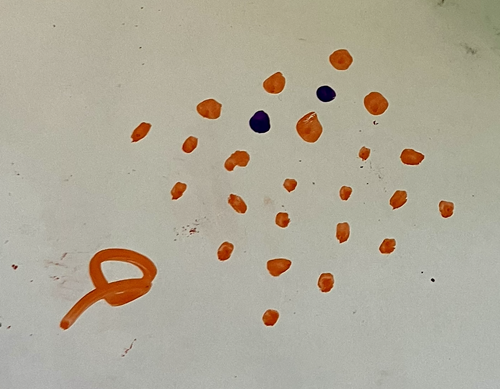
We can arrange dots in a similar way to the 5 on a dice. What do you notice?
Problem
In this problem, we will be looking at the arrangement on the 5 dice:

We can extend this to make something we could call a 3 by 5 or a 5 by 3 arrangement:

Counting these dots, we can see that we have 23 altogether. As this isn't multiplication, we can't use a × symbol, so instead we can write it as something like:
$3 ? 5 = 23$
Now if this were an ordinary thing like multiplication, where you'd use in an ordinary rectangle like:

You would probably be able to work out the answer from things that you already know, or perhaps you would just know the answer straight away. But with our new operation, '?', it isn't as easy to work out the answer!
Have a go at drawing some arrangements of different sizes and working out the number of dots in each arrangement. Is there a quick way of doing this?
When people learn multiplication tables they often write them out in a big table. You might like to explore what happens if you try a similar idea with doing '?' instead of multiplication and make a ? table instead of a times table.
Student Solutions
Mitsuki, Marc, Koya, Atticus, Preston and Jakob from The Bavarian International School in Munich used a multiplication-type table to record their results. Their teacher wrote up their observations:
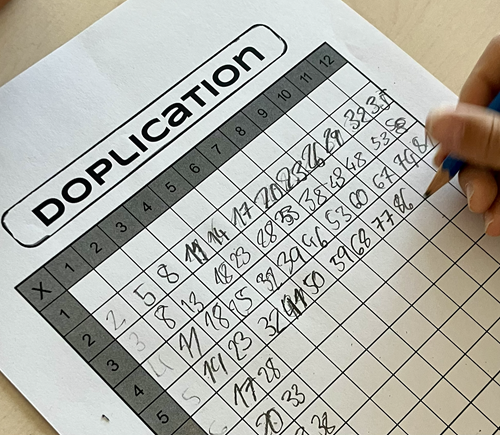
Marc noticed that the numbers in each line of the table increased by an odd number.
E.g. line 5 - 14, 23, 32, 41, 50, (so +9 each time)
line 6 - 17, 28, 39, 50, 61, (so +11 each time)
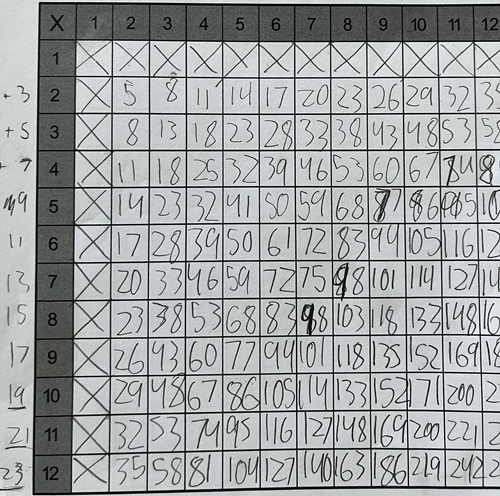
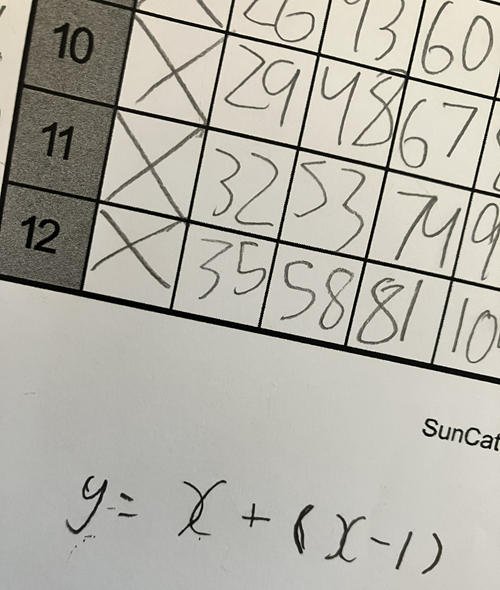
He generated this formula to predict the value of the increase for each row:
y = x + (x-1) where x is the line number and y the value of the increase.
E.g. 11 = 6 + (6 - 1) so numbers in line 6 increase by 11 each time.
Atticus noticed that like a normal multiplication table there was symmetry on either side of the diagonal line.
Preston, working with Jakob, announced that the value of the numbers along the diagonal was the sum of two consecutive square numbers.
E.g. 4 ? 4 = 16 + 9 = 25
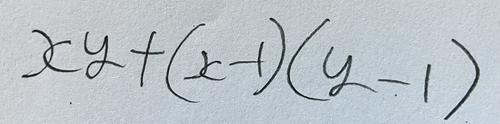
Mitsuki, working with Koya, came up with this formula to calculate the answer to any 'doplication' sum:
xy + (x - 1) (y - 1)
E.g. 8 ? 7 = 8 x 7 + (7 x 6) = 56 + 42 = 98
These are all very interesting observations! It looks like Preston and Jakob's noticing about the diagonal values being the sum of two consecutive square numbers fits nicely with Mitsuki and Koya's formula, where x and y are the same. Thank you all for sharing your ideas about this problem with us.
Teachers' Resources
Using NRICH Tasks Richly describes ways in which teachers and learners can work with NRICH tasks in the classroom.
Why do this problem?
This activity is extremely open and invites exploration at whatever the level of pupils' understanding. It can lead to a pupil having a wider understanding of what it is to multiply. Many opportunities are built in for exploring number patterns.
Possible approach
I have found it good to lay out some counters or cubes in the initial pattern and invite pupils to talk about what they notice, with the simple prompt, "Tell me what you see!".
Key questions
What do you notice?
Can you describe what you see for everyone so that they might see it too?
How did you work that out? What adding did you actually do?
Possible extension
Get the pupils to imagine that the pattern you've presented to them at the start is just one item in a sequence. Ask them to create/talk about what the previous/next ones might be.
When this activity has satisfied pupils then go to 3D Stacks for a much larger 3D exploration giving numbers that have very many properties and relationships.
Possible support
Joining in with pupils so that they are very involved with the talk would be a big asset for many children.