Tourism
If you can copy a network without lifting your pen off the paper and without drawing any line twice, then it is traversable. Decide which of these diagrams are traversable.


The items in the shopping basket add and multiply to give the same amount. What could their prices be?
A circle of radius r touches two sides of a right angled triangle, sides x and y, and has its centre on the hypotenuse. Can you prove the formula linking x, y and r?
Take any prime number greater than 3 , square it and subtract one. Working on the building blocks will help you to explain what is special about your results.
The diagonals of a trapezium divide it into four parts. Can you create a trapezium where three of those parts are equal in area?
Can you work out the probability of winning the Mathsland National Lottery?
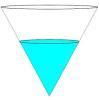
In Fill Me Up we invited you to sketch graphs as vessels are filled with water. Can you work out the equations of the graphs?
A 2-digit number is squared. When this 2-digit number is reversed and squared, the difference between the squares is also a square. What is the 2-digit number?
It is impossible to trisect an angle using only ruler and compasses but it can be done using a carpenter's square.
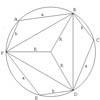
A hexagon, with sides alternately a and b units in length, is inscribed in a circle. How big is the radius of the circle?
Using a ruler, pencil and compasses only, it is possible to construct a square inside any triangle so that all four vertices touch the sides of the triangle.
What is the same and what is different about these circle questions? What connections can you make?
Watch the video to see how to sum the sequence. Can you adapt the method to sum other sequences?
What do you get when you raise a quadratic to the power of a quadratic?
Take a triangular number, multiply it by 8 and add 1. What is special about your answer? Can you prove it?
Show that if you add 1 to the product of four consecutive numbers the answer is ALWAYS a perfect square.
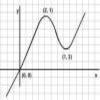
This problem challenges you to find cubic equations which satisfy different conditions.
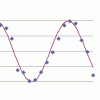
10 graphs of experimental data are given. Can you use a spreadsheet to find algebraic graphs which match them closely, and thus discover the formulae most likely to govern the underlying processes?
There are many different methods to solve this geometrical problem - how many can you find?
Stick some cubes together to make a cuboid. Find two of the angles by as many different methods as you can devise.