Explain how the thirteen pieces making up the regular hexagon shown
in the diagram can be re-assembled to form three smaller regular
hexagons congruent to each other.
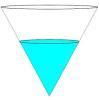
A right circular cone is filled with liquid to a depth of half its
vertical height. The cone is inverted. How high up the vertical
height of the cone will the liquid rise?
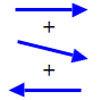
The first part of an investigation into how to represent numbers
using geometric transformations that ultimately leads us to
discover numbers not on the number line.
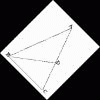
Three triangles ABC, CBD and ABD (where D is a point on AC) are all isosceles. Find all the angles. Prove that the ratio of AB to BC is equal to the golden ratio.
A finite area inside and infinite skin! You can paint the interior of this fractal with a small tin of paint but you could never get enough paint to paint the edge.
We use statistics to give ourselves an informed view on a subject of interest. This problem explores how to scale countries on a map to represent characteristics other than land area.