This article (the first of two) contains ideas for investigations.
Space-time, the curvature of space and topology are introduced with
some fascinating problems to explore.
This is the second of two articles and discusses problems relating
to the curvature of space, shortest distances on surfaces,
triangulations of surfaces and representation by graphs.
Some puzzles requiring no knowledge of knot theory, just a careful inspection of the patterns. A glimpse of the classification of knots, prime knots, crossing numbers and knot arithmetic.
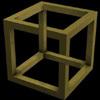
Is it possible to make an irregular polyhedron using only polygons of, say, six, seven and eight sides? The answer (rather surprisingly) is 'no', but how do we prove a statement like this?
This is the first article in a series which aim to provide some insight into the way spatial thinking develops in children, and draw on a range of reported research. The focus of this article is the work of Piaget and Inhelder.
There is a long tradition of creating mazes throughout history and across the world. This article gives details of mazes you can visit and those that you can tackle on paper.