


article
Developing Logical Thinking: The Place of Strategy Games
This article outlines how strategy games can help children develop logical thinking, using examples from the NRICH website.
This article outlines how strategy games can help children develop logical thinking, using examples from the NRICH website.

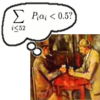
This article supplies teachers with information that may be useful in better understanding the nature of games and their role in teaching and learning mathematics.

This article, the second in the series, looks at some different types of games and the sort of mathematical thinking they can develop.

Basic strategy games are particularly suitable as starting points for investigations. Players instinctively try to discover a winning strategy, and usually the best way to do this is to analyse the outcomes of series of 'moves'. With a little encouragement from the teacher, a mathematical investigation is born.

This article for teachers describes several games, found on the site, all of which have a related structure that can be used to develop the skills of strategic planning.


 1 out of 3
Many natural systems appear to be in equilibrium until suddenly a critical point is reached, setting up a mudslide or an avalanche or an earthquake. In this project, students will use a simple simulation game to investigate the properties of such systems.
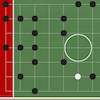
Read this article to find out more about the inspiration for NRICH's game, Phiddlywinks.

This second Sudoku article discusses "Corresponding Sudokus" which are pairs of Sudokus with terms that can be matched using a substitution rule.

This article explains the use of the idea of connectedness in networks, in two different ways, to bring into focus the basics of the game of Go, namely capture and territory.