

You can write all the numbers as:
x, x+1, x+2, x+3... etc.
Work backwards from ones that narrow down x:
x+9 is a multiple of 10 - the only way this happens is if the last digit of x+9 is 0, meaning the last digit of x is 1.
x+8 is a multiple of 9 - the sum of the rest of the digits plus nine must be a multiple of 9. Since 9 itself is a multiple of nine, the rest of the digits have to have a sum of a multiple of nine, meaning the rest of the digits are a multiple of 9.
x+7 is a multiple of 8 - a number is a multiple of 8 if the first 3 digits (starting from the ones place) are a multiple of 8. You could try all combinations to see what 3-digit numbers ending with 8 are multiples of 8, and you'd get 008, 048, 088, 128, 168, 208, 248, 288, 328, 368, 408, 448, 488, 528, 568, 608, 648, 688, 728, 768, 808, 848, 888, 928, 968, meaning the last 3 digits of x has to be any one of these, minus 7.
x+6 is a multiple of 7 - this is a tricky one - the divisibility rule of 7 is to take the last digit of a number, double it, and subtract that result from the remaining digits. Here, the last digit is 1+6, which is 7, so, the remaining digits have to be a multiple of 7 (if y-14 is a multiple of 7, y is a multiple of 7. (Proof: 7z-14 = 7(z-2)))
x+5 is a multiple of 6 - the divisibility test for this one is if it's divisible by both 2 and 3. This gives nothing whatsoever - we already know the sum of the digits minus the first one is a multiple of 9 (and, by extension, a multiple of 3), and adding the last digit, 6, still keeps it like that. As for 2, 5+1, 6 is already a multiple of 2.
x+4 is a multiple of 5 - 1 + 4 is 5, and any number ending with 5 is divisible by 5.
x+3 is divisible by 4 - this is 4 less than x+7, and any multiple of 8 minus four is a multiple of four, and this again tells us nothing. (8z-4 = 4(2z-1))
x+2 is a multiple of 3 - as stated in x+5, we already know the sum of the digits minus the first one is a multiple of 9 (and, by extension, a multiple of 3), and adding the last digit, 3, still keeps it like that.
x+1 is a multiple of 2 - 1+1=2, and any number ending with 2 is even.
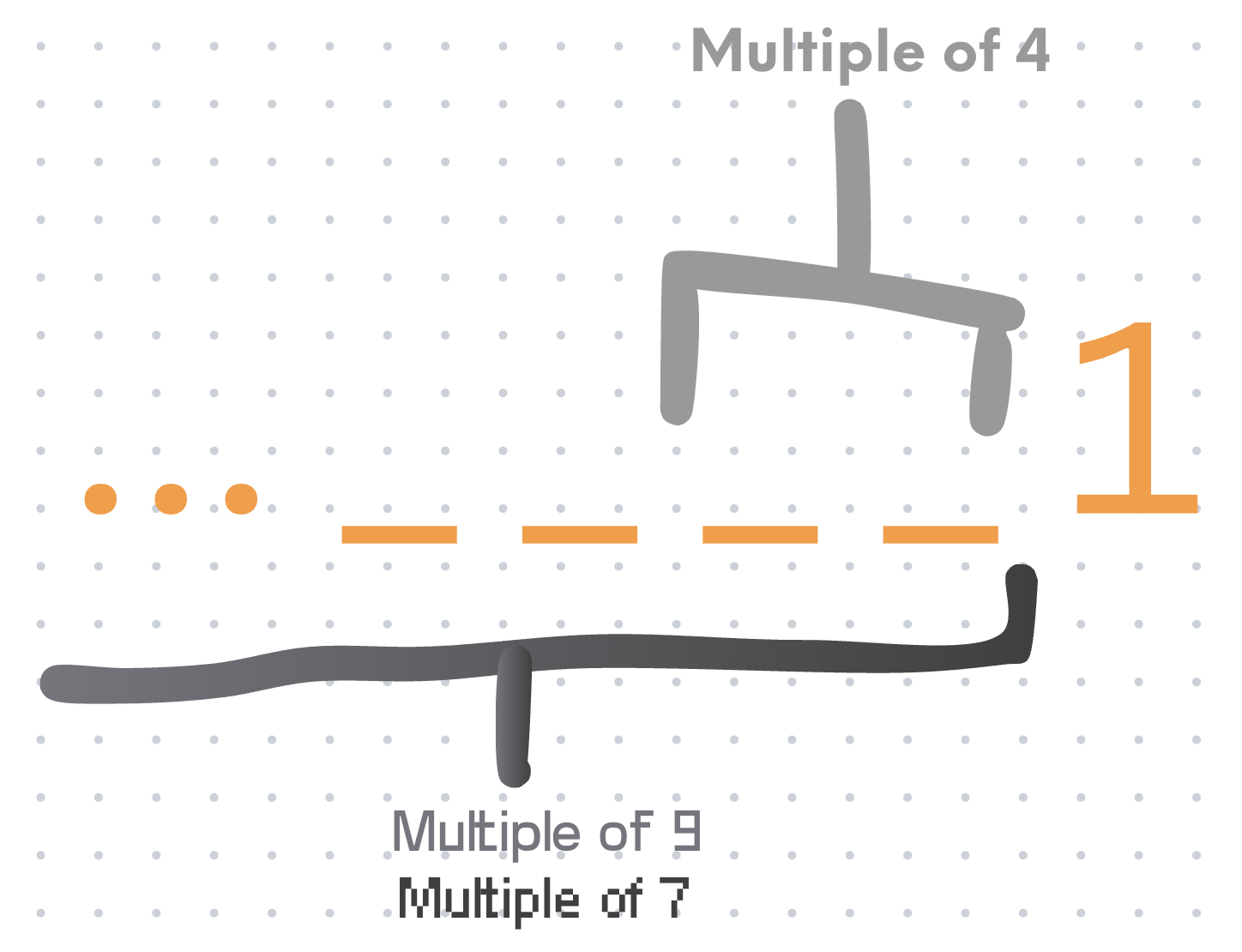
So, if you put the info all together, the final pattern for what the very first number should be, is explained in the image.
And, as it turns out these are all just multiples of 252 with 1 on the end for the first number!
2521, 2522, 2523, 2524, 2525, 2526, 2527, 2528, 2529, and 2530 is one.
There's also 5041, 5042, 5043, 5044, 5045, 5046, 5047, 5048, 5049, 5050.
And let's not forget the trivial case of 1,2,3,4,5,6,7,8,9,10.