

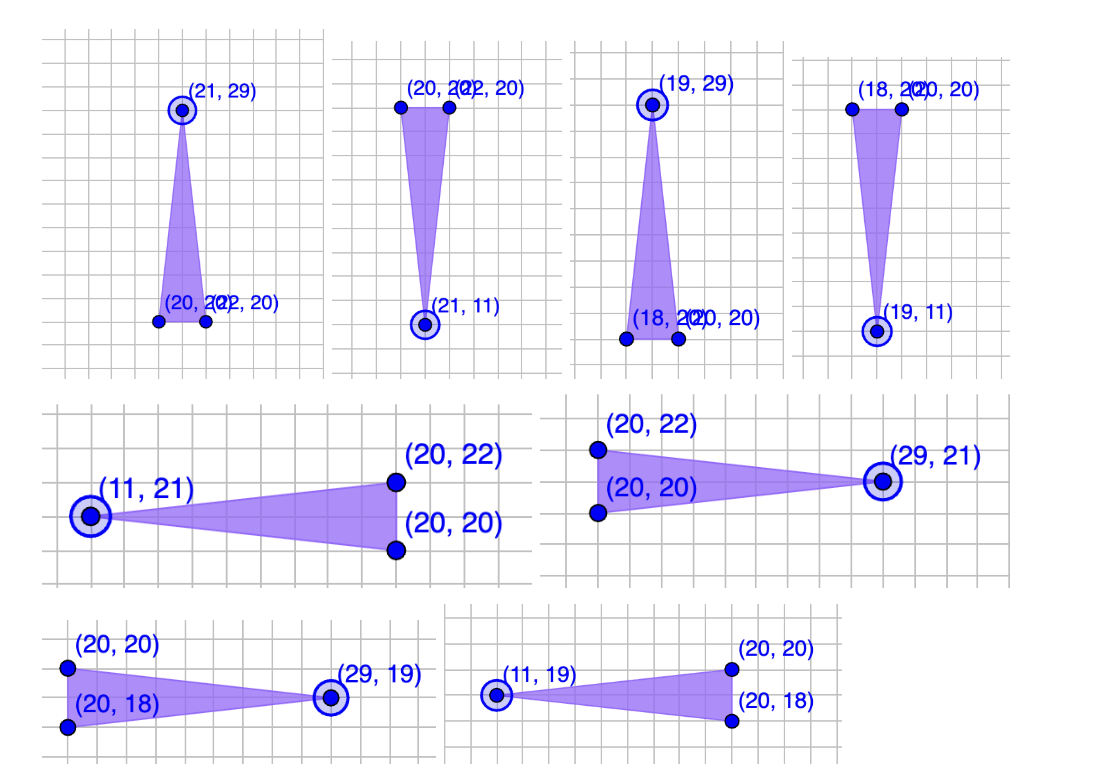
An isosceles triangle is a triangle that has at least two sides of equal length. To start, we can start by trying on the GeoGebra applet all of the possible right triangles, where the legs are the same length. If we try that, we can know all of these types of triangles either exceed or are less than 9 for their area. We can then try making the bottom (the side which is parallel to the x-axis) of the triangle an even number (e.g., 2, 4, 6, 8), and putting the third point in the middle of the bottom side (the midpoint) to make it an isosceles triangle. As we start from 2 as our bottom side - the coordinates being (20,20) and (22,20) - we can see that as the y-axis of the third point goes up by 1, the area goes up by 1 as well. Using that, we can make the point (21,29) to make an isosceles triangle with an area of 9. Using those side lengths, we can make a total of 8 isosceles triangles with an area of 9, like the images below (the bottom can be up/down/left/right of (20,20)). If we move on to 4 as our bottom side length, we can see that as the y-axis increases by 1, the area increases by 2. That makes it not possible to make an area of 9, as 9 is not a multiple of 2. With that, we can see the pattern that as the y increases by 1, the area increases by 1n (n being counting the even numbers starting from two; ex, 2 is 1, 4 is 2, 6 is 3). Using this pattern, we can see that in order to make an isosceles triangle that has an area of 9, the bottom length should be 2,4, or 18 (the factors of 9 are only 1,3, and 9). Using that, we can see that we can make a total of three different bottom lengths, and each bottom length can make 8 triangles. So, in total, as 8x3 is 24, we can make up a total of 24 isosceles triangles with an area of 9.
Solution
Isosceles Triangles Arin
Problem / game
First name
Arin
School
Daegu International School
Country
Age
14