Unequal Averages

 2 out of 3
Play around with sets of five numbers and see what you can discover about different types of average...
Problem
Unequal Averages printable sheet
This problem follows on from M, M and M and About Average, so you may want to look at these first.
Here's an interesting set of five numbers: $$2, 5, 5, 6, 7$$ The mean, mode, median and range are all 5.
Can you find other sets of five positive whole numbers where:
Mean = Median = Mode = Range
Can you find sets of five positive whole numbers that satisfy the following properties?
A. Mode < Median < Mean
B. Mode < Mean < Median
C. Mean < Mode < Median
D. Mean < Median < Mode
E. Median < Mode < Mean
F. Median < Mean < Mode
Not all of these can be satisfied by sets of five numbers! Can you explain why?
Show that some of them can be satisfied with sets of just four numbers.
Show that all of them can be satisfied with sets of six numbers.
If you enjoyed this problem, you may be interested in Wipeout
Student Solutions
Thank you to everyone who submitted a solution for this problem. There were too many good solutions to mention everyone, but well done to all!
Finding sets of five positive whole numbers where Mean = Median = Mode = Range
It looks like there are lots of possibilities for these five numbers. Maya from Nottingham Girls High School in the UK suggested:
8, 12, 14, 14, 22
Meera and Dhanyashree from The GYM Foundation in India found this solution:
5, 6, 8, 8, 13
Tia and Mikhail from JBCN International School in Oshiwara, India found this set of numbers:
3, 4, 5, 5, 8
Leo from Twyford School in the UK found three related solutions:
1, 2, 2, 2, 3
2, 4, 4, 4, 6
4, 8, 8, 8, 12
Harman and Zakariya from Eastcourt Independent School in England found the same starting solution as Leo, but they extended it slightly differently:
1, 2, 2, 2, 3
3, 6, 6, 6, 9
Sophia from Eastcourt Independent School in England found a set of five related solutions. Can you see how these are all similar to the example we gave in the problem?
4, 10, 10, 12, 14
8, 20, 20, 24, 28
16, 40, 40, 48, 56
32, 80, 80, 96, 112
64, 160, 160, 192, 224
The students from Ganit Kreeda in Vichar Varika, India did a lot of thinking about this method of finding related solutions. Rishaan, Ruhi and Siddharth found these solutions from the same starting point as Sophia:
6, 15, 15, 18, 21
10, 25, 25, 30, 35
12, 30, 30, 36, 42
Rishaan explained why multiplying a set of numbers in this way keeps the mean, median and mode the same. Take a look at Rishaan's explanation to see more of Ganit Kreeda's ideas about this.
Finding sets of five positive whole numbers that satisfy the inequalities
Jack from Twyford School in the UK found solutions for the first inequality:
A. Mode < Median < Mean: 6, 6, 7, 8, 12
Mode = 6, Median = 7, Mode = 6 + 6 + 7 + 8 + 12 = 39 divided by five = 7.8
Another one for Mode < Median < Mean is 3, 3, 4, 6, 7
Mode = 3 as it is most commonly used. Median = 4 as it is in the middle of the range. Mean = 4.6 because 3 + 3 + 4 + 6 + 7 = 23 divided by five = 4.6
Keita from St. Mary's International School in Japan had a lot of thoughts about each of the six inequalities:
A. Mode < Median < Mean: 1, 1, 2, 4, 9
B. Mode < Mean < Median: 2, 2, 7, 8, 9
C. Mean < Mode < Median: impossible
D. Mean < Median < Mode: 1, 2, 3, 4, 4
E. Median < Mode < Mean: impossible
F. Median < Mean < Mode: 1, 1, 3, 9, 9
Take a look at Keita's full solution to see the reasoning behind each of these. Keita's solution to F isn't quite correct because there are two modes - can you see how these numbers could be tweaked slightly to leave only 9 as the mode?
We received several solutions explaining that inequalities C (Mean < Mode < Median) and E (Median < Mode < Mean) are impossible to solve. An anonymous solution pointed out:
It is impossible because you would need to put the mode in the first or last two.
V from The Camford International School in India explained why this is a problem:
E. Median < Mode < Mean
This is impossible because the mode can only be less than or equal to the median, since if it is more, it will be larger than the mean. This does not work.
Keita's solution explained this further:
This is impossible because if the mode is greater than the median, the mode needs to be the 4th number or the 5th number. However, the mean can’t get above that because the 4th and 5th number is both in the top 2 largest number.
Finding sets of four positive whole numbers that satisfy the inequalities
Enzo from Harrow International School in Hong Kong explained why most of these inequalities were impossible to solve with four numbers:
A. Mode < Median < Mean
1, 1, 3, 5
B. Mode < Mean < Median
For mode < mean < median, the third integer must be less than the fourth one. I soon realized that the condition cannot be satisfied due to the mean having to be equal to the median when the third and fourth integers are the same.
IMPOSSIBLE
C. Mean < Mode < Median
To satisfy the condition of mean < mode < median, we can pull out that the mode has to be the smallest. If it was the middle value, this causes the median and mode to be equal. Even if, the mean must be greater than the mode in such conditions – unless there are negative numbers involved.
IMPOSSIBLE
D. Mean < Median < Mode
Moreover, for the mean < median < mode, the mode must be the largest value in the set. For the mean to be as low as possible, the first value needs to be as low as possible, with the other 3 values being significantly more than the first one. Here is an example with the mean being brought down due to the anomaly (1).
1, 66, 67, 67
E. Median < Mode < Mean
Furthermore, for the median < mode < mean, the mode must be the largest value. The mean can never exceed the mode, so this cannot be satisfied.
IMPOSSIBLE
F. Median < Mean < Mode
Finally, for median < mean < mode, we need to make the first two values as small as possible and the mode much larger. However, I always find that the median is greater than the mean. Which means this is impossible to achieve.
IMPOSSIBLE
Finding sets of six positive whole numbers that satisfy the inequalities
Vishnuvardhan from Ganit Kreeda and Enzo from Harrow International School both found a solution for all six of the inequalities. Enzo's solutions were:
A. Mode < Median < Mean
Firstly, for mode < median < mean, the mode has to be as small as possible. We can take 2 as the mode and leave 1 as the very first integer. The fourth value should be 1 more than the third (as an example). This leaves us with two more integers, and we will make them as large as possible to make the mean significantly greater.
1, 2, 2, 3, 67, 68
B. Mode < Mean < Median
On top of that, for mode < mean < median, we will set the mode as 1. This is slightly more challenging as the mean needs to be slightly greater than the mode. The remaining four integers need to be larger than the other two (the mode). Here is an example of how this could be done.
1, 1, 67, 68, 69, 70
C. Mean < Mode < Median
Then, for mean < mode < median, the mode can be the second and third data sets. The fourth value can be slightly larger, and we will make the first one as small as possible.
1, 67, 67, 68, 69, 70
D. Mean < Median < Mode
Next, for mean < median < mode, the first two values must be much less than the other four. This makes the mean way lower. The mode can be the second largest integer among the set.
1, 2, 67, 68, 68, 69
E. Median < Mode < Mean
Furthermore, for median < mode < mean, we will make the largest value an obvious anomaly. The other five integers will need to be as small as possible.
1, 2, 3, 4, 4, 67
F. Median < Mean < Mode
Finally, for median < mean < mode, the largest value can be repeated, and the other four values are going to be much smaller than the mode.
1, 2, 3, 4, 67, 67
Once again, well done again to everyone who had a go at this problem and submitted solutions!
Teachers' Resources
This problem featured in an NRICH webinar in December 2020.
You may wish to look at Wipeout as a follow-up activity.
The Inquiry Maths website offers a related activity and explains how it can be used as an inquiry prompt in the classroom.
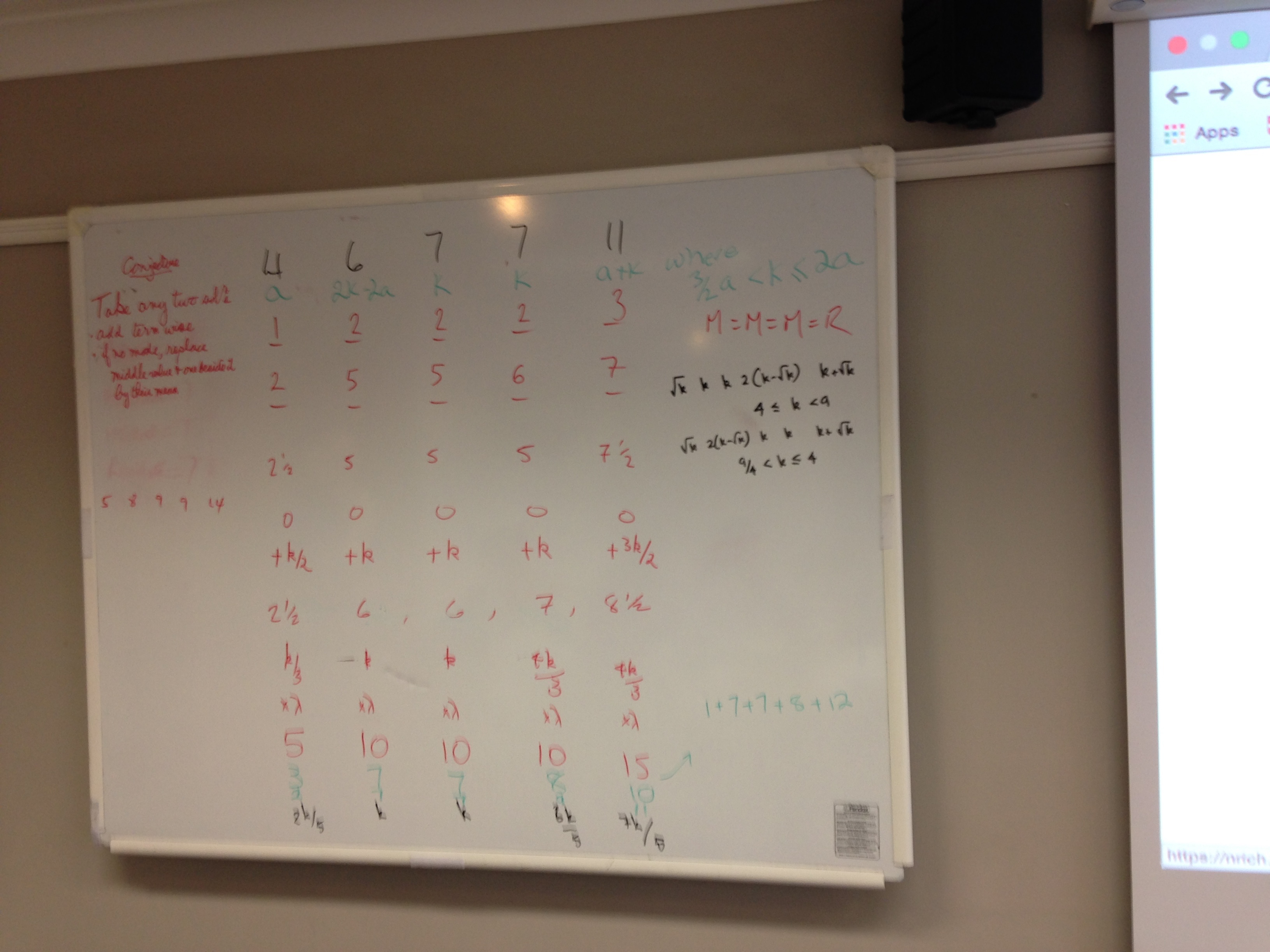
Here is a photo of some of the contributions offered by delegates at the ATM Conference in 2015.