

Some Spirals and Tessellations

 1 out of 3
Making spirals with LOGO
Problem
Image
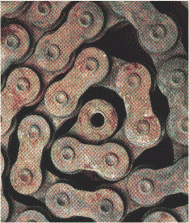
| Aspiral is a curve formed by a point moving around a fixed point and constantly moving away from or approaching the fixed point. |
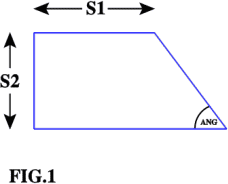
This month, building on the idea that many sets of things can be placed in a spiral configuration, we consider the following program based on Fig.1:
TO TRAP :S1 :S2 :ANG
IF :S1 > 100 [STOP]
FD :S1 RT :ANG
FD :S2/SIN :ANG RT (180 - :ANG)
FD :S1 + :S2 * TAN (90 - :ANG) RT 90
FD :S2 RT 90 FD :S1 LT (90 - :ANG)
TRAP :S1/SIN :ANG :S2/SIN :ANG :ANG
END
Image
| Image
|
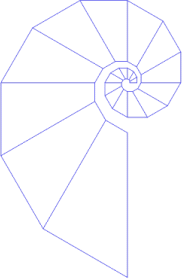
Try TRAP 5 25 60 as a starter for your investigations. See what spirals you can generate now.
While still in the realm of geometry a consideration of tessellations, tiles and tilings is long overdue.
Cundy C.M. and Rollett A. P. in 'Mathematical Models' give a good introduction to the plane tessallations.
First consider the three regular tessellations based on the square, equilateral triangle and regular hexagon respectively as below.
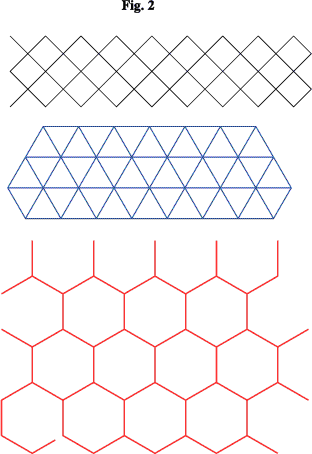
Can you devise a set of elegant procedures to illustrate these somewhat lacklustre tilings? But colour them much more imaginatively! [Hint: try drawing them freehand before thinking about construction procedures.]
Getting Started
What do each of the variables in TRAP do?
Try changing one variable at a time.
Some LOGO programmes will allow you to "step through" the procedure so you can see what each instruction does.
Student Solutions
YOu will know if you have a solutions as you will be able to create the tessellations.
Did you base your tessellation on the polygon or the lines?
Teachers' Resources
A Lot can be gained by discussing how you might created the tessllations:
what basic unit will you use - a line or a plygon?
how will you "connect" each element
what method proved "most efficient" or "most elegant"?