

For the sets that require the mean, median, mode and range to be equal, we will use a, b, c and d as unknowns (sorted from smallest to largest). Now the variables a and d cannot be the mode since they are the upper and lower limits of the set.
This can leave either b or c as the repeated variable.
Now it is impossible for each to be 1 since the total will be 1*5=5, and it requires positive whole integers.
For 2, the sum is 2*5=10. The mode is 2, and there is only one possibility that satisfies the instructions.
1 2 2 2 3
This is the case because 1 and 3 differ by 2. 2 is in the middle between these two numbers. We can see that the sum is exactly 10, and the center term is 2. 2 appears three times.
We can also investigate 3, as for the sum is 3*5=15.
If 3 is repeated twice, the remaining numbers sum to 9. However, for the condition of 3 also being the range, we need to investigate.
(1 4 4) cannot be the case as there will be two modes (3 and 4). Neither is (2 2 5) for the same reason.
If 3 is repeated three times, the other two numbers must sum to 6 and differ by 3. The numbers that satisfy these criteria are 1.5 and 4.5, but the question limits us to positive integers.
Meaning 3 cannot be the mean, median, mode, and range.
For 4, the sum is 4*5=20:
If there are two 4s, the remaining numbers sum to 12. We have three possibilities, namely (1 5 6) (2 6 4) (3 7 2). Among them, there will be three 4s in the second possibility, but that also counts towards our solution.
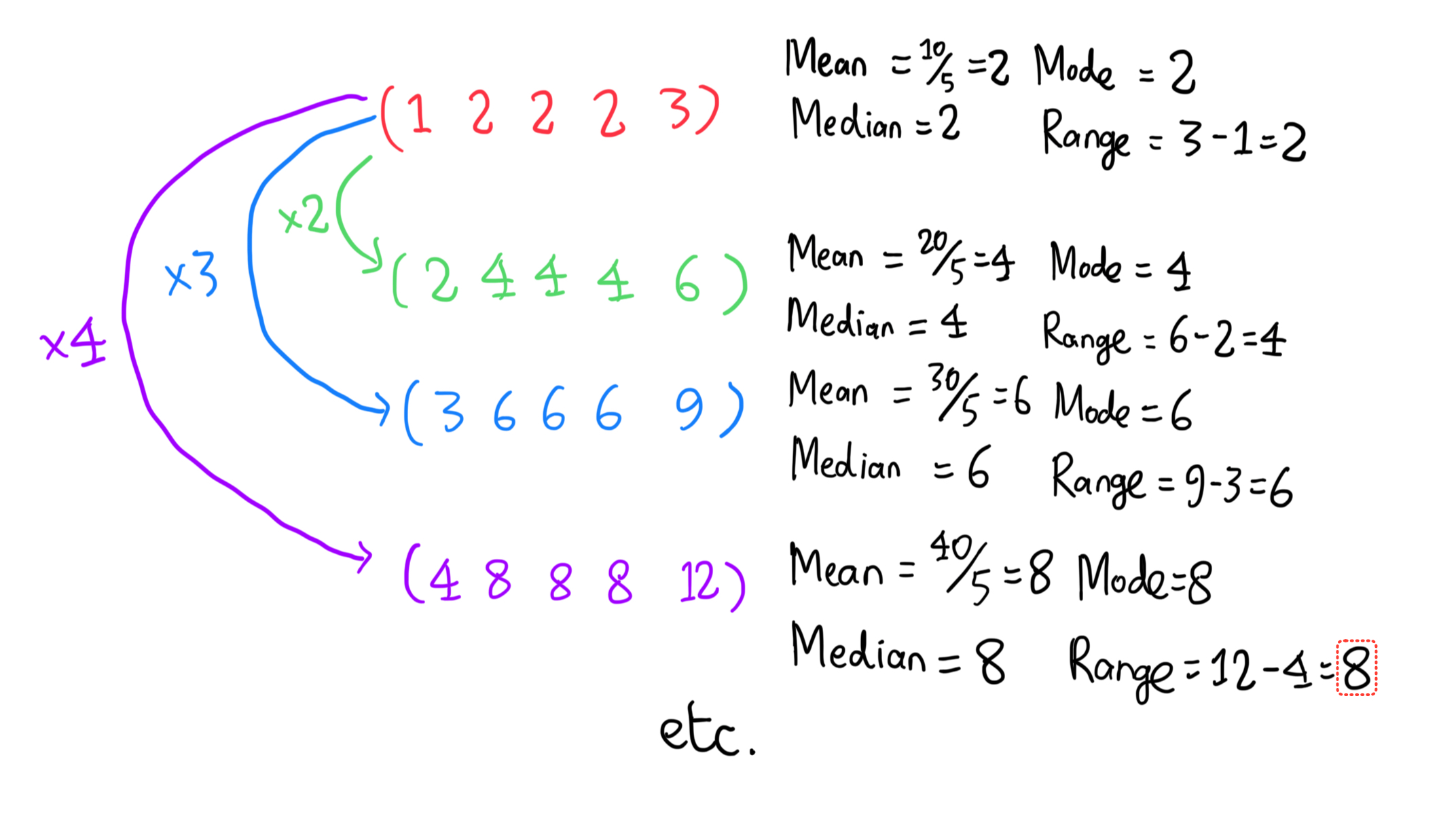
I also realized that if you multiply each of the numbers in the set (1 2 2 2 3) by any positive integer n, you can get different sets of five positive integers while keeping the mean, median, mode and range the same. You can see how effective this is as follows.
(1 2 2 2 3) Mean 2, Median 2, Mode 2, Range 2
(2 4 4 4 6) (2x) Mean 4, Median 4, Mode 4, Range 4
(3 6 6 6 9) (3x) Mean 6, Median 6, Mode 6, Range 6
… and so on. However, I also want to investigate different sets which are not multiples of (1 2 2 2 3). Now we can continue to look at more sets.
For 5 (sum 25), if there are two 5s, we already investigated the set (2 5 5 6 7), so we can look even further. The remaining numbers sum to 15, and for the range to be 5, we can pick out the following possibilities: (1 6 8) (2 7 6) (3 8 4) (4 9 2). We can tell that the set (3 4 5 5 8) also works.
When the mode is repeated three times, it is only possible when the set is a multiple of the smaller set (1 2 2 2 3).
For the sets of five positive whole numbers that satisfy the condition mode < median < mean, the mode will be the smallest number. We will take 1 as an example, and this creates our data set: 1 1 _ _ _
We will assume the median is 2 and the mean is 3. Meaning the full set can look like this: 1 1 2 3 8 (sum 15). Note: this is one of the examples which satisfy the requirement.
1 1 2 3 8
Secondly, for mode < mean < median, we will use 1 as the mode as before. If the mean is 2 and the median is 3, it can look like this: 1 1 3 _ _
However, the remaining two numbers must sum to 5, and the median will be affected as one of the numbers will have to be less than 3.
For the mean to be 3 and median 4, it cannot be the case because the other 2 numbers must sum to 3*5-6=9, and one number will have to be less than 4. If 4 is the case, it makes the whole data set bimodal – two modes at the same time (1 and 4).
What if the mean is 4 and median 5? Well, we can figure it out. There can only be a single possibility because the remaining numbers must add up to 4*5-7=13. Moreover, it is possible because 6+7=13, and the median will remain unchanged. This leaves us with the condition being possible.
1 1 5 6 7
Then, for mean < mode < median, the mode MUST be the smallest value in the set. Otherwise, it will be equal to the median. Since the mean needs to be less than the mode, the only way this can happen is if there are negative numbers involved, which does not satisfy the requirements.
IMPOSSIBLE
Next, for mean < median < mode, we can assume the median is 5 and the mode being 6. For the mean being 4, the remaining numbers sum to 4*5-5-6-6=3. As we can see, 1 and 2 can fill in the leftovers without altering the median or mode.
1 2 5 6 6
Furthermore, for median < mode < mean, the mode will need to be the largest number in the set. The mean will have to be less than the largest number, therefore no such set can exist.
IMPOSSIBLE
Finally, for median < mean < mode, we can set the first three as close as possible, and the mode being an anomaly in the data set. For example, this can be done by using the set as follows. The mode is significantly greater than all other numbers, and this increases the mean.
1 2 3 67 67
Moving on to the sets of four numbers.
Firstly, for mode < median < mean, the mode will have to be the smallest number in the set (for example, 1). We will set the median to 1.5, making the third value 3. The mean can be any integer equal to or greater than 4, which makes the conditions possible.
1 1 3 5
Secondly, for mode < mean < median, the third integer must be less than the fourth one. I soon realized that the condition cannot be satisfied due to the mean having to be equal to the median when the third and fourth integers are the same.
IMPOSSIBLE
To satisfy the condition of mean < mode < median, we can pull out that the mode has to be the smallest. If it was the middle value, this causes the median and mode to be equal. Even if, the mean must be greater than the mode in such conditions – unless there are negative numbers involved.
IMPOSSIBLE
Moreover, for the mean < median < mode, the mode must be the largest value in the set. For the mean to be as low as possible, the first value needs to be as low as possible, with the other 3 values being significantly more than the first one. Here is an example with the mean being brought down due to the anomaly (1).
1 66 67 67
Furthermore, for the median < mode < mean, the mode must be the largest value. The mean can never exceed the mode, so this cannot be satisfied.
IMPOSSIBLE
Finally, for median < mean < mode, we need to make the first two values as small as possible and the mode much larger. However, I always find that the median greater than the mean. Which means this is impossible to achieve.
IMPOSSIBLE
We arrive at the sets of six integers.
Firstly, for mode < median < mean, the mode has to be as small as possible. We can take 2 as the mode and leave 1 as the very first integer. The fourth value should be 1 more than the third (as an example). This leaves us with two more integers, and we will make them as large as possible to make the mean significantly greater.
1 2 2 3 67 68
On top of that, for mode < mean < median, we will set the mode as 1. This is slightly more challenging as the mean needs to be slightly greater than the mode. The remaining four integers need to be larger than the other two (the mode). Here is an example of how this could be done.
Then, for mean < mode < median, the mode can be the second and third data sets. The fourth value can be slightly larger, and we will make the first one as small as possible.
Next, for mean < median < mode, the first two values must be much less than the other four. This makes the mean way lower. The mode can be the second largest integer among the set.
Furthermore, for median < mode < mean, we will make the largest value an obvious anomaly. The other five integers will need to be as small as possible.
1 2 3 4 4 67
Finally, for median < mean < mode, the largest value can be repeated, and the other four values are going to be much smaller than the mode.
1 2 3 4 67 67