

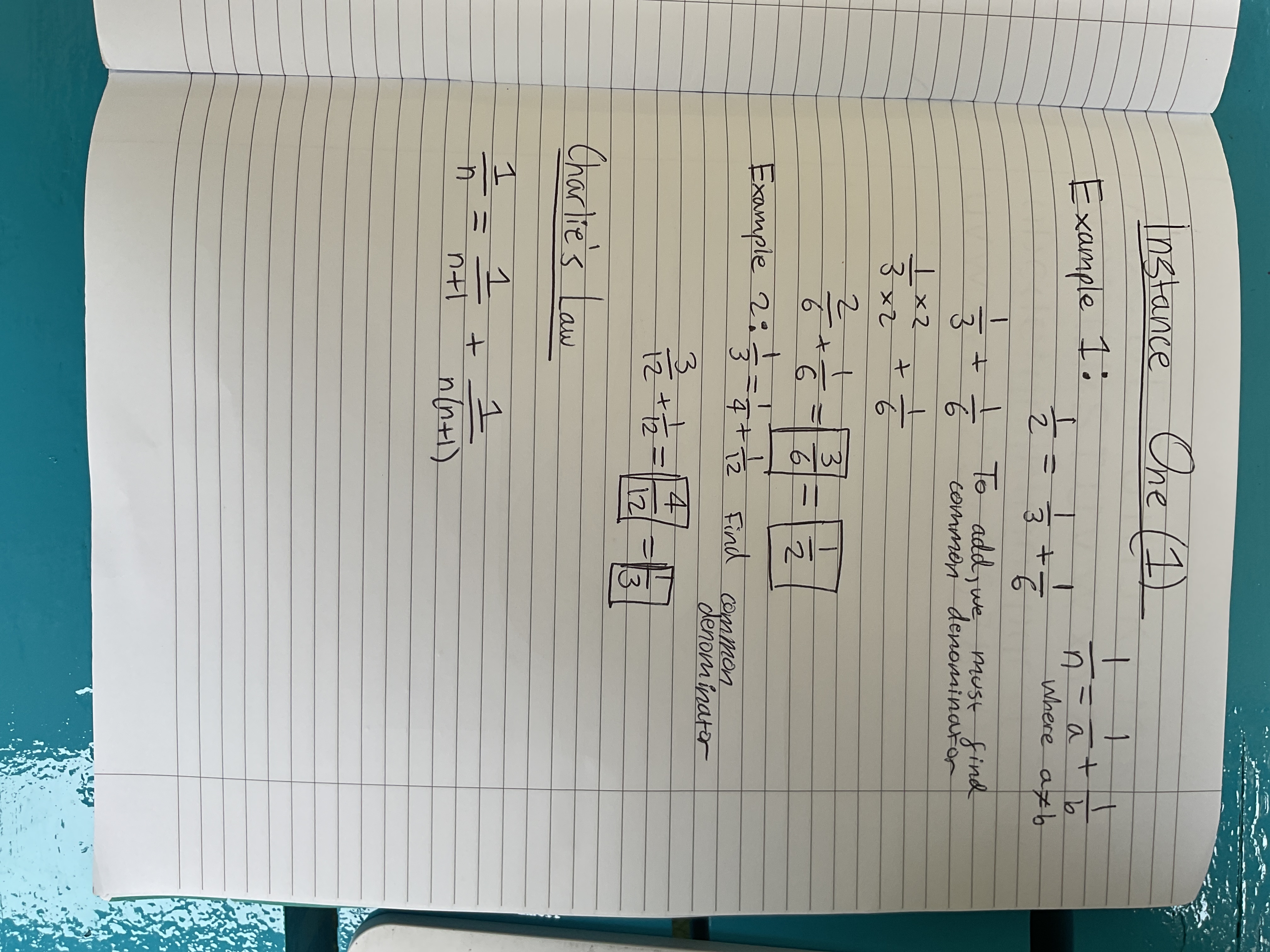
Charlie appears to be taking a unit fraction and expressing it as a sum of two unit fractions, which have denominators of whole positive integers where the two denominators aren’t equal. We can represent this by 1/n = (1/a) + (1/b) where a=/b and an and b are both. First, we must verify Charlie’s examples (shown in file attached below labeled instance 1). Now that we have verified Charlie’s examples, we can analyze for patterns, it appears that the first denominator of the first fraction in the sum is always one more than the denominator of the number we are adding to get, and the second denominator of the second fraction is always the product of the first fraction denominator and the sum denominator. This can be shown as a formula in instance 1 labeled “Charlie’s Law”. Represented as 1/n = (1/n+1) + 1/n(n+1)). Following this rule, we can generate new examples with absurdly large numbers, take for example 1/678. We can figure out the sum using fractions by following the formula. First we generate a fraction of 1/n+1 so we get 1/679. Then we generate the second fraction 1/n(n+1) which is 1/460362. In summary we get the sum, (1/679) + (1/460362 which is equal to 1/678. We can also verify this with a calculator. Overall, we can generate the sum of a unit fraction using more unit fractions by following this rule, of 1/n = (1/n+1) + 1/n(n+1)).
Solution
Keep It Simple Mohammad Rayyan
Problem / game
First name
Mohammad Rayyan
School
Doha College
School's Twitter handle
@DohaCollege
Country
Age
14
File