A Chance to Win?
Imagine you were given the chance to win some money... and imagine you had nothing to lose...

Can you find the values at the vertices when you know the values on the edges?
Caroline and James pick sets of five numbers. Charlie tries to find three that add together to make a multiple of three. Can they stop him?
Choose four consecutive whole numbers. Multiply the first and last numbers together. Multiply the middle pair together. What do you notice?
Have a go at creating these images based on circles. What do you notice about the areas of the different sections?
Explore when it is possible to construct a circle which just touches all four sides of a quadrilateral.
Here is a machine with four coloured lights. Can you make two lights switch on at once? Three lights? All four lights?
Imagine a room full of people who keep flipping coins until they get a tail. Will anyone get six heads in a row?
Have you ever wondered what it would be like to race against Usain Bolt?
When two closely matched teams play each other, what is the most likely result?
Some students have been working out the number of strands needed for different sizes of cable. Can you make sense of their solutions?
Is it the fastest swimmer, the fastest runner or the fastest cyclist who wins the Olympic Triathlon?
Surprising numerical patterns can be explained using algebra and diagrams...
Can you find a general rule for finding the areas of equilateral triangles drawn on an isometric grid?
A mother wants to share some money by giving each child in turn a lump sum plus a fraction of the remainder. How can she do this to share the money out equally?
Many numbers can be expressed as the difference of two perfect squares. What do you notice about the numbers you CANNOT make?
Each of the following shapes is made from arcs of a circle of radius r. What is the perimeter of a shape with 3, 4, 5 and n "nodes".
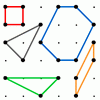
Polygons drawn on square dotty paper have dots on their perimeter (p) and often internal (i) ones as well. Find a relationship between p, i and the area of the polygons.
Imagine a large cube made from small red cubes being dropped into a pot of yellow paint. How many of the small cubes will have yellow paint on their faces?
Pick a square within a multiplication square and add the numbers on each diagonal. What do you notice?
Can you work out the fraction of the original triangle that is covered by the inner triangle?
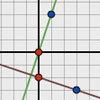
Position the lines so that they are perpendicular to each other. What can you say about the equations of perpendicular lines?
If the hypotenuse (base) length is 100cm and if an extra line splits the base into 36cm and 64cm parts, what were the side lengths for the original right-angled triangle?
Charlie has moved between countries and the average income of both has increased. How can this be so?
Can you decide whether two lines are perpendicular or not? Can you do this without drawing them?
Two boats travel up and down a lake. Can you picture where they will cross if you know how fast each boat is travelling?
I took the graph y=4x+7 and performed four transformations. Can you find the order in which I could have carried out the transformations?
Use the animation to help you work out how many lines are needed to draw mystic roses of different sizes.