Product Sudoku
The clues for this Sudoku are the product of the numbers in adjacent squares.
These hands-on activities are ideal for students aged 14-16 to explore in maths clubs.
The clues for this Sudoku are the product of the numbers in adjacent squares.
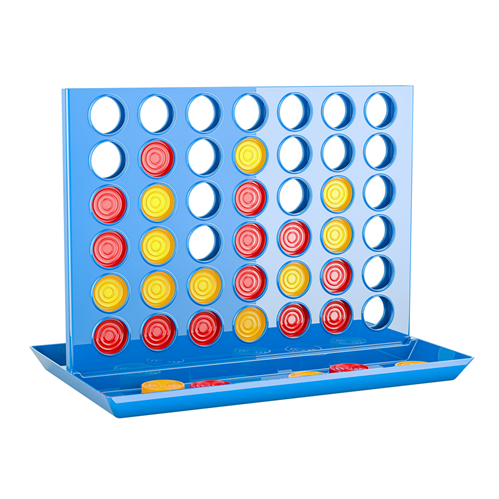
In this game the winner is the first to complete a row of three. Are some squares easier to land on than others?

A game for 2 players. Set out 16 counters in rows of 1,3,5 and 7. Players take turns to remove any number of counters from a row. The player left with the last counter looses.
Using the digits 1, 2, 3, 4, 5, 6, 7 and 8, mulitply a two two digit numbers are multiplied to give a four digit number, so that the expression is correct. How many different solutions can you find?
Can you use small coloured cubes to make a 3 by 3 by 3 cube so that each face of the bigger cube contains one of each colour?
Can you find a strategy that ensures you get to take the last biscuit in this game?
Four friends must cross a bridge. How can they all cross it in just 17 minutes?
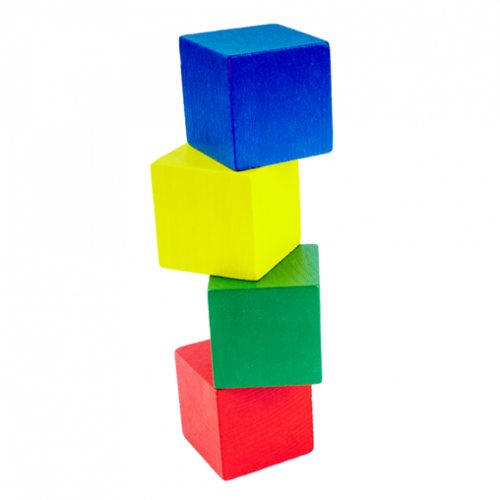
Given the nets of 4 cubes with the faces coloured in 4 colours, build a tower so that on each vertical wall no colour is repeated.
In 15 years' time my age will be the square of my age 15 years ago. Can you work out my age, and when I had other special birthdays?
Choose four consecutive whole numbers. Multiply the first and last numbers together. Multiply the middle pair together. What do you notice?
How have "Warmsnug" arrived at the prices shown on their windows? Which window has been given an incorrect price?
Have a go at creating these images based on circles. What do you notice about the areas of the different sections?
In this problem we are faced with an apparently easy area problem, but it has gone horribly wrong! What happened?
Many numbers can be expressed as the difference of two perfect squares. What do you notice about the numbers you CANNOT make?
Take any prime number greater than 3 , square it and subtract one. Working on the building blocks will help you to explain what is special about your results.
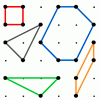
Polygons drawn on square dotty paper have dots on their perimeter (p) and often internal (i) ones as well. Find a relationship between p, i and the area of the polygons.
Imagine a large cube made from small red cubes being dropped into a pot of yellow paint. How many of the small cubes will have yellow paint on their faces?
There are unexpected discoveries to be made about square numbers...
A 2-digit number is squared. When this 2-digit number is reversed and squared, the difference between the squares is also a square. What is the 2-digit number?
Which has the greatest area, a circle or a square, inscribed in an isosceles right angle triangle?
Can you rearrange the cards to make a series of correct mathematical statements?
Can you make sense of the three methods to work out what fraction of the total area is shaded?