Swimming Pool
In this problem, we're investigating the number of steps we would climb up or down to get out of or into the swimming pool. How could you number the steps below the water?
This is part of our collection of favourite rich tasks arranged by topic.
If you are a teacher, you can find the whole collection on our Primary Curriculum teacher page.
Alternatively, if you are a student, you'll find the same problems on our Primary Curriculum student page.
In this problem, we're investigating the number of steps we would climb up or down to get out of or into the swimming pool. How could you number the steps below the water?
There are six numbers written in five different scripts. Can you sort out which is which?
Put operations signs between the numbers 3, 4, 5 and 6 to make the highest possible number and lowest possible number.
Would you rather: Have 10% of £5 or 75% of 80p? Be given 60% of 2 pizzas or 26% of 5 pizzas?
Which is quicker, counting up to 30 in ones or counting up to 300 in tens? Why?
Each child in Class 3 took four numbers out of the bag. Who had made the highest even number?
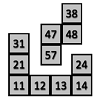
These sixteen children are standing in four lines of four, one behind the other. They are each holding a card with a number on it. Can you work out the missing numbers?
Can you complete this jigsaw of the multiplication square?
Add or subtract the two numbers on the spinners and try to complete a row of three. Are there some numbers that are good to aim for?
In this game, you can add, subtract, multiply or divide the numbers on the dice. Which will you do so that you get to the end of the number line first?
What numbers would you put on this number line as it goes under the sea level?
Can you put the numbers 1-5 in the V shape so that both 'arms' have the same total?
There are nasty versions of this dice game but we'll start with the nice ones...
Look at some of the results from the Olympic Games in the past. How do you compare if you try some similar activities?
This activity involves rounding four-digit numbers to the nearest thousand.
What happens when you round these numbers to the nearest whole number?
What happens when you round these three-digit numbers to the nearest 100?
Use two dice to generate two numbers with one decimal place. What happens when you round these numbers to the nearest whole number?
Can you find some examples when the number of Roman numerals is fewer than the number of Arabic numerals for the same number?
Find as many different ways of representing this number of dots as you can.
Use your knowledge of place value to try to win this game. How will you maximise your score?
Can you see how these factor-multiple chains work? Find the chain which contains the smallest possible numbers. How about the largest possible numbers?
Have a look at the results for some events at past Olympic Games. Can you use these to predict the results at the next Olympics?
In these addition and subtraction games, you'll need to think strategically to get closest to the target.
An investigation involving adding and subtracting sets of consecutive numbers. Lots to find out, lots to explore.
Four strategy dice games to consolidate pupils' understanding of rounding.
In these multiplication and division games, you'll need to think strategically to get closest to the target.
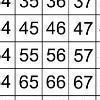
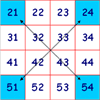
In this 100 square, look at the green square which contains the numbers 2, 3, 12 and 13. What is the sum of the numbers that are diagonally opposite each other? What do you notice?
Take three consecutive numbers and add them together. What do you notice?
Some of the numbers have fallen off Becky's number line. Can you figure out what they were?