

Strike It Out

 1 out of 3
This game involves addition and subtraction skills combined with some strategic thinking.
Problem
Watch the video below which shows two people playing the first few turns of a game.
What do you notice?
What do you want to ask?
Watch the video a second time.
Can you work out how to play the game?
What do you think the rules might be?
How might someone win the game?
If you are unable to view the video, the rules of the game are hidden below.
Rules
The aim of the game:
The player who stops their opponent from being able to go wins the game.
How to play:
- Start by drawing a number line from 0 to 20 like this, or print off a sheet of number lines:

- The first player chooses two numbers on the line and crosses them out. Then they circle the sum or difference of the two numbers and they write down the calculation.
For example, the first player's turn could look like this:

- The second player must start by crossing off the number that Player 1 has just circled. They then choose another number to cross out and then circle a third number which is the sum or difference of the two crossed-off numbers. Player 2 also writes down their calculation.
For example, once the second player has had a turn, the game could look like this:
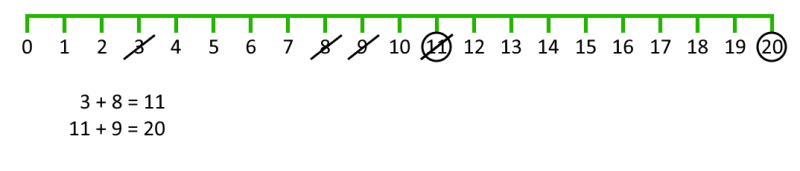
- Play continues in this way with each player starting with the number that has just been circled.
- Once a number has been used in a calculation, it cannot be used again.
- The game ends when one player cannot make a calculation. The other player is the winner.
It's your turn!
Try playing the game against someone else a few times to get a feel for it.
Do you have any good ways of winning?
Now it's time to work together with a partner, rather than against them.
Try to create a string of calculations that uses as many numbers as possible on the 0-20 number line.
Is it possible to create a string of number sentences that uses all the numbers on the 0-20 number line? Why or why not? How would you convince a mathematician?
Once you've had a good think about it, you may like to look at this proof that has been scrambled up.
Can you rearrange it into its original order?
If you would prefer to work away from a screen, you could print off, cut up and rearrange the statements. (This sheet includes three copies of each statement.)
What about the 1-20 number line? Is it possible to create a string of number sentences that uses all the numbers on the 1-20 number line? Why or why not? How would you convince a mathematician?
Again, once you have thought about it, you may like to look at this proof that has been scrambled up.
Can you rearrange it into its original order?
If you would prefer to work away from a screen, you could print off, cut up and rearrange the statements. (This sheet includes two copies of each statement.)
Getting Started
It's a good idea to play the game lots of times to start with to get the feel of it.
You could keep the lines you use for each game and compare them afterwards.
Are there any numbers that you haven't crossed off in any of the games you've played on the 0-20 number line? Will it ever be possible to cross them off?
When you come to consider the 1-20 number line, have a think about the total number of numbers you use in a game.
Student Solutions
Thank you to those of you who submitted comments about this game.
Anika from Holy Family Catholic Primary School in Boothstown, Manchester suggested the following rules:
- The answer from the previous calculation should be the answer to the next one
- You can only use each number once
- Player A uses addition and Player B uses subtraction, and this pattern follows throughout the game
- The aim of the game is to stop the other player from getting a calculation from the remaining numbers
Thank you, Anika! Jake said:
- Player A does a calculation using numbers 0-20. They cross off the numbers they use but circle the answer.
- Player B then uses the answer of player A's calculation to start their number sentence.
- Each player can decide whether they would like to add or subtract.
- The player who cannot make a calculation from the numbers remaining loses the game.
So, it seems that Anika and Jake were largely in agreement. Anika, it does look like the order of calculations goes addition, subtraction, addition, subtraction etc from what we see in the video, you're right. However, I would suggest that the order doesn't matter. (You can read our suggested rules by clicking on the 'Show' button underneath the video on the problem page itself.)
Eleanor from Cottenham Primary School told us:
Good ways to win are to try and use up the numbers 1, 2, 3, 4 and possibly 5 and 6, because you can get to many different numbers by adding those whereas with the larger numbers you cannot get to so many because you can only go up to the number 20.
Eleanor also went on to explore the cooperative challenges. She says:
We can't use all of the numbers because:
For the number line going from 0 to 20, you cannot use zero as you wouldn't be adding or taking away anything so you would stay on the same number.
Yes, Eleanor, if you add zero, or take away zero, from a number, the answer to your calculation is the same number, so you would need to be able to use a number more than once and the rules don't allow this.
For the number line going from 1 to 20, you cannot use all the numbers because there will always be one number left over.
Each new calculation uses two new numbers apart from the first calculation which uses three so if you keep adding two to three you will always be on odd numbers and 20 is an even number, not odd.
Thank you, Eleanor, what great reasoning. Can you follow Eleanor's argument?
Teachers' Resources
Using NRICH Tasks Richly describes ways in which teachers and learners can work with NRICH tasks in the classroom.
Why play this game?
This game offers an engaging context for practising addition and subtraction, but it also requires some strategic thinking. The collaborative version provides a fantastic opportunity for learners to reason mathematically, and to experience proof.
The game also offers the chance to focus on any of the five key ingredients that characterise successful mathematicians. The collaborative version lends itself particularly to fostering a positive attitude to mathematics as learners' resilience may be tested!
Possible approach
This problem featured in an NRICH Primary webinar in October 2020.
Show the video to the group, explaining that there is no sound as such and inviting them to think about what they notice and what they want to ask. (You could click through this powerpoint presentation one 'go' at a time if you cannot access the video.) Having watched it once, give them an opportunity to talk to a partner and then collect some of their questions and 'noticings' on the board. Encourage other members of the class to respond rather than you. Before playing the video a second time, explain that as they're watching, you'd like them to consider what the rules of the game might be. Mediate a discussion following the second viewing so that the class comes to an agreement about the rules of the game and how a player wins.
Give children time to play several games in pairs so they get a feel for it, perhaps on some printable number lines. Share some of their strategies and then ask them whether they think it might be possible to cross off all the numbers in a game. Give them time to work co-operatively with their partner on this challenge before bringing them together again to see what they have found out. You could find out whether, for example, any pairs have used more than half the numbers. More than fifteen numbers? Given enough time, do they think they could find a way to use all the numbers? Some will have realised that it is impossible to cross off zero - encourage them to explain why this is the case. To give them an example of the kind of reasoning that constitutes a proof, you could share this proof sorter with them. It includes all the steps to create a watertight chain of reasoning, but muddled up. The challenge is to put the statements in the correct order. (If you would prefer learners to be working away from a screen, you could print off and cut up copies of the proof sorter statements.)
Learners could then investigate whether it is possible to use all the numbers if the number line goes from 1 to 20 instead. Give them chance to explore this new scenario in pairs. Many will be able to reason that it is still not possible due to there being an even number of numbers in total. Again, you could work on this proof sorter as a class, ordering the statements to help learners get to grips with the idea of proof. (Alternatively, you could print off the proof sorter statements.)
Key questions
Have you found any good ways to beat your opponent?
Can you cross out all the numbers in one game? How do you know?
What is the biggest number of numbers you can cross out?
Possible support
If children are struggling with the calculations, a shorter number line may be appropriate so focusing on a number line to 10 still elicits many of the same ideas about possibilities and outcomes as well as the way in which the operations of addition and subtraction work on a limited set of numbers.
Possible extension
Can children reason whether it would be possible to use all the numbers on any number line of consecutive numbers? (They may like to unscramble this proof sorter, or use a printed copy of the proof sorter statements.)
Children can suggest their own 'what if ...?' questions, for example:
What if we could use multiplication/division?
What if we drew a longer number line?
What would happen if we included decimal numbers in our number line?
What if the number line extended beyond zero to negative numbers?
The possibilities are endless but do make sure they try out their new version of the game to check it is a 'good' game.
The Highland Numeracy Team in Scotland kindly shared with us some ideas for adapting Strike it Out. Some variations include the use of concrete materials suited to the version of the game, such as tens frames, Dienes, or place value counters.