Abundant Numbers
48 is called an abundant number because it is less than the sum of its factors (without itself). Can you find some more abundant numbers?
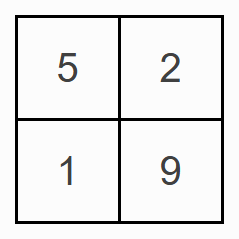
Can you work out the arrangement of the digits in the square so that the given products are correct? The numbers 1 - 9 may be used once and once only.
Can you replace the letters with numbers? Is there only one solution in each case?
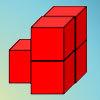
How can you arrange the 5 cubes so that you need the smallest number of Brush Loads of paint to cover them? Try with other numbers of cubes as well.
What happens when you round these numbers to the nearest whole number?
This task offers opportunities to subtract fractions using A4 paper.
Can you go through this maze so that the numbers you pass add to exactly 100?
The ancient Egyptians were said to make right-angled triangles using a rope with twelve equal sections divided by knots. What other triangles could you make if you had a rope like this?
On my calculator I divided one whole number by another whole number and got the answer 3.125. If the numbers are both under 50, what are they?
Can you draw a square in which the perimeter is numerically equal to the area?
Katie had a pack of 20 cards numbered from 1 to 20. She arranged the cards into 6 unequal piles where each pile added to the same total. What was the total and how could this be done?
Mrs Morgan, the class's teacher, pinned numbers onto the backs of three children. Use the information to find out what the three numbers were.
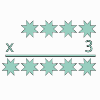
This multiplication uses each of the digits 0 - 9 once and once only. Using the information given, can you replace the stars in the calculation with figures?
Choose four different digits from 1-9 and put one in each box so that the resulting four two-digit numbers add to a total of 100.
Can you make square numbers by adding two prime numbers together?
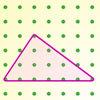
Use the interactivity to find all the different right-angled triangles you can make by just moving one corner of the starting triangle.
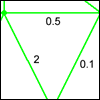
Find the product of the numbers on the routes from A to B. Which route has the smallest product? Which the largest?
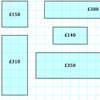
My local DIY shop calculates the price of its windows according to the area of glass and the length of frame used. Can you work out how they arrived at these prices?
This task combines spatial awareness with addition and multiplication.
Nine squares with side lengths 1, 4, 7, 8, 9, 10, 14, 15, and 18 cm can be fitted together to form a rectangle. What are the dimensions of the rectangle?
Can you order the digits from 1-3 to make a number which is divisible by 3 so when the last digit is removed it becomes a 2-figure number divisible by 2, and so on?
What is the largest 'ribbon square' you can make? And the smallest? How many different squares can you make altogether?