Strike It Out
Use your addition and subtraction skills, combined with some strategic thinking, to beat your partner at this game.
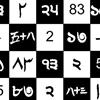
There are six numbers written in five different scripts. Can you sort out which is which?
What is the greatest number of counters you can place on the grid below without four of them lying at the corners of a square?
Place the numbers from 1 to 9 in the squares below so that the difference between joined squares is odd. How many different ways can you do this?
Have a look at this table of how children travel to school. How does it compare with children in your class?
Can you predict when you'll be clapping and when you'll be clicking if you start this rhythm? How about when a friend begins a new rhythm at the same time?
Can you put the numbers 1-5 in the V shape so that both 'arms' have the same total?
What happens when you add the digits of a number then multiply the result by 2 and you keep doing this? You could try for different numbers and different rules.
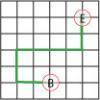
Tom and Ben visited Numberland. Use the maps to work out the number of points each of their routes scores.
Class 5 were looking at the first letter of each of their names. They created different charts to show this information. Can you work out which member of the class was away on that day?
Take a look at these data collected by children in 1986 as part of the Domesday Project. What do they tell you? What do you think about the way they are presented?
In this game the winner is the first to make the total 37. Is this a fair game?
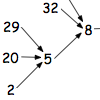
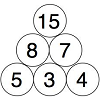
Can you find all the ways to get 15 at the top of this triangle of numbers? Many opportunities to work in different ways.
Investigate the different numbers of people and rats there could have been if you know how many legs there are altogether!
Choose the size of your pegboard and the shapes you can make. Can you work out the strategies needed to block your opponent?
An investigation involving adding and subtracting sets of consecutive numbers. Lots to find out, lots to explore.
A game for two people, or play online. Given a target number, say 23, and a range of numbers to choose from, say 1-4, players take it in turns to add to the running total to hit their target.