Trigonometric functions and graphs

  • Small Steps
    problem

    Small steps

    Age
    16 to 18
    Challenge level
    filled star empty star empty star
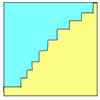
    Two problems about infinite processes where smaller and smaller steps are taken and you have to discover what happens in the limit.
  • Climbing
    problem

    Climbing

    Age
    16 to 18
    Challenge level
    filled star empty star empty star
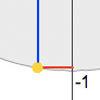
    Sketch the graphs of y = sin x and y = tan x and some straight lines. Prove some inequalities.
  • Sine and Cosine
    problem

    Sine and cosine

    Age
    14 to 16
    Challenge level
    filled star empty star empty star
    The sine of an angle is equal to the cosine of its complement. Can you explain why and does this rule extend beyond angles of 90 degrees?
  • Trigger
    problem

    Trigger

    Age
    16 to 18
    Challenge level
    filled star filled star empty star
    Can you sketch this tricky trig function?
  • Squareness
    problem

    Squareness

    Age
    16 to 18
    Challenge level
    filled star filled star filled star
    The family of graphs of x^n + y^n =1 (for even n) includes the circle. Why do the graphs look more and more square as n increases?
  • Spherical triangles on very big spheres
    problem

    Spherical triangles on very big spheres

    Age
    16 to 18
    Challenge level
    filled star filled star filled star
    Shows that Pythagoras for Spherical Triangles reduces to Pythagoras's Theorem in the plane when the triangles are small relative to the radius of the sphere.
  • Trig-trig
    problem

    Trig-trig

    Age
    16 to 18
    Challenge level
    filled star filled star filled star
    Explore the properties of combinations of trig functions in this open investigation.
  • Back fitter
    problem

    Back fitter

    Age
    14 to 18
    Challenge level
    filled star filled star empty star

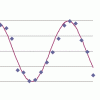
    10 graphs of experimental data are given. Can you use a spreadsheet to find algebraic graphs which match them closely, and thus discover the formulae most likely to govern the underlying processes?